DDR5 RAM Shortage: Global Overview in July 2026 - prices multiplied by 4 to 5, and a market that is fracturing

DDR5 shortage 2026 DDR5 RAM price whereismyram

Ten months of shortage, 215,000 price surveys, 9 markets monitored. DDR5 now costs x4 to x5 its pre-crisis price. The United States finally lags behind, while Europe breaks its records. Complete analysis by DropReference.

Quick summary of the article

Ten months after the start of the shortage, DDR5 is priced between 4 and 5 times its September 2025 price depending on the country. And for the first time since the crisis began, trajectories are diverging: the United States is finally experiencing a real easing (x4.1 after peaking at x4.6 in March), the United Kingdom remains the hardest-hit market (close to x5), while Europe and Australia are breaking their historical records right now. The 2x16 GB 6000 CL30 kit, a gamer's reference, is trading around €620 / $567 compared to €147 / $129 before the crisis. And there is no indication of a return to normalcy before 2027.

How this analysis was built

Since fall 2025, we have been closely monitoring the evolution of the DDR5 shortage. This new analysis is based on the DropReference database, the same one that feeds whereismyram.com , our dedicated DDR5 RAM tracker:

  • more than 1,500 references of DDR5 kits in dual-channel (2x16 GB, 2x32 GB, and 2x64 GB), monitored day after day;
  • more than 215,000 price records between August 2025 and July 2026;
  • the main European markets (France, Germany, Spain, Belgium, Italy, Netherlands), the United Kingdom, the United States and Australia;
  • a wide range of resellers: specialized merchants, major retailers, and marketplaces (Amazon, LDLC, TopAchat, Materiel.net, Alternate, Caseking, PC Componentes, Coolmod, Scan, Overclockers UK, Newegg, BestBuy, etc.).

To objectively compare markets despite currencies, VAT, and different ranges, all prices are brought back to a common base: September 2025 = index 1.0 , just before the onset of the shortage. Each reference is standardized on its own price in September 2025, then the national index is calculated by truncated average (the 10% extreme values on each side are discarded).

The data has been thoroughly cleaned: removal of "scam" offers and survey errors (aberrant prices, isolated peaks deviating by more than 35% from the trend of a reference), and exclusion of obsolete prices when a reference has not been monitored for more than three weeks. The curves presented reflect the market actually accessible to buyers.

Note: the United Kingdom's data has been integrated into our database in January 2026; its curve is connected to the European index at that date. The Australian curve is an estimate built from the European dynamics, calibrated based on our observations from March 2026.

The numbers: September 2025 → July 2026

Before going into the details of the curves, here are the observed price multipliers country by country, from the most affected to the least affected.

Rank Country / Zone Multiplier (Jul. 2026) Peak Reached Current Trend
1 United Kingdom x4.95 x5.28 (mid-March 2026) Back on the rise
2 Spain x4.70 x4.70 (in progress) All-time high record
3 Italy x4.70 x4.70 (in progress) All-time high record
4 Germany x4.69 x4.69 (in progress) All-time high record
5 Netherlands x4.69 x4.69 (in progress) All-time high record
6 France x4.67 x4.67 (in progress) All-time high record
7 Belgium x4.67 x4.67 (in progress) All-time high record
8 Australia ≈ x4.3 ≈ x4.3 (in progress) Continuous increase
9 United States x4.13 x4.60 (mid-March 2026) First real easing
Swipe to view more

Three key lessons stand out:

  1. No market has found reasonable prices. The least affected country remains at more than 4 times pre-crisis prices.
  2. The global market is fracturing. After ten months of perfectly synchronized rise, the United States decouples from the rest of the world: it is the only market showing a clear improvement since spring, with a decline of about 10% since the peak in March.
  3. The expected recovery for 2026 did not happen elsewhere. The United Kingdom remains around x5, and both Europe and Australia are hitting their all-time high at this very moment, after a four-month plateau.

Global evolution: four trajectories, one same disaster

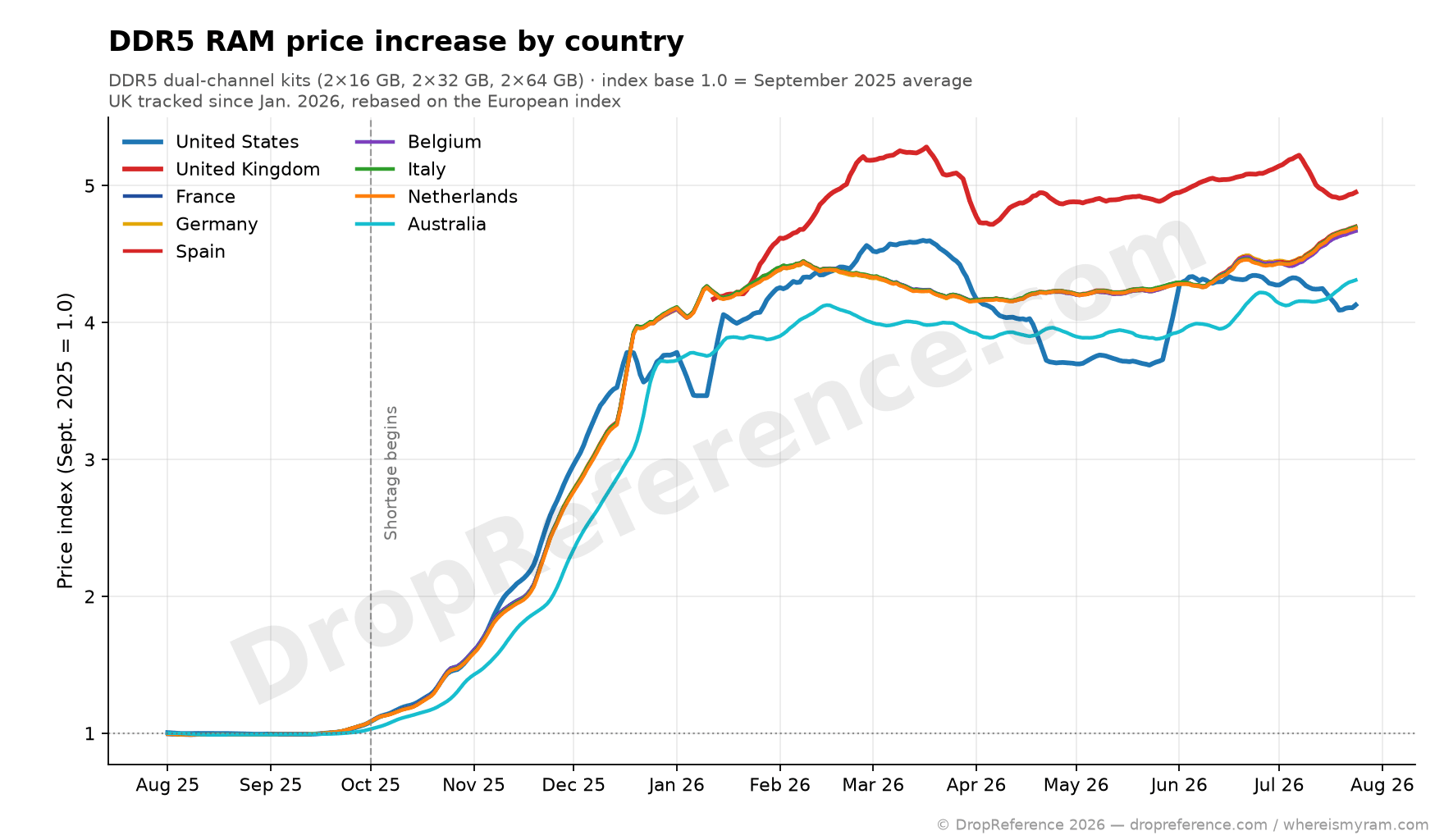
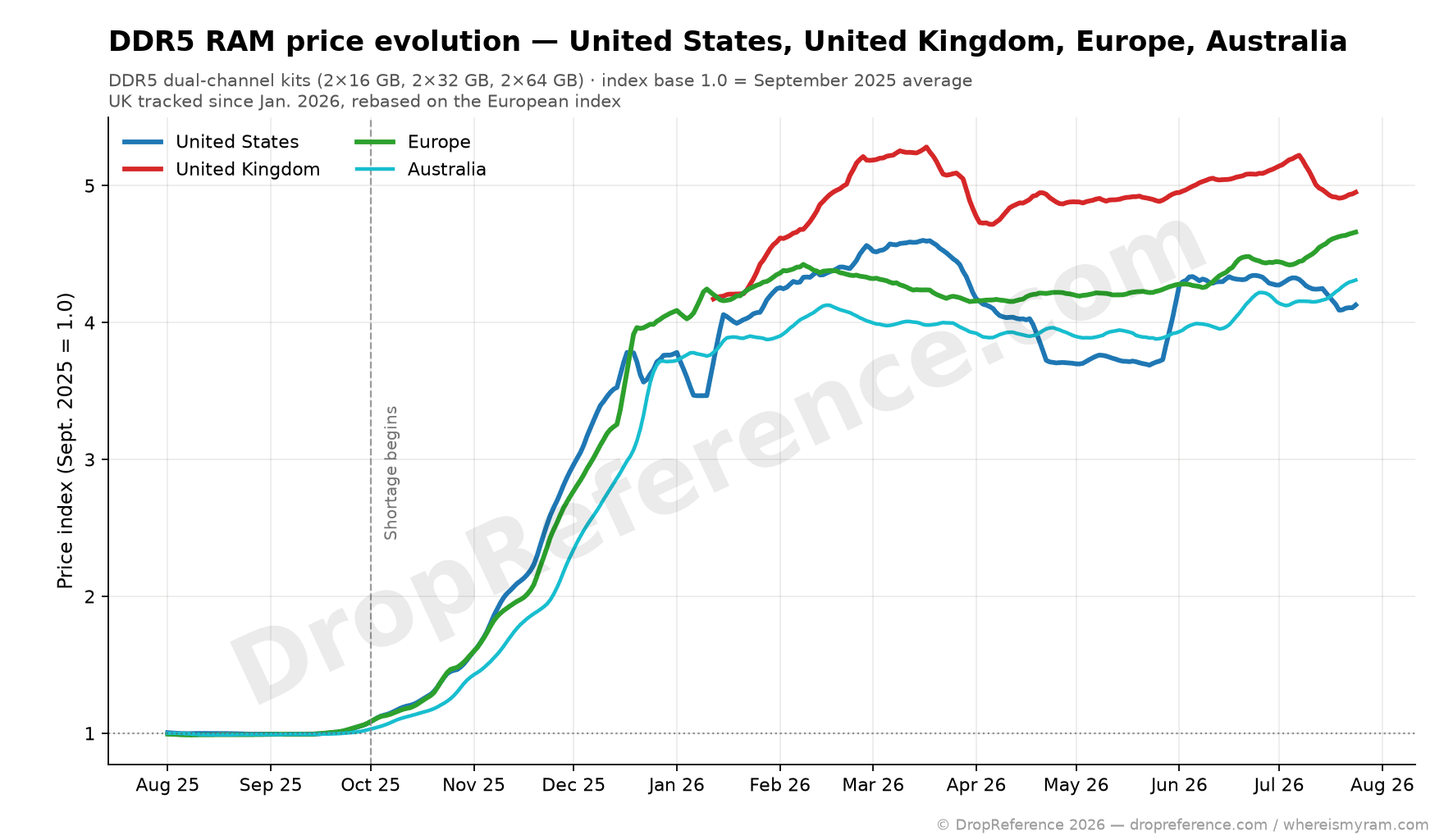
Graphique évolution prix DDR5 monde entier septembre 2025 à juillet 2026 Click to enlarge

This first graph summarizes ten months of crisis:

  • Until early October 2025, prices remain flat, around index 1. The breaking point is sharp and simultaneous in all areas.
  • From October to the end of December 2025, it's an explosion: prices quadruple in less than three months, at a pace almost identical to the United States and Europe.
  • From January to March 2026, the increase continues at a slower pace. The United Kingdom takes the lead and peaks at x5.3 mid-March , the United States to x4.6 .
  • From April 2026, trajectories divergent for the first time since the beginning of the crisis: the United States is experiencing a real decline, Europe remains on its high plateau... before starting to rise again at the end of June.
  • Australia follows the European dynamic with approximately one week delay and slightly less amplitude, around x4.3 today.

The almost perfect synchronization of the initial shock confirms what was written in March: the origin of the problem is not regional but global, linked to the production of DRAM and its priority allocation to data centers and AI.

Focus on Europe: a single market under tension, and a new record

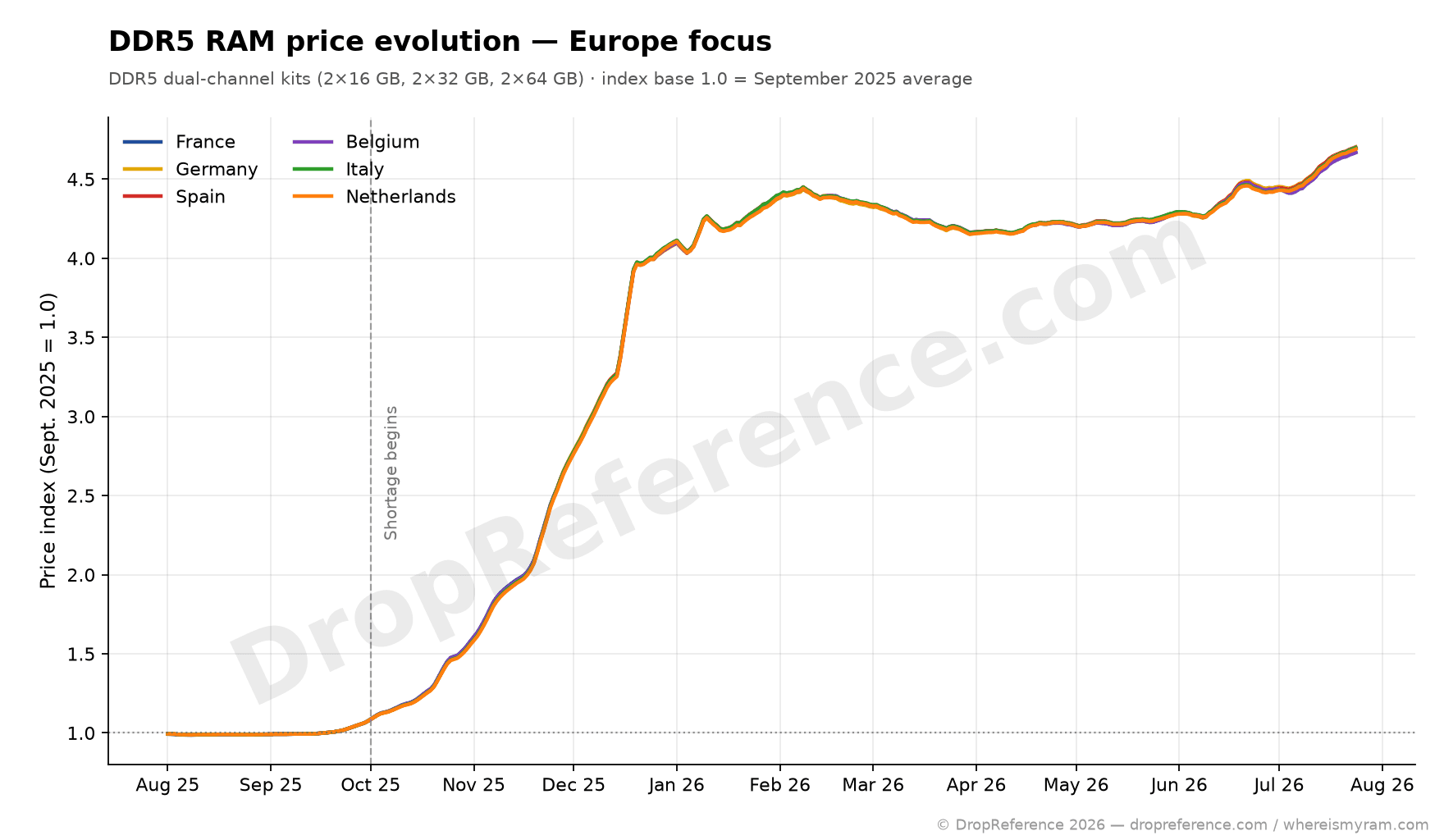
Graphique prix DDR5 focus Europe six pays Click to enlarge

The European focus shows a phenomenon that is still striking: the curves of the six countries are practically superimposed , from x4.67 in France and Belgium to x4.70 in Spain and Italy. The difference between the most expensive and the cheapest country does not exceed 1%.

The eurozone behaves like a single market under tension: price differences do not come from exchange rates or VAT, but only from distribution policies and local stocks — and these differences are now marginal.

The European timeline of 2026 is bitter:

  • January - February : end of the flare phase, the index peaks at ~x4.4;
  • March - June : long plateau between x4.2 and x4.3, with some micro-breaths that could have suggested a lull;
  • end of June - July : new wave of increase , the index breaks through the February ceiling and reaches x4.7 — an absolute record, ongoing at the time of writing these lines.

All countries on the same graph

Graphique hausse prix DDR5 par pays tous marchés Click to enlarge

By superimposing the eight countries followed plus Australia, the overall pattern is clear. All curves follow the same sequence:

  1. stagnation extended before the shortage;
  2. Abrupt takeoff on a window of a few days in early October 2025;
  3. flare-up until January-February 2026;
  4. volatile high plateau in the spring;
  5. and now divergence : American easing on one side, records in Europe and Australia on the other.

No market has escaped the rise. Even historically better-supplied countries have not cushioned the blow.

Timeline: the five phases of shortage

Phase 1 — The calm before the storm (until September 2025)

The 2x16 GB kits are trading between 125 and 210 € in Europe (110 to 160 $ in the United States) depending on the profiles. The 6000 CL30 is king at ~150 € / 130 $, the 32 GB becomes the standard for the PC gamer. No one sees what's next.

Phase 2 — The shock (October - December 2025)

The explosive demand from AI data centers is sucking up the global production of DRAM. Manufacturers are reallocating their lines to server chips (HBM in the lead) at the expense of the general public. In ten weeks, consumer prices quadruple. December 2025 marks the peak of panic, with massive shortages and a proliferation of fraudulent offers.

Phase 3 — The continued surge (January - March 2026)

The increase is slowing down but does not stop. The United Kingdom peaks at x5.3, the United States at x4.6. In Europe, the most sought-after profiles (6000 CL30/CL36) exceed the €550-600 mark.

Phase 4 — The fake plateau (April - June 2026)

European prices are stabilizing around x4.2. Some see this as the beginning of normalization. In the United States, the easing is real: more regular arrivals, clearer corrections, the index falls back to x3.7-4.1 depending on the weeks.

Phase 5 — The global fracture (end of June - July 2026)

The global market no longer moves as a single block. The United States consolidates their decline around x4.1, the United Kingdom fluctuates near x5, while Europe and Australia are on the rise again and break their historical records: x4.7 and ~x4.3 end of July The shortage is not over — it is simply changing its face depending on the continents.

Focus kits DDR5 2x16 GB: the heart of the shortage for gamers

The 32GB (2x16GB) kits remain the most sought-after format: it's the sweet spot of modern gaming and mid/high-end configurations. Here is the breakdown by frequency/latency profile.

Europe: all profiles above €500

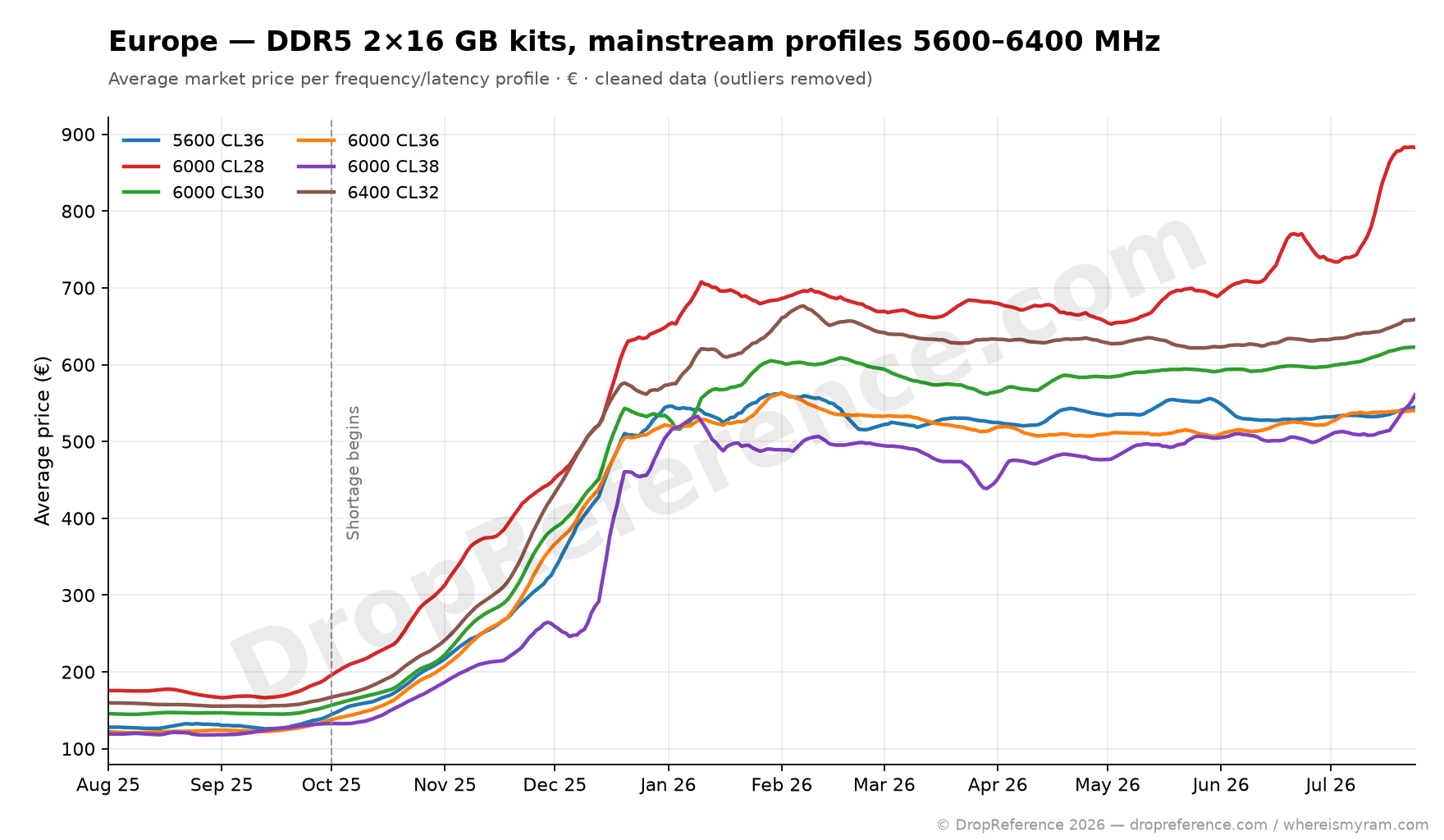
Graphique prix DDR5 2x16 Go profils mainstream Europe Click to enlarge
DDR5 Profile (2x16 GB) Average price Sep. 2025 Average price Jul. 2026 Evolution
5600 MHz CL36 131 € 545 € +316%
6000 MHz CL28 173 € 883 € +410%
6000 MHz CL30 147 € 623 € +324 %
6000 MHz CL36 126 € 540 € +329%
6000 MHz CL38 125 € 561 € +349 %
6400 MHz CL32 158 € 659 € +317 %
Swipe to view more

What mainstream curves show:

  • No more 2x16 GB kit is available for under 500 € , even in entry-level 5600 MHz. Before the shortage, this same kit cost €131.
  • The 6000 CL28 has gone crazy : +410%, to €883 on average, with a new spectacular surge since June. Demand is focusing on this premium profile that has become scarce.
  • The "popular" profiles (6000 CL30, CL36) peaked in February, calmed down slightly in the spring... and have been rising again since the end of June.
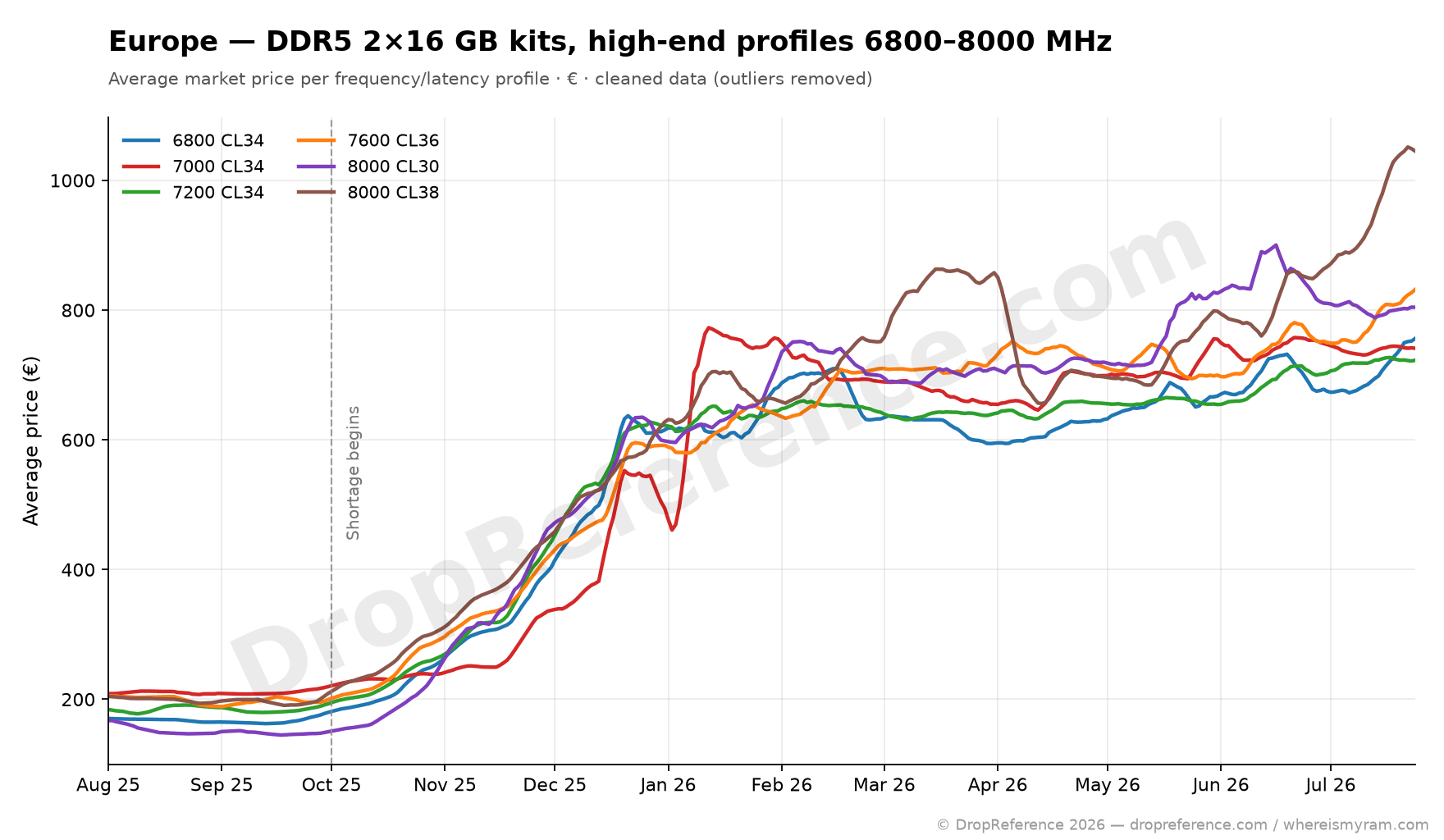
Graphique prix DDR5 2x16 Go profils high-end Europe Click to enlarge
DDR5 Profile (2x16 GB) Average Price Sep. 2025 Average price Jul. 2026 Evolution
6800 MHz CL34 167 € 756 € +353%
7000 MHz CL34 211 € 741 € +251 %
7200 MHz CL34 183 € 723 € +295 %
7600 MHz CL36 197 € 832 € +322 %
8000 MHz CL30 148 € 804 € +443%
8000 MHz CL38 197 € 1 045 € +430 %
Swipe to view more

At the very high end, the situation turns absurd:

  • the 8000 CL38 exceeds €1,000 — for a consumer RAM kit;
  • the 8000 CL30 , technological showcase of overclocking, shows the highest relative increase in the European market (+443%);
  • only the 7000 CL34, already expensive before the crisis, "limits" the damage to +251%.

United States: the first real easing, but prices still tripled

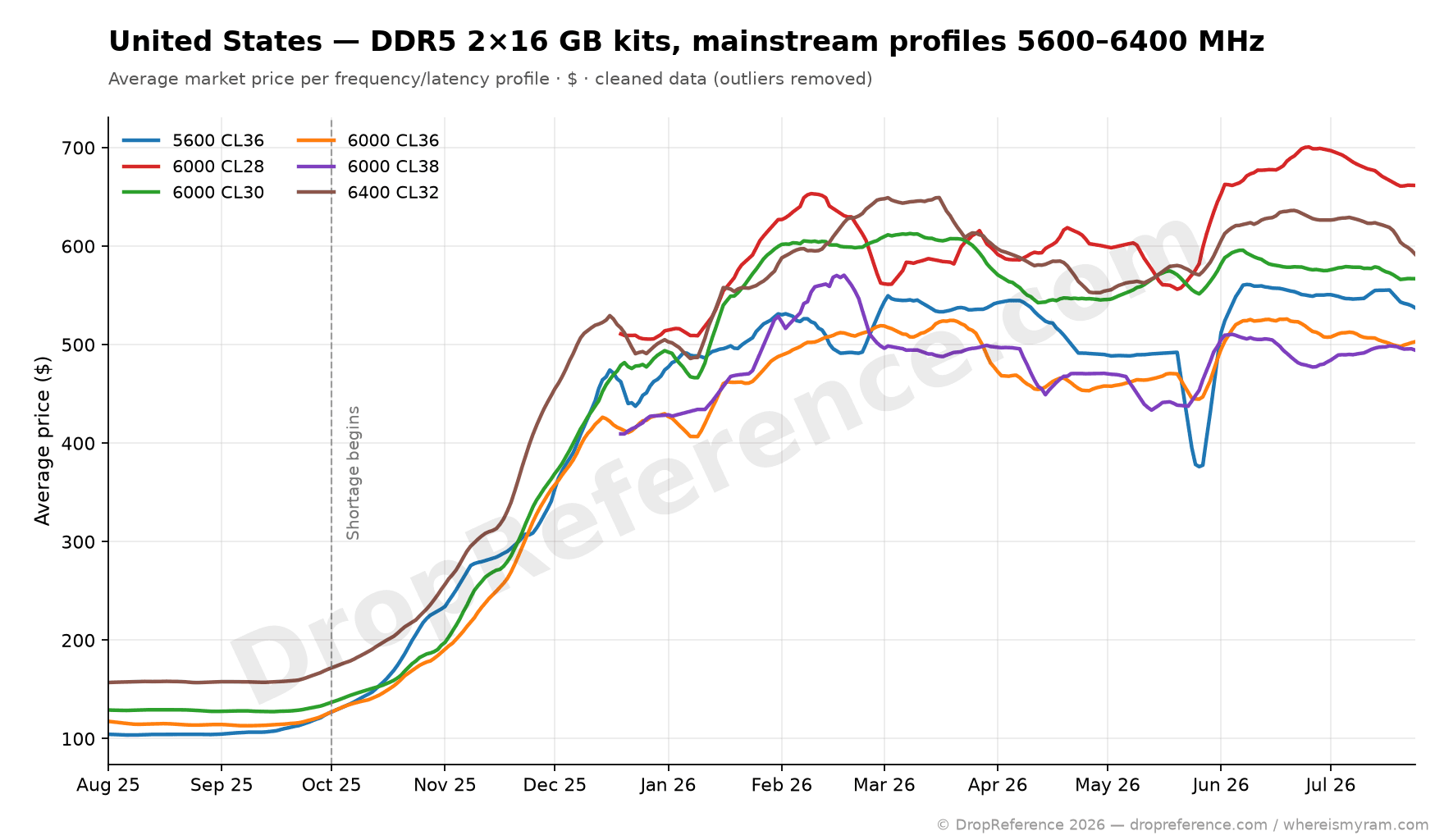
Graphique prix DDR5 2x16 Go profils mainstream États-Unis Click to enlarge
DDR5 Profile (2x16 GB) Average price Sept. 2025 Peak Average price Jul. 2026 Evolution
5600 MHz CL36 111 $ $561 (June) 537 $ +384 %
6000 MHz CL30 129 $ 613 $ (March) 567 $ +340 %
6000 MHz CL36 116 $ $526 (June) 503 $ +334 %
6400 MHz CL32 160 $ $649 (March) $592 +270 %
Swipe to view more

The American market confirms its profile "more reactive but more unstable":

  • the peaks are more violent than in Europe, so are the corrections;
  • the dip in May 2026 (index dropped to x3.7) is explained by a market temporarily emptied of its most expensive references — as soon as they returned to stock at the end of May, the average price of the available market suddenly jumped;
  • since the peak of March, the underlying trend is lowering : this is the first market where we can talk about a beginning of normalization, even if prices remain 3 to 4 times higher than those of 2025.

Why is Europe rising when the United States is falling?

Several factors combine:

  • Allocation priority : available volumes are primarily directed towards the American market, closer to module manufacturers and more responsive to prices;
  • Exchange rate effect and logistics costs weighing on European importers;
  • Stock replenishment : European retailers, wary after the fall of 2025, buy at any price to secure their supplies, which fuels the spiral;
  • Structurally strong demand in Europe on the 32 GB, become the de facto standard for new configurations.

Why the shortage persists: the structural causes have not changed

The fundamentals identified at the end of 2025 are still there, and have even strengthened:

  • AI absorbs all DRAM production. Manufacturers (Samsung, SK hynix, Micron) allocate their capacities to HBM chips and server memory, whose margins are incomparable with the consumer market.
  • The gradual withdrawal of the consumer segment. Crucial's recent refocusing announced at the end of 2025 has reduced the offer dedicated to individuals, and no major player has taken over.
  • No significant new production capacity will come online before 2027. Building a fab takes years; the investments announced in 2026 will not have a short-term effect.
  • The demand from the general public shows no sign of weakening : generalization of 32GB configurations, renewal towards DDR5 platforms, and panic buying that maintains tension.

These factors do not create scarcity: they confirm that it is structural, and not temporary .

Forecasts: what to expect by 2027?

DropReference's opinion, in light of ten months of data:

  • Summer - autumn 2026 : in the United States, the decline that began in March is expected to continue slowly, with fluctuations related to arrivals. In Europe, the United Kingdom, and Australia, no significant decrease is expected: the current upward trend may continue for several more weeks. Micro-promotions will remain the only smart purchasing lever.
  • End 2026 : a global stabilization, or even a slight decrease, is plausible if the American easing is confirmed and spreads to other markets — the American scenario proves that it is possible.
  • 2027 : this is the most realistic horizon for true normalization, provided that the additional promised production capacities actually come into service. A return to 2025 prices, on the other hand, remains very unlikely in the medium term: current levels are becoming the new market reference everywhere in the world.

In short: if you need RAM now, waiting a few weeks probably won't change anything — except maybe in the United States, where the downward trend may reward a little patience. Wait until 2027, perhaps.

How to buy your DDR5 without getting ripped off in 2026

In this context, the displayed price is no longer sufficient to judge an offer. Three essential reflexes:

  1. Check who really sells. Marketplace or direct seller: it changes everything for reliability, after-sales service, and warranty. Scams have multiplied since the start of the shortage, with offers "too good to be true" that actually are.
  2. Compare the price history. A high price may be "normal" in the current context, but a sudden peak on a specific reference deserves to wait a few days.
  3. Expand to equivalent profiles. A 6000 CL36 at 540 € provides almost the same service as a 6000 CL30 at 623 €. And the 6000 CL28 at 883 € objectively is not worth its extra cost for gaming.

WhereIsMyRAM: our tracker dedicated to DDR5

To follow all this in real time, whereismyram.com centralizes all DDR5 offers on a single page: price history by reference and by category, almost real-time prices, delivery times, ratings from third-party sellers. The tracker relies directly on the DropReference database — the same one that was used to build this analysis.

FAQ — Shortage and prices of DDR5 RAM in July 2026

By how much has the price of DDR5 increased since the beginning of the shortage?

Between September 2025 and July 2026, the average price of DDR5 has multiplied by 4.1 to 5 depending on the countries, representing an increase of +310% to +400%. The United Kingdom is close to x5, Europe is at x4.7 (historical record in progress), Australia at ~x4.3, and the United States at x4.1.

Did prices drop in 2026 as some had hoped?

Not for Europe: after a plateau from April to June, prices hit a new record in July. Yes, partially, for the United States: around -10% since the peak of March 2026. This is the first real easing observed since the beginning of the crisis.

Which country is the most affected?

The United Kingdom, with a peak at x5.3 in March 2026 and a current level close to x5. In continental Europe, all countries are between x4.67 and x4.70 — a remarkably homogeneous market.

Have the 32GB (2x16) kits increased more than the others?

They are at the heart of the tension. In Europe, increases range from +251% (7000 CL34) to +443% (8000 CL30). No more 2x16 GB kits are sold for less than €500 in Europe, and the 8000 CL38 now exceeds €1,000.

Should we buy now or wait?

If your need is immediate, buy while monitoring the micro-promotions: there is no indication of a short-term decline in Europe, the United Kingdom, or Australia. In the United States, the downward trend since March may reward a few weeks of patience. If your purchase can wait until 2027, the entry into service of new production capacities could finally ease the market.

Is a return to 2025 prices possible?

Very unlikely in the medium term. Even in the optimistic scenario, current levels become the new market norm, and a decrease would at best bring prices back to x2-x3 compared to 2025.

Analysis and visualizations © DropReference 2026 - data from tracking over 1,500 DDR5 references on dropreference.com and whereismyram.com. Any quotation is allowed provided that the source is clearly mentioned and a link to DropReference is included.