yuux
Co-founder of DropReference, I'm here to give you the best tips to build the gaming PC of your dreams!
yuux
Co-founder of DropReference, I'm here to give you the best tips to build the gaming PC of your dreams!
TurboQuant causes stocks to drop, the media cheers. But DDR5 prices have hardly moved. Let's take stock country by country with real data.
If you follow hardware news, you have definitely seen the big headlines this week: "The DDR5 RAM finally drops!" , Prices drop after TurboQuant . Kotaku, NotebookCheck, Wccftech—everyone got excited. And we understand why: after months of seeing prices triple, any step back feels like a victory.
We had already done a comprehensive review of the DDR5 shortage in March 2026 , with curves by country and price multipliers. This article is the direct sequel. Except this time, we're not just going to relay rumors - we're going to confront the headlines with real market data.
Spoiler: the reality is much less rosy than what the media would have us believe.
On March 25, Google published TurboQuant , a compression algorithm that reduces the memory used by AI model KV caches - up to 6x less RAM for certain inference workflows. On paper, this is huge. Financial markets reacted immediately: Samsung, SK Hynix, and Micron stocks plunged by several percent in one day.
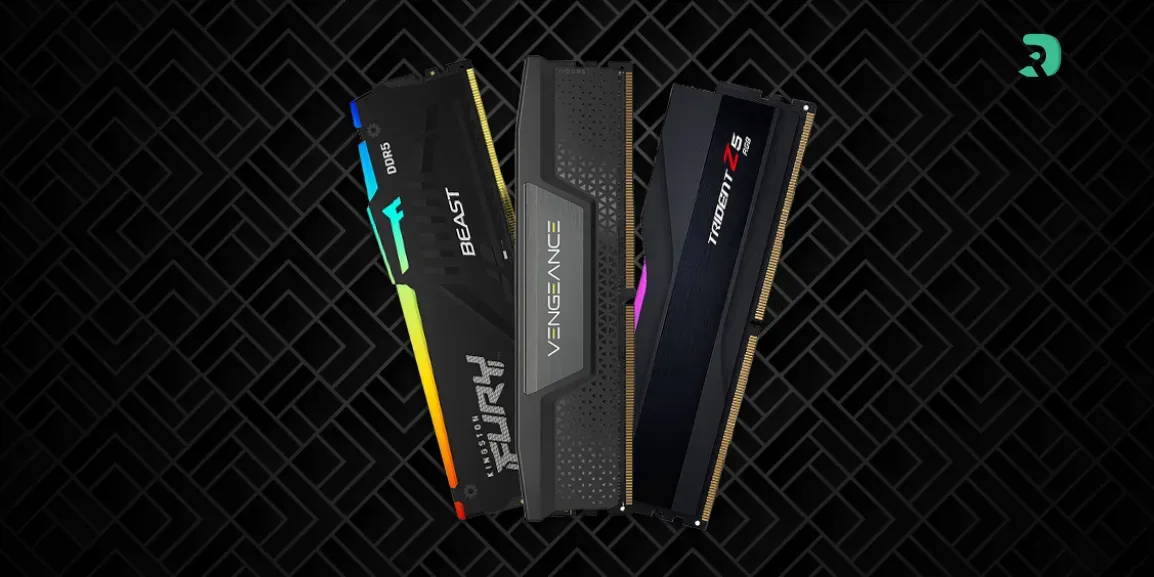
And as stock prices have fallen, some RAM kits have indeed dropped in store. Kotaku reports that the Corsair Vengeance RGB DDR5-6000 32GB has dropped from $409 to $370 , soit $40 less. At the time, it's nice.
But let's put this into perspective. This same Corsair kit? Its lowest historical price is 87$ . We therefore went from $409 to $370... on a product that cost $87 a year ago. Cool.
For those interested, TurboQuant is a compression algorithm without training targeting key-value (KV) caches used during LLM inference. Specifically, it compresses data to ~3 bits per value instead of 32, thanks to two techniques—PolarQuant (conversion to polar coordinates) and QJL (1-bit error correction). Google announces x8 speedups on H100.
The problem? As highlighted by Ben Barringer, analyst at Quilter Cheviot on CNBC: it's "evolutionary, not revolutionary" TurboQuant only touches inference, not training. It does not reduce overall demand for DRAM chips. And above all, there is the Jevons paradox : making AI less RAM-hungry per request means we can run more of it. Likely outcome? Even more demand in the medium term.
Press articles are good. Raw data is better. We went to fetch real-time prices on WhereIsMyRam - a DDR5 tracker that follows prices by country, by category, with 7-day and 30-day trends.
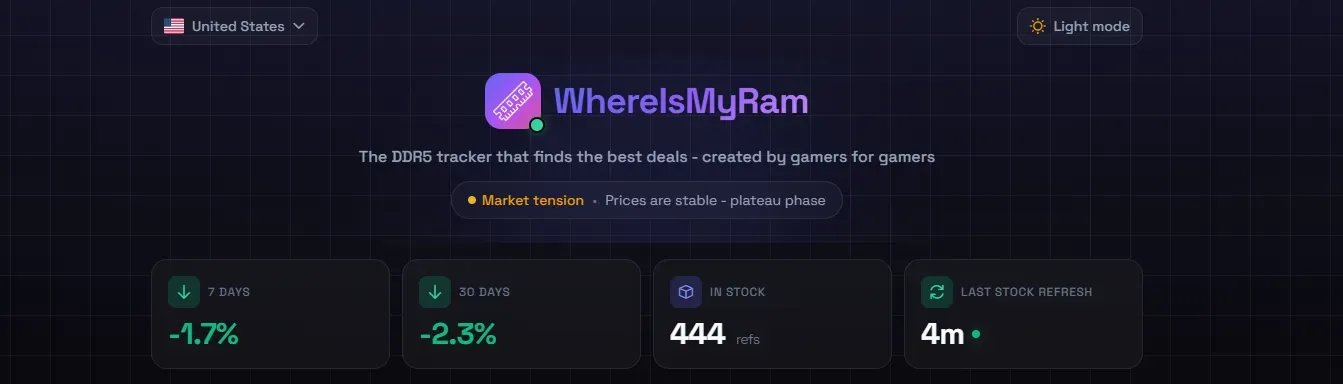
In the USA, the verdict is clear: Prices are stable - plateau phase The tracker displays -1.7% over 7 days and -2.3% over 30 days. It's not a decrease, it's statistical noise on a plateau.
The DDR5 2x16GB 6000 MHz CL30 kit - the gaming sweet spot - starts at 390$ with an average of $529. A year ago, this kind of kit was between $80 and $110. We are talking about a multiplier that still revolves around x3.5 to x4.
 Click to enlarge
444 references in stock only in the US. Before the shortage, there were thousands. The American market remains the most tense in the world, with the combined pressure of AI data centers and the consumer market.
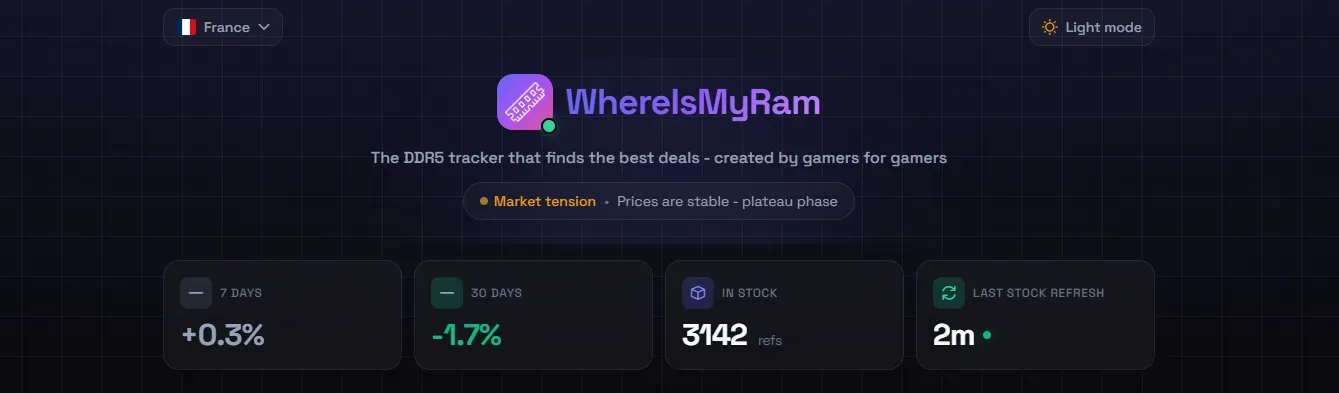
In France, the market shows +0.3% over 7 days and -1.7% over 30 days. In other words: it's stagnating. The best price for a 2x16GB 6000 CL30 kit is at 309€ , with an average of 545€. Reminder: this same type of kit cost between 60 and 80€ in September 2025 at LDLC or Amazon.fr.
3142 references in stock, it's correct compared to the US. The French market benefits from a more diversified network of distributors (LDLC, TopAchat, Materiel.net, Amazon, CDiscount), which maintains a little more competition.
 Click to enlarge
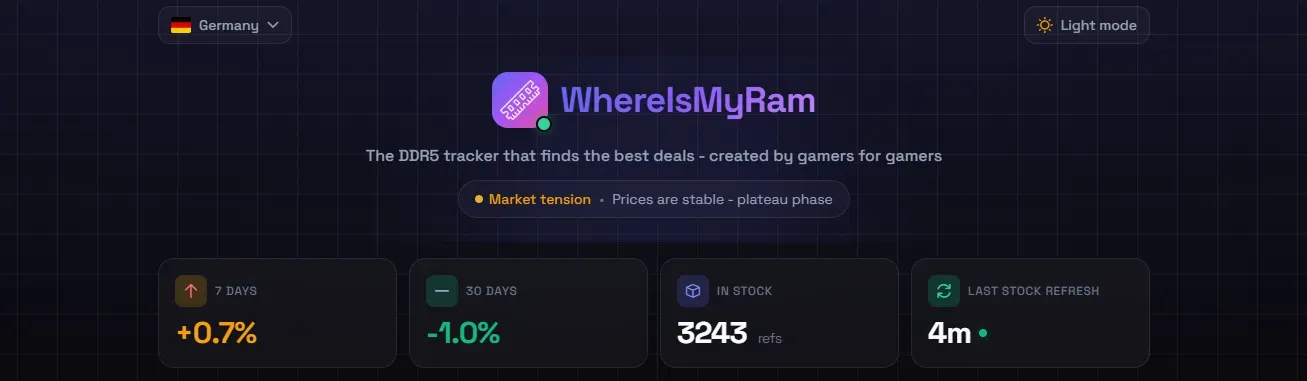
Germany, historically the cheapest market in Europe, shows +0.7% over 7 days and -1.0% over 30 days. Prices are almost identical to France: €309 minimum at 6000 CL30, 339€ at 6000 CL36. With 3243 refs in stock, it is the best-supplied European market. But even here, the "drop" is a mirage.
 Click to enlarge
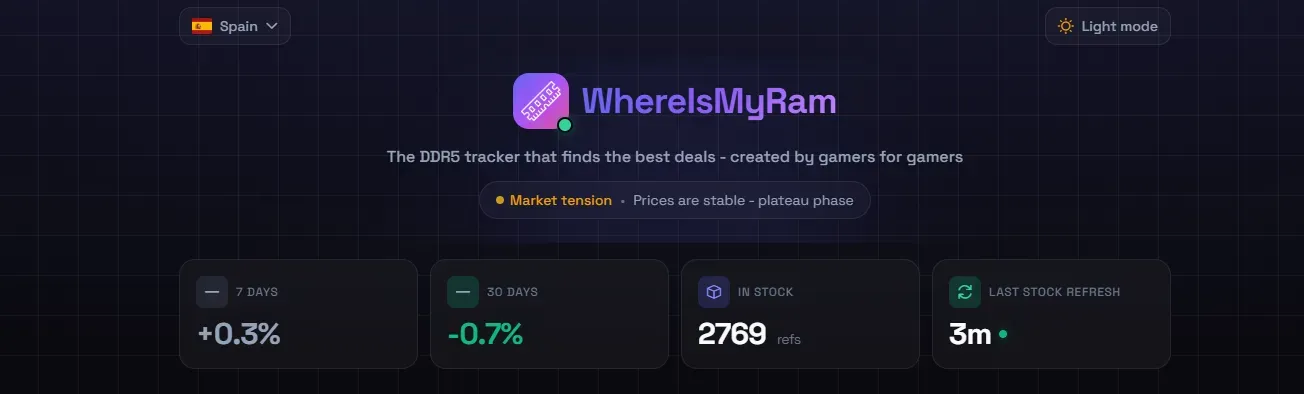
Spain is following exactly the same trend: +0.3% over 7 days, -0.7% over 30 days. The CL30 6000 MHz is at a minimum of 309€. 2769 refs. No surprises, no real decrease.
 Click to enlarge
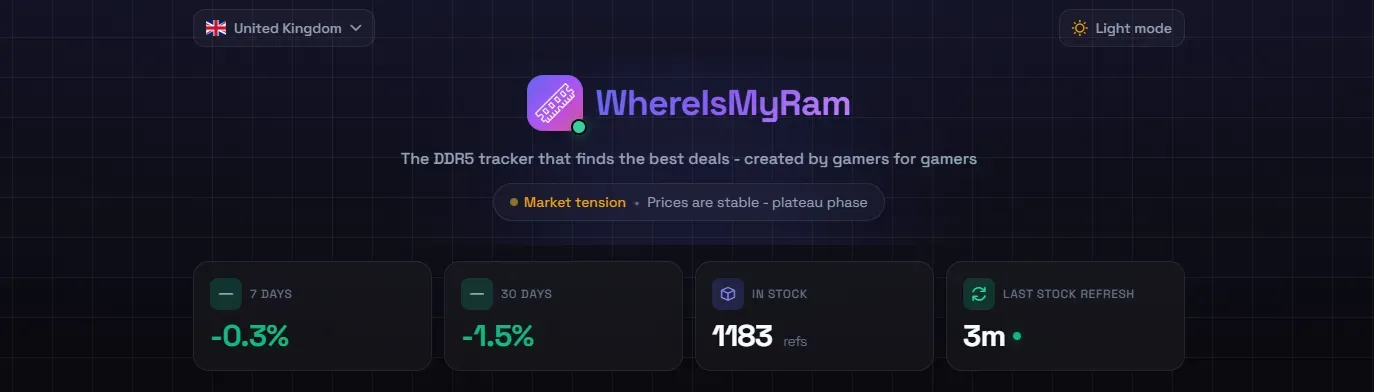
The UK shows -0.3% over 7 days and -1.5% over 30 days. The CL30 6000 MHz kit starts at 329£ (~385€ at the current rate), with only 1183 references available. Smaller market, similar prices in proportion.
 Click to enlarge
| Country | DDR5 6000 CL30 (min) | DDR5 6000 CL36 (min) | 7-Day Trend | 30-day Trend | Stock References |
|---|---|---|---|---|---|
| United States | $390 | $350 | -1.7% | -2.3% | 444 |
| France | 309€ | 340€ | +0.3% | -1.7% | 3142 |
| Germany | 309€ | 339€ | +0.7% | -1.0% | 3243 |
| Spain | 309€ | 340€ | +0.3% | -0.7% | 2769 |
| United Kingdom | £329 | £307 | -0.3% | -1.5% | 1183 |
We're going to be direct: what we've been observing since mid-March in all markets is a tray Prices have stopped rising as sharply as between October 2025 and January 2026, but they are not going down either. The -1% or -2% we see over 30 days is natural volatility, not a reversal of the trend.
Wccftech also highlighted it in a separate article: "prices are stabilizing, but do not be mistaken" . Suppliers are clearing their remaining stocks before the new contractual price increases. Samsung has already announced a doubling of DRAM prices to manufacturers in December 2025, and analysts are forecasting further +30 to 50% per quarter in the first semester of 2026.
At MSI, CEO Huang Jinqing confirmed price increases between 15 and 30% across the entire range in 2026. And it's not just RAM: motherboards, GPUs, SSDs—everything that uses memory is affected.
The underlying problem has not changed. The DRAM shortage is structural , not conjunctural:
The question everyone is asking. And the answer really depends on your situation.
If you must upgrader - your machine is no longer running, you build a new PC, you need to work - don't wait for a miracle. Prices are stable, it's the "least bad" time we've had since October 2025. Take advantage of a promotion if you find one, but don't expect a real decrease until at least the second half of 2026.
If you can wait, wait. But not hoping for a sudden drop. The realistic scenario is a slow erosion of prices over 6 to 12 months, not a return to €80 for the 32GB kit. The AI demand is not going to disappear, and supplier contracts lock in price increases for the coming quarters.
In any case, use WhereIsMyRam to monitor prices in your country. Variations of a few percent between retailers, that's often where you find the real good deals.
The best value for money is the profile DDR5 6000 MHz CL30 in 2x16 GB . This is the sweet spot for gaming on recent Intel and AMD platforms. Below 320€ in France, it's a good price in the current context. The CL36 kits are a bit cheaper (~340€) if you want to save a few euros without losing that much performance.
Avoid spending 600-700€ on 7200+ MHz unless you are doing serious overclocking. The gaming performance gain between 6000 and 7200 is marginal.
Not before 2027 at the earliest, if the situation resolves. As long as AI giants monopolize DRAM production, the consumer market remains the poor relative. A return to €80-100 for a 2x16GB 6000 MHz kit would require either a collapse in AI demand or a massive increase in production capacity. Both are unlikely in the short term.
No. Not directly. TurboQuant optimizes inference, which reduces the cost per query but increases the number of possible queries. It's Jevons' paradox applied to AI: making something cheaper per unit encourages people to consume more of it. Last week's stock market reaction was a reflex, not a rational market prediction.
Because the European market operates as an almost unified block for RAM. Distributors source from the same suppliers, stocks circulate between countries, and prices are based on global DRAM prices. The observed differences (a few euros between France and Germany) come from retailer margins and local pricing policies, not the actual cost of the chips.