Intel Core Ultra 7 270K Plus: Full Review, Benchmarks & Verdict (April 2026)

intel core ultra 7 270k plus high-end processor 2026 arrow lake refresh

The 270K Plus hits $359 with 285K performance for half the price. We compiled all the benchmarks to see what it's got under the hood.

A 285K at half the price: Intel finally gets it right

$359. That's the price of the Core Ultra 7 270K Plus at Newegg and Amazon in early April 2026. To put this in context: the Core Ultra 9 285K, which delivers essentially the same performance, launched at over $600. Intel has cut the price in half — and it's frankly the best thing that could have happened to this platform.

The 270K Plus features 8 P-cores + 16 E-cores, that's 24 cores and 24 threads for $299 MSRP. It's exactly the same configuration as the 285K, but with revised die-to-die frequencies and ring clock bumped up. And the results are there: Hardware Unboxed, Gamers Nexus and TechSpot confirm that this CPU delivers 14900K performance — or better — while consuming 20% less.

We compiled data from all the reviews to give you the complete breakdown. And we also have an exclusive benchmark across 14 games to show you.

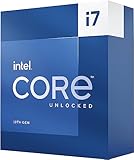
Intel Core Ultra 7 270K Plus Arrow Lake Refresh processor Click to enlarge

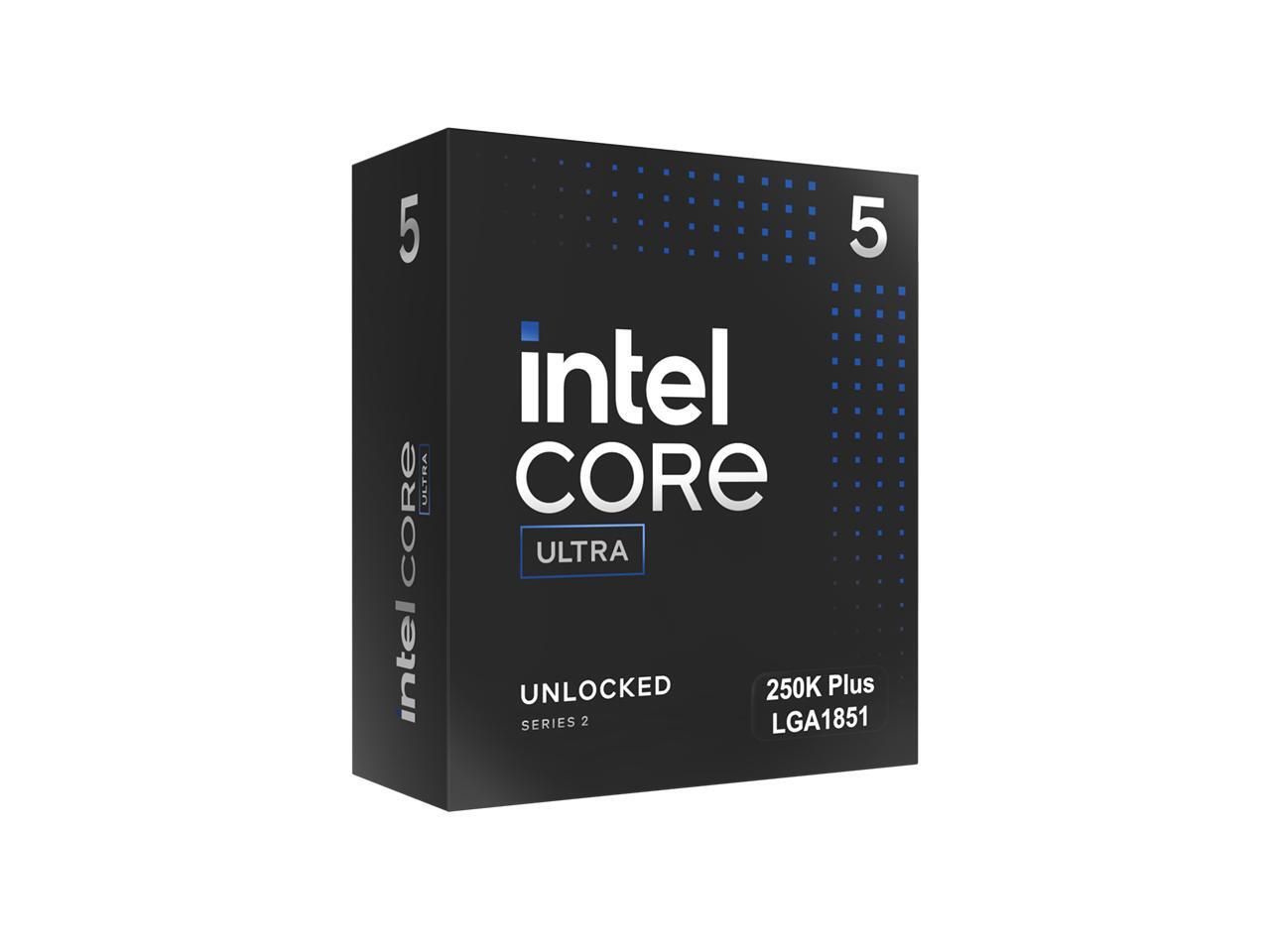
If you also want to see our review of the little brother, we did a dedicated article on the Core Ultra 5 250K Plus which is a price-to-performance monster at $234. And if you want to see Hardware Unboxed's video review of the 270K Plus, it's here:

https://www.youtube.com/watch?v=jQmQEypnHRY

Core Ultra 7 270K Plus specifications

Here's what Intel brings to the table with this processor:

Feature Intel Core Ultra 7 270K Plus
Architecture Arrow Lake Refresh (Intel Core Ultra Series 2)
Socket LGA 1851
Cores / Threads 24 (8P + 16E) / 24
Base frequency (P-cores) 3.7 GHz
Base frequency (E-cores) 3.2 GHz
Max Turbo frequency (P-cores) 5.5 GHz
Max Turbo frequency (E-cores) 4.7 GHz
L2 cache 40 MB
L3 cache (Smart Cache) 36 MB
TDP (Processor Base Power) 125 W
Maximum Turbo Power 250 W
Die-to-die frequency 3 GHz (+43% vs 285K)
Ring Clock 3.9 GHz (+200 MHz vs 285K)
Memory support DDR5 up to 7200 MT/s + CUDIMM
Max memory capacity 256 GB
PCIe PCIe 5.0 (x16 + x4) / PCIe 4.0
Overclocking Yes (K unlocked)
Compatible chipsets Z890, B860 (with BIOS update)
MSRP $299 (~$359 retail in US)
Release date March 26, 2026
Swipe to view more
Choose your delivery country to see prices based on your location

Filters

AMD Ryzen 7 7800X3D 5.0GHz Turbo AM5 Socket

AMD Ryzen 7 7800X3D 5.0GHz Turbo AM5 Socket

288€

(8 Vendors)
Chipset: r7-7800x3D
Gem Gaming / Streaming
AMD Ryzen 7 7800X3D AM5

AMD Ryzen 7 7800X3D AM5

265€

(4 Vendors)
Chipset: r7-7800x3D
Gem Gaming / Streaming
AMD Ryzen 7 9800X3D Black Zen 5 AM5

AMD Ryzen 7 9800X3D Black Zen 5 AM5

437€

(13 Vendors)
5 (2)
Chipset: r7-9800x3D
Gem Gaming / Streaming
AMD Ryzen 5 9600X Black 65W AM5 DDR5 PCIe5

AMD Ryzen 5 9600X Black 65W AM5 DDR5 PCIe5

180€

(17 Vendors)
Chipset: r5-9600x
AMD Ryzen 5 5600 Multicolor AM4 65W

AMD Ryzen 5 5600 Multicolor AM4 65W

111€

(8 Vendors)
Chipset: r5-5600
Gaming
AMD Ryzen 7 5700X AM4 3.4 GHz

AMD Ryzen 7 5700X AM4 3.4 GHz

175€

(5 Vendors)
Chipset: r7-5700x
Gaming / Streaming
AMD Ryzen 7 9700X 3.8 GHz PCIe 5.0 65W

AMD Ryzen 7 9700X 3.8 GHz PCIe 5.0 65W

226€

(9 Vendors)
Chipset: r7-9700x
Gaming / Streaming
AMD Ryzen 5 7600X Black Zen 4 AM5

AMD Ryzen 5 7600X Black Zen 4 AM5

158€

(15 Vendors)
Chipset: r5-7600x
AMD Ryzen 9 9950X3D 3D V-Cache AM5 5.7 GHz

AMD Ryzen 9 9950X3D 3D V-Cache AM5 5.7 GHz

600€

(17 Vendors)
5 (1)
Chipset: r9-9950x3D
Editing + / Streaming +
AMD Ryzen 5 5600 3500 MHz Noir

AMD Ryzen 5 5600 3500 MHz Noir

109€

(4 Vendors)
Chipset: r5-5600
Gaming
AMD Ryzen 7 5800X Black AM4 No iGPU

AMD Ryzen 7 5800X Black AM4 No iGPU

178€

(15 Vendors)
Chipset: r7-5800x
Gaming / Streaming
Intel Core i5-14600K Black 125W

Intel Core i5-14600K Black 125W

249€

(2 Vendors)
Chipset: i5-14600k
Gaming
AMD Ryzen 5 7500F 3.7 GHz AM5

AMD Ryzen 5 7500F 3.7 GHz AM5

125€

(6 Vendors)
Chipset: r5-7500f
Gaming
AMD Ryzen 7 5700X AM4

AMD Ryzen 7 5700X AM4

149€

(2 Vendors)
Chipset: r7-5700x
Gaming / Streaming
AMD Ryzen 7 9800X3D 5.2GHz Boost AM5 Socket

AMD Ryzen 7 9800X3D 5.2GHz Boost AM5 Socket

422€

(4 Vendors)
Chipset: r7-9800x3D
Gem Gaming / Streaming
AMD Ryzen 5 5500 Black 3.6-4.2 GHz

AMD Ryzen 5 5500 Black 3.6-4.2 GHz

74€

(7 Vendors)
Chipset: r5-5500
Gaming
AMD Ryzen 5 5500 Multicolor 65W AM4

AMD Ryzen 5 5500 Multicolor 65W AM4

78€

(13 Vendors)
Chipset: r5-5500
Gaming
Intel Core Ultra 7 265KF 3.9 GHz and 5.5 GHz 125W no iGPU

Intel Core Ultra 7 265KF 3.9 GHz and 5.5 GHz 125W no iGPU

238€

(14 Vendors)
Chipset: icu7-265kf
Not very interesting Gaming / Streaming
AMD Ryzen 7 9850X3D 8 core 96 MB L3 cache

AMD Ryzen 7 9850X3D 8 core 96 MB L3 cache

468€

(16 Vendors)
Graphics: true
Gaming / Streaming
AMD Ryzen 5 7600 Black AM5 65W

AMD Ryzen 5 7600 Black AM5 65W

151€

(9 Vendors)
Chipset: r5-7600
AMD Ryzen 7 9700X Black Zen 5 AM5

AMD Ryzen 7 9700X Black Zen 5 AM5

279€

(15 Vendors)
Chipset: r7-9700x
Gaming / Streaming
Intel Core i5-12400F Black 6-core No iGPU

Intel Core i5-12400F Black 6-core No iGPU

121€

(7 Vendors)
Chipset: i5-12400f
Gaming
Intel Core i5-14600K LGA1700 24MB cache DDR4/DDR5

Intel Core i5-14600K LGA1700 24MB cache DDR4/DDR5

259€

(2 Vendors)
Chipset: i5-14600k
Gaming
AMD Ryzen 5 7500X3D

AMD Ryzen 5 7500X3D

207€

(11 Vendors)
Chipset: r5-7500x3D
Intel Core i5-14400F up to 4.7 GHz 65W PCIe 5.0/4.0 DDR5/DDR4

Intel Core i5-14400F up to 4.7 GHz 65W PCIe 5.0/4.0 DDR5/DDR4

170€

(9 Vendors)
Chipset: i5-14400f
Gaming

What changes compared to the 265K and 285K

The 270K Plus is essentially a remastered 285K. Same core count (8P + 16E), same 250W max TDP. But Intel boosted three key things: the die-to-die frequency jumps to 3 GHz (+43% compared to the 285K), the ring clock rises to 3.9 GHz (+200 MHz), and the IMC frequency gains 400 MHz. All this gives a CPU that hits 5.1 GHz all-core P-cores and 4.6 GHz E-cores in real workloads (measured by Hardware Unboxed under Cinebench).

Against the 265K (20 cores, 20 threads), the jump is even more pronounced: +4 cores, +4 MB L2 cache, higher frequencies. And the price? The 265K was $394 at launch. The 270K Plus does better for $299. It's almost insulting.

270K Plus 265K 285K 270K+ vs 285K difference
Cores / Threads 24 / 24 (8P+16E) 20 / 20 (8P+12E) 24 / 24 (8P+16E) Identical
L2 + L3 cache 40 + 36 MB 36 + 30 MB 40 + 36 MB Identical
Max P-core boost 5.5 GHz 5.5 GHz 5.7 GHz -200 MHz
Die-to-die freq 3 GHz 2.1 GHz 2.1 GHz +43%
Ring clock 3.9 GHz 3.6 GHz 3.7 GHz +200 MHz
Max TDP 250 W 250 W 250 W Identical
MSRP $299 $394 $589 -49% vs 285K
Cinebench Multi (vs 265K) +23% Baseline ~identical to 270K+
Swipe to view more

Productivity benchmarks: Cinebench, Blender, compression

This is where the 270K Plus really hurts the competition. AMD has nothing to compete at this price point. The Ryzen 7 9700X also sells for $300, and it gets literally crushed in anything multi-threaded.

Cinebench 2026

In multi-thread, the 270K Plus beats the 14900K by 10% and the 265K by 23%. That's 36% ahead of the 250K Plus. But the figure that hurts the most is against the Ryzen 7 9700X: +106% performance. More than double. And the 9800X3D? Beaten by 77%. AMD simply has nothing in this price segment for multi-threaded productivity.

In single-thread, the 270K Plus takes the lead, 4% ahead of the 250K Plus. The P-cores at 5.5 GHz get the job done.

Blender, compression, editing

In Blender rendering, it's 285 samples per minute — that's 121% more than the 9700X. In 7-Zip compression, it beats the 14900K, outperforms the 265K by 18% and the 250K Plus by 22%. Even in decompression — where it gives up 7% to the 14900K — it stays 27% ahead of the 265K and 37% ahead of the 250K Plus.

Only weak point spotted by Hardware Unboxed: Photoshop. It's a light-threaded workload, and Zen 5 architecture performs better here. The 270K Plus finishes 15% behind the 9700X in this specific test. But on Premiere Pro, which loads more cores, Intel regains the advantage with a 6% margin.

Benchmark 270K Plus 250K Plus 265K 14900K Ryzen 7 9700X
Cinebench Multi Baseline -36% -23% -10% -106%
Cinebench Single Fastest -4% Behind Behind Behind
Blender (samples/min) 285 spm ~210 spm ~230 spm ~260 spm 129 spm
7-Zip Compression Baseline -22% -18% Slightly behind -62%
7-Zip Decompression Baseline -37% -27% +7% -63%
Photoshop -15% vs 9700X N/A Behind Comparable Baseline
Premiere Pro +6% vs 9700X N/A N/A N/A Baseline
Swipe to view more

Gaming benchmarks: 14 games tested with an RTX 5090

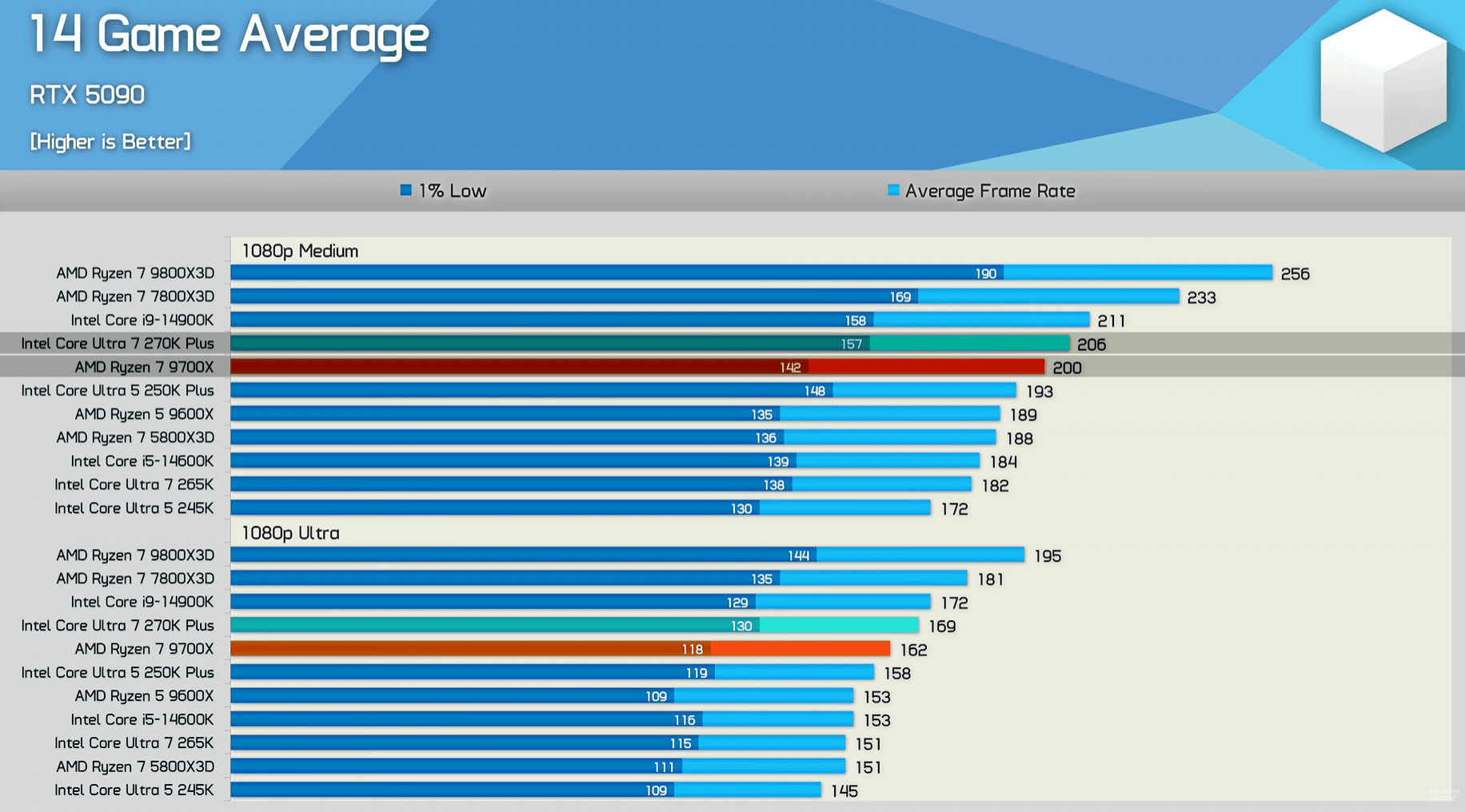
Let's get to gaming. And for that, we have benchmarks across 14 games with an RTX 5090 — to really push the CPU to its limits without GPU bottlenecking. Here's the overall average (source: Hardware Unboxed):

Intel Core Ultra 7 270K Plus 14 games benchmark Click to enlarge

14-game average: 270K Plus matches the 14900K

The numbers speak for themselves. At 1080p Medium, the 270K Plus delivers 206 FPS average with 157 FPS 1% lows. That's virtually identical to the 14900K (211 / 158) and 3% ahead of the Ryzen 7 9700X (200 / 142). But where it gets really interesting is the 1% lows: +11% compared to the 9700X. You feel the difference in-game.

At Ultra settings, same story: 169 FPS / 130 1% lows. The 9700X sits at 162 / 118. And against the 265K? It's a massacre: +13% at Medium, +12% at Ultra. The Arrow Lake refresh makes a real difference in gaming.

CPU 1080p Medium (Avg / 1% Low) 1080p Ultra (Avg / 1% Low)
Ryzen 7 9800X3D 256 / 190 195 / 144
Ryzen 7 7800X3D 233 / 169 181 / 135
Core i9-14900K 211 / 158 172 / 129
Core Ultra 7 270K Plus 206 / 157 169 / 130
Ryzen 7 9700X 200 / 142 162 / 118
Core Ultra 5 250K Plus 193 / 148 158 / 119
Ryzen 5 9600X 189 / 135 153 / 109
Ryzen 7 5800X3D 188 / 136 151 / 111
Core i5-14600K 184 / 139 153 / 116
Core Ultra 7 265K 182 / 138 151 / 115
Core Ultra 5 245K 172 / 130 145 / 109
Swipe to view more

Game-by-game results

The average is nice, but each game tells a different story. Here are the highlights from the 14 games tested by Hardware Unboxed:

Battlefield 6 — Probably the best result. The 270K Plus beats the 9700X by 6% on average but especially by 30% on 1% lows at Medium. That's a massive gap that translates to much superior smoothness during intense moments.

Arc Raiders — 11% ahead of the 9700X at Medium, 22% ahead of the 265K. One of the games where the Arrow Lake refresh shows the biggest delta.

Marvel Rivals — At Ultra (GPU limited), the 270K Plus matches the 9800X3D. At Medium, it's 6% ahead of the 9700X on average and 17% on 1% lows.

Cyberpunk 2077 Phantom Liberty — Mixed results. At Medium, it matches the 9700X on average but with 12% better 1% lows. In RT Ultra (GPU limited), still up to 10% ahead.

Counter-Strike 2 — 8% ahead of the 9700X, but the real number is +21% against the 265K. The 270K Plus approaches the 7800X3D in this title.

The Last of Us Part II Remastered — This is the beatdown. The 270K Plus puts 15% on the 9700X on average and 34% on 1% lows. It delivers an experience comparable to the 9800X3D and 14900K.

Spider-Man 2 — +7% at Medium vs 9700X, and +17% in RT Ultimate. Very good score, just below the 14900K.

Rainbow Six Siege — Only game where the 9700X does better: 4% lead over the 270K Plus. But Intel remains 14-16% ahead of the 250K Plus and 20%+ ahead of the 265K.

ACC (Assetto Corsa Competizione) — Not the best result for Intel: 11% behind the 9700X. But it stays 22% ahead of the 265K, which shows the progress of the refresh.

Power consumption, temperatures and efficiency

Let's talk about the elephant in the room. The 270K Plus is not a frugal CPU. Under full load, it draws up to 250W — that's the same max TDP as the 285K. But let's put this in perspective: it's 10% faster than the 14900K in Cinebench while consuming 20% less power. Efficiency improves compared to gen 14, even if AMD maintains a lead.

In gaming, it's less flattering. Hardware Unboxed measured:

  • Cyberpunk 2077 — 42% more than the 9700X for 12% more performance
  • Space Marine 2 — 35% more for 10% performance
  • Spider-Man 2 — 58% more for 17% performance. The worst ratio.

Temperature-wise, Hardware Unboxed measured a peak of 86°C under Cinebench with a 360mm AIO. That's hot but manageable. However, forget small tower coolers here — you need at minimum a large 240mm AIO, and a 360mm is recommended if you want headroom for overclocking.

DDR5 memory scaling: 6000 vs 7200 vs 8200

Hardware Unboxed tested memory scaling across three DDR5 speeds. Good news: the 270K Plus is not very sensitive to RAM speed in gaming.

Game DDR5-8200 DDR5-7200 DDR5-6000 8200 vs 6000 loss
Horizon Zero Dawn Remastered Baseline ~-1% ~-3% 3%
Marvel Rivals Baseline ~-2% ~-5% 5%
Rainbow Six Siege Baseline ~0% ~-1% 1%
Swipe to view more

In short: you lose 1 to 5% going from DDR5-8200 (CUDIMM, super expensive) to DDR5-6000 (affordable). It's basically nothing. Don't bother dropping $300+ on an 8200 CUDIMM kit if your budget is tight — a good DDR5-6000 CL30 or CL36 2x16GB kit will do the job perfectly. DDR5-7200 is the compromise if you want to squeeze out a few percent without exploding the RAM budget.

The big comparison: which CPU to choose in April 2026?

270K Plus 250K Plus Ryzen 7 9700X Ryzen 7 9800X3D
Price (US) ~$359 ~$234 ~$220-240 ~$380-400
Cores / Threads 24 / 24 18 / 18 8 / 16 8 / 16
Gaming (14 games, medium) 206 FPS avg 193 FPS avg 200 FPS avg 256 FPS avg
Gaming 1% lows (medium) 157 FPS 148 FPS 142 FPS 190 FPS
Multi-thread productivity Monster Very good Mediocre Mediocre
Cinebench vs 9700X +106% +86% Baseline ~-77%
Max power consumption 250 W 159 W ~88 W ~88 W
Best for... Productivity + gaming Best overall value Efficiency Pure gaming
Swipe to view more

270K Plus vs Ryzen 7 9700X: not even close

At the same $300 price point, the matchup is painful for AMD. In gaming, the 270K Plus wins by 3% on average — not huge. But in 1% lows it's 11% better, and in multi-threaded productivity it's +106%. More than double. If you do anything outside of gaming (streaming, editing, compilation, rendering), the choice is obvious.

The 9700X's only argument: power consumption. It drinks half as much in gaming. And the AM5 platform has a future (Zen 6 confirmed), while LGA 1851 is end-of-life. That's a real consideration.

270K Plus vs 9800X3D: gaming vs productivity

If gaming is your absolute priority, the 9800X3D remains king with 256 FPS average against 206 for the 270K Plus. That's a 24% gap you can't ignore. And the X3D consumes half as much. But in productivity? The 270K Plus beats the 9800X3D by 77% in Cinebench multi. Two different worlds.

At $380-400 for the 9800X3D versus $359 for the 270K Plus, the choice depends on your use case. Pure gamer: X3D. Gamer + creator: 270K Plus without hesitation.

270K Plus vs 250K Plus: is the $125 premium worth it?

The 250K Plus at $234 remains the best price-to-performance on the market. The 270K Plus costs 53% more for 7% more gaming FPS and 36% more in Cinebench multi. If you want to maximize every dollar spent, the 250K Plus is the rational choice. The 270K Plus is for those who need the extra multi-threaded power — or simply want the best Intel CPU without paying 285K prices.

The platform problem

Let's not beat around the bush: LGA 1851 is an end-of-life platform. Intel will move to a new socket with the next generation. Hardware Unboxed says it clearly: "it's being released on a dead platform". That's the biggest black mark against the 270K Plus.

On the other side, AMD's AM5 will receive at minimum Zen 6. If you're thinking about upgrading your CPU in 2-3 years without changing the motherboard, AMD has a structural advantage. Now, if you buy a CPU to keep it 4-5 years without touching anything — and the 270K Plus absolutely has the shoulders for that — the platform question becomes secondary.

The other problem is DDR5 pricing right now. It's not Intel's fault, but it impacts the total cost of a build. A good DDR5-6000 32GB kit runs around $100-120 — that's decent, but high-frequency CUDIMM kits can easily exceed $250.

Verdict: an impressive CPU on a fragile platform

The Core Ultra 7 270K Plus is probably the best processor Intel has released since the 14900K. It offers 285K performance for half the price, it crushes the Ryzen 7 9700X in productivity, and it holds its ground in gaming with superior 1% lows compared to non-X3D AMD competition.

It's frustrating that it took Intel 18 months to find the right recipe. But hey, better late than never.

It's made for you if:

  • You do content creation, development, 3D rendering AND gaming
  • You want high-end performance without paying 285K/9950X prices
  • You plan to keep this CPU for 4+ years
  • Power consumption isn't a priority criterion

Skip it if:

  • You want maximum gaming FPS (get a 9800X3D)
  • You want a platform with upgrade future (get AM5)
  • Your total budget is tight (the 250K Plus at $234 is the best deal)
  • You already have a 14900K (the upgrade isn't worth it)

FAQ

Is the Core Ultra 7 270K Plus better than the 285K?

In practice, yes. Benchmarks show virtually identical performance — sometimes even slightly better thanks to higher die-to-die frequencies and ring clock. And the 270K Plus costs half the price ($299 vs $589). The 285K has no commercial interest anymore.

What cooling for the 270K Plus?

A 240mm AIO minimum, ideally a 360mm. Hardware Unboxed measured 86°C under load with a 360mm AIO. A tower cooler, even high-end like the Noctua NH-D15, might be close under heavy load. For gaming only, it'll work, but for sustained multi-threaded productivity, the 360mm is recommended.

Is the 270K Plus worth the premium over the 250K Plus?

Depends on your usage. For gaming alone, no — the 250K Plus offers 95% of gaming performance for 65% of the price. But if you do streaming, video editing, rendering or compilation, the 270K Plus's extra 6 cores make a real difference (+36% in Cinebench multi).

Do you need fast DDR5 for the 270K Plus?

No. Memory scaling tests show 1 to 5% loss between DDR5-8200 and DDR5-6000. A DDR5-6000 CL30 or CL36 2x16GB kit is the sweet spot. High-frequency CUDIMM kits cost a fortune for minimal gaming gains.

Is LGA 1851 really a dead platform?

Intel hasn't officially confirmed the end of LGA 1851, but everything indicates a new socket is coming with the next generation. If you buy a 270K Plus, do it knowing you'll keep this CPU for a long time. The advantage: Z890 motherboards are mature, well-supported, and their prices have dropped.

270K Plus or used 14900K?

The 270K Plus. It offers similar gaming performance, 10% better productivity, and consumes 20% less. The 14900K also has its well-documented reliability issues. And you'll be on a native DDR5 platform with full PCIe 5.0.