DDR4 vs DDR5 for gaming in 2026: are you really losing performance?

DDR4 vs DDR5 Gaming RAM 2026 Memory benchmark

A DDR5 32GB kit costs 620 euros, an equivalent DDR4 costs 80 euros. Does DDR5 really change your FPS in games, or is it a waste? Benchmarks, figures, and verdict.

DDR4 vs DDR5 in 2026: the real impact on your FPS

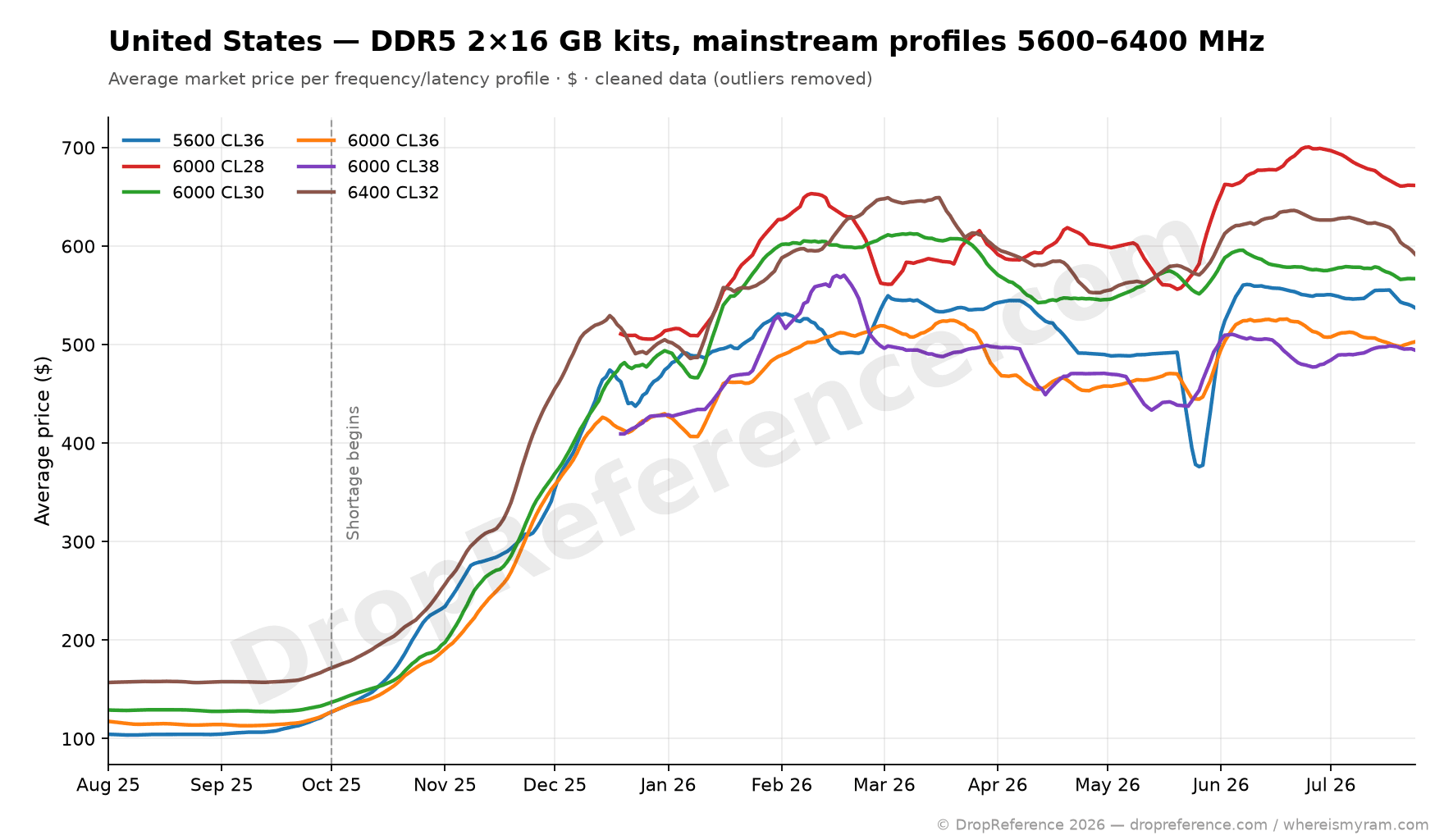
620 euros for the 32GB DDR5 6000 CL30 kit. This is the average price in Europe in July 2026. Compared to 70-80 euros for an equivalent DDR4 3200 CL16 kit. Nine times cheaper. And so, the question keeps coming back on forums: Is it really worth paying so much for DDR5, or does DDR4 still do the job for gaming?

The short answer: it depends on the game, the resolution, and above all on your CPU. The long answer is this article.

We will rely on recent benchmarks - notably those of Club386 who built two almost identical PCs (same RTX 5070, same storage) by only changing the platform: Ryzen 7 9700X + DDR5 6000 on one side, Ryzen 7 5700X + DDR4 3200 on the other. Plus Intel LGA 1700 data that allows comparing DDR4 and DDR5 on the same CPU , which truly isolates the memory effect.

Spoiler: the results are sometimes brutal. But not always in the way we think.

Feature DDR4 DDR5
Throughput 2133-3600 MT/s (current) 4800-8000 MT/s (current)
Voltage 1.2V 1.1V
Channels per DIMM 1 (64-bit) 2 x 32-bit (sub-channels)
Theoretical bandwidth ~25 GB/s (3200 MT/s) ~48 GB/s (6000 MT/s)
Typical CAS latency CL14-16 CL28-36
Actual Latency (ns) ~10 ns (advantage) ~12 ns
Price 32GB (Jul. 2026) 70-90 euros 540-630 euros
Platform AM4, Intel LGA 1200/1700 AM5, Intel LGA 1700/1851
Swipe to view more

The bandwidth: the massive advantage of DDR5

Before talking about FPS, you need to understand what changes concretely between the two. And the answer can be summed up in one word: bandwidth .

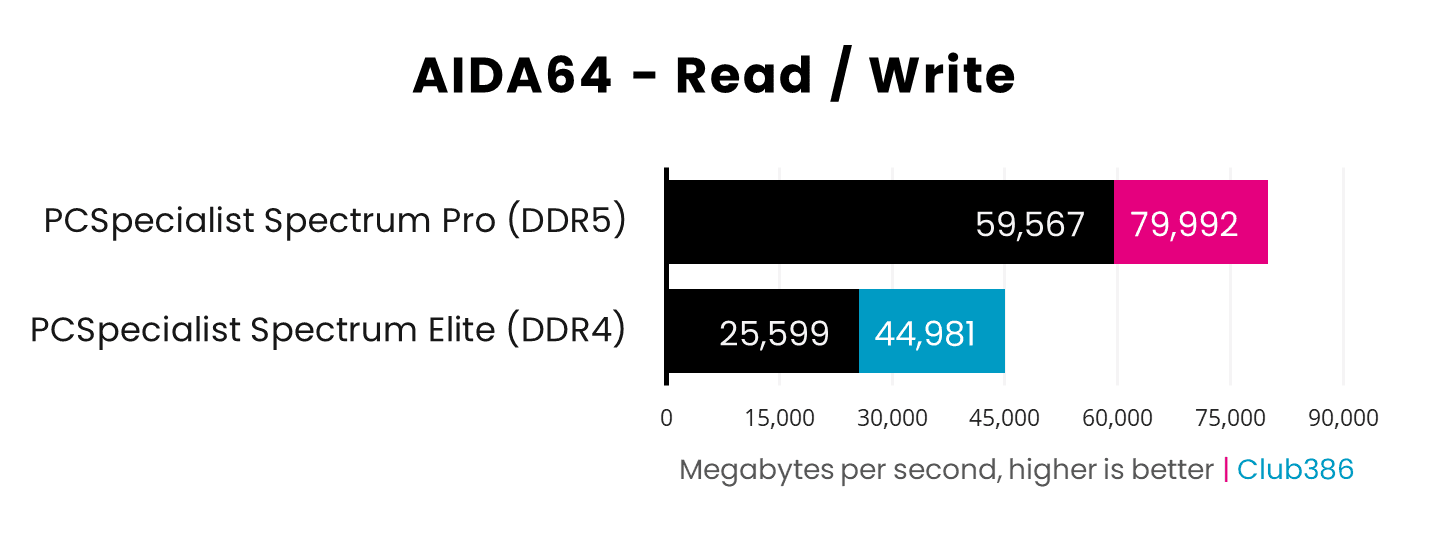
A DDR5 6000 MT/s kit sends almost double the amount of data per second than a DDR4 3200 kit. Club386's AIDA64 benchmarks show it unequivocally: 59,567 MB/s in read for DDR5 compared to 25,599 MB/s for DDR4. That's 2.33 times faster. In writing, it's 1.78x.

On the other hand — and this is a point that synthetic benchmarks do not show — DDR4 retains an advantage in raw latency . CL16 at 3200 MT/s gives around 10 ns of latency, compared to 10 ns more for CL30 at 6000 MT/s. It matters in some scenarios (pure competitive, some CPU-bound games), but bandwidth dominates in the majority of gaming cases.

The AIDA64 chart below clearly illustrates the difference:

Benchmark DDR4 vs DDR5 AIDA64 memory bandwidth comparison Club386 Click to enlarge

Gaming benchmarks: differences from 0 to 130%

This is where it gets interesting. Club386 tested 8 games on both setups (Ryzen 9700X/DDR5 vs Ryzen 5700X/DDR4, same RTX 5070), at 1080p with Medium and Maximum settings. The results vary tremendously according to the game.

Games where DDR5 crushes DDR4:

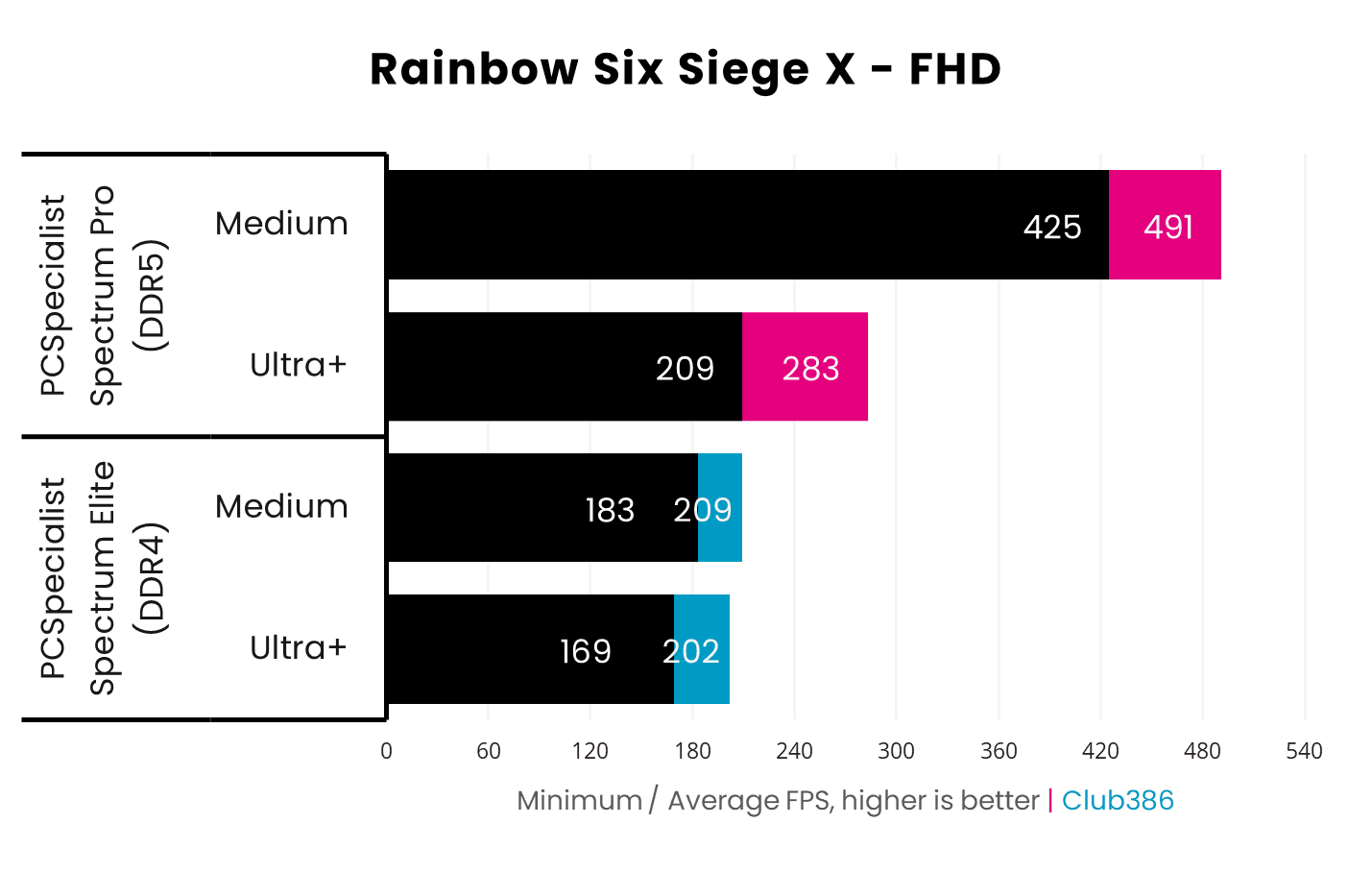
  • Rainbow Six Siege X: +132% in Medium (yes, you read that right - the DDR4 CPU bottleneck to death)
  • Mount & Blade II: Bannerlord: +27% on average, +51% on the 1% lows in Very High
  • Total War: Warhammer III: +38% on average, +51% on minimums in Ultra
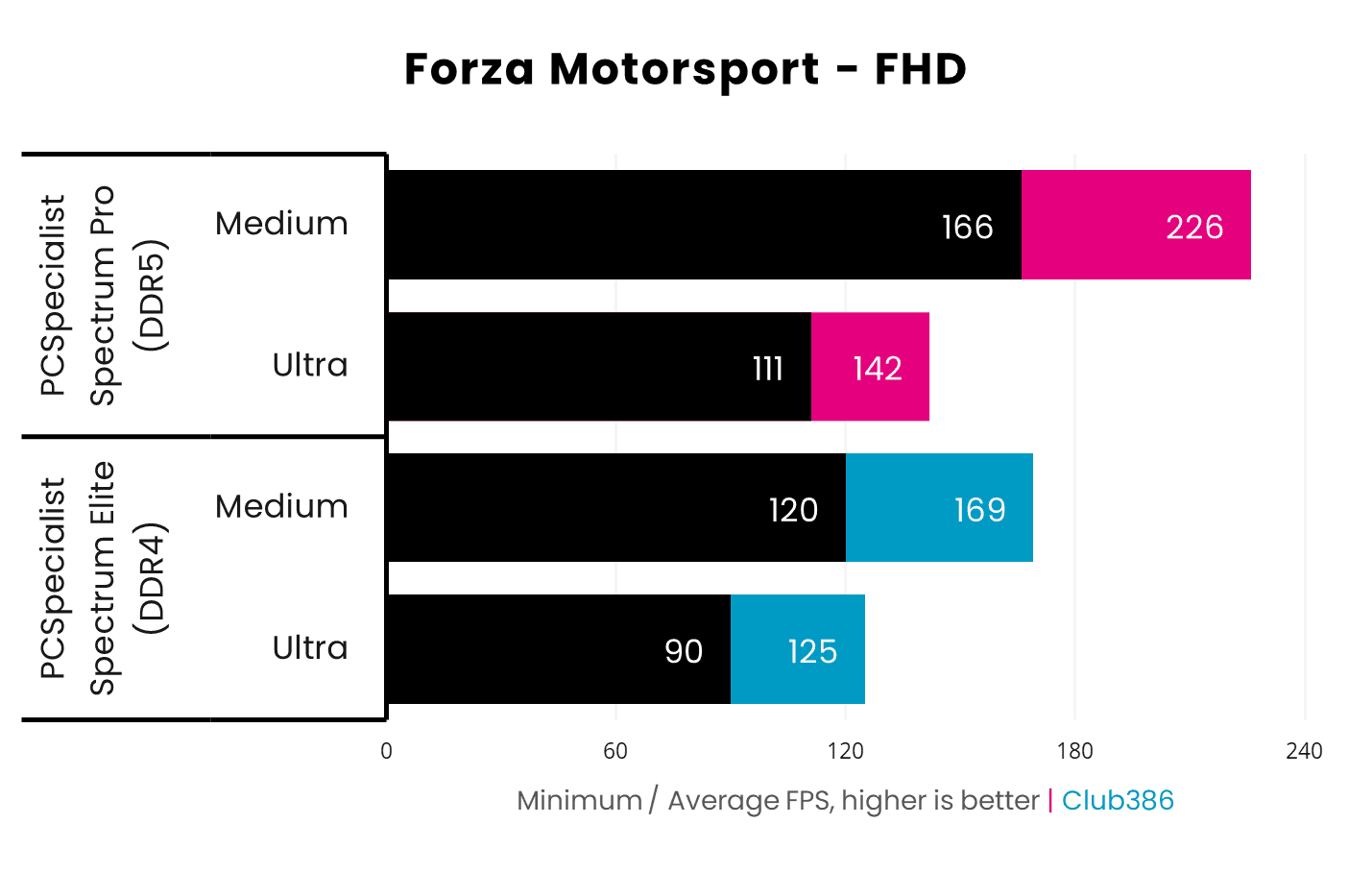
  • Forza Motorsport: +34% in Medium, +14% in Ultra

Games where DDR5 moderately wins:

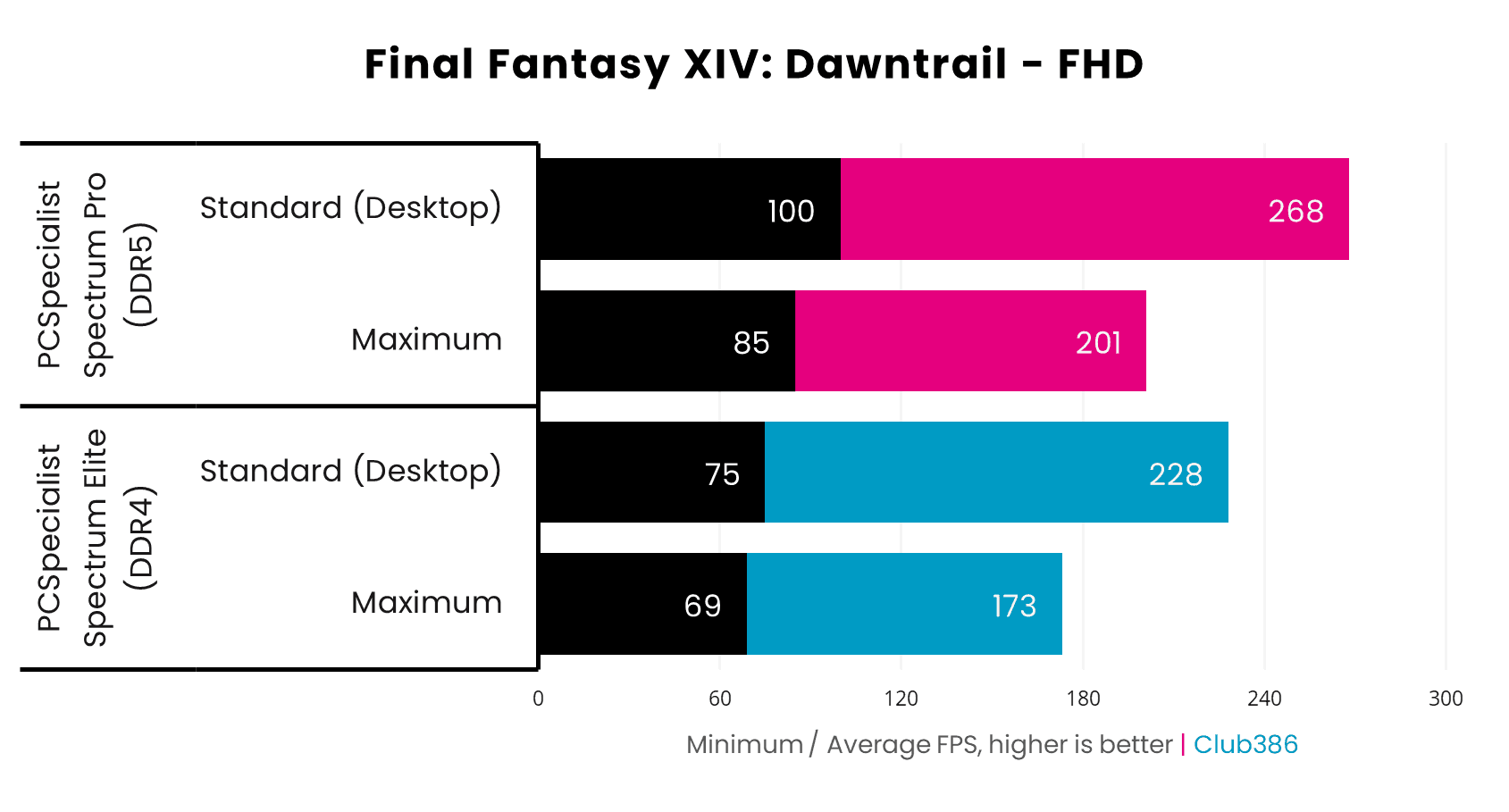
  • Final Fantasy XIV: Dawntrail: +16-18% on average, +23-33% on minimums
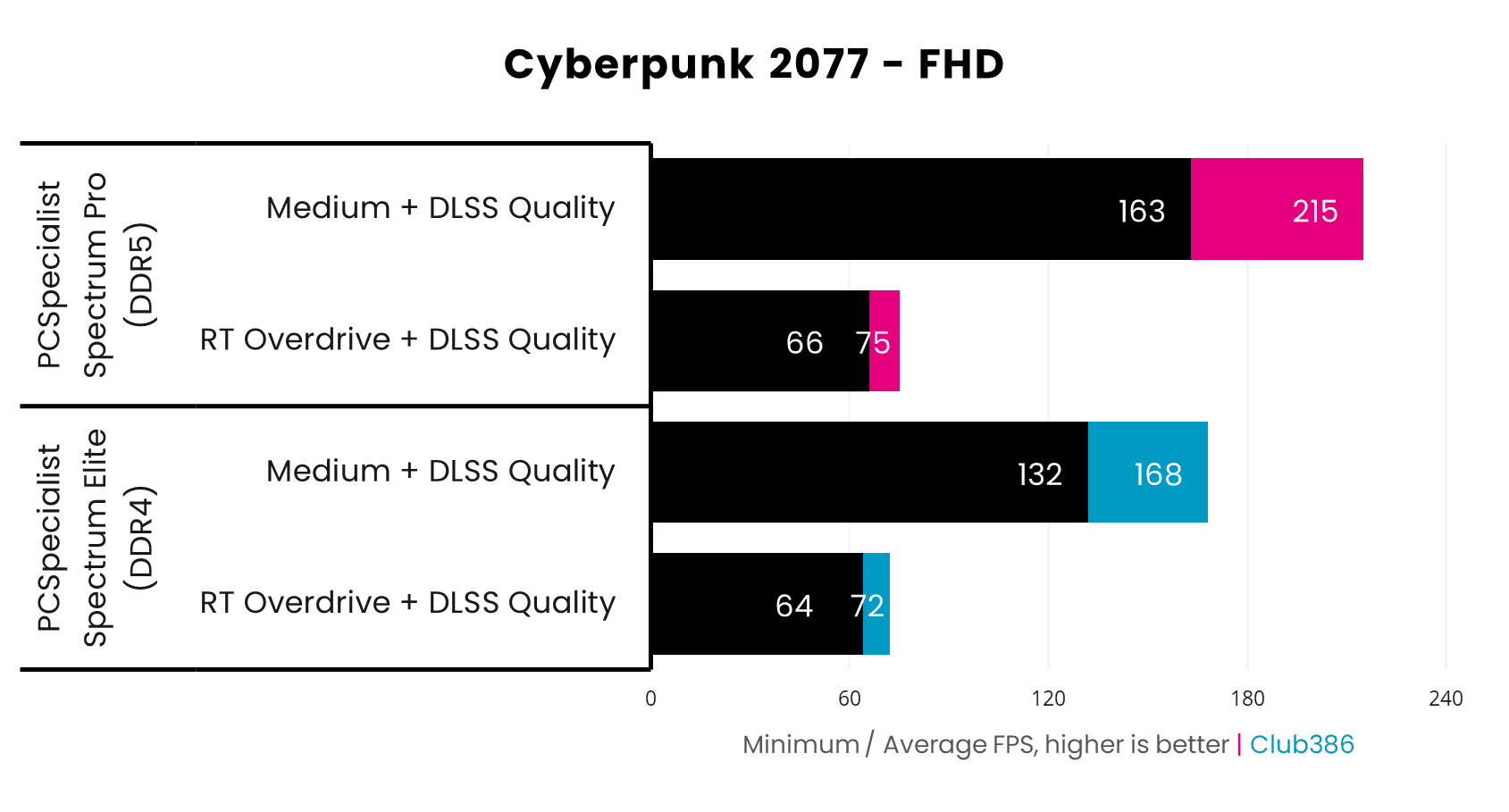
  • Cyberpunk 2077 (raster): +23-28% in Medium, +3-4% with ray tracing
  • Civilization VII: ~14% faster in AI turn calculation

Games where the difference is almost zero:

  • Assassin's Creed Shadows: +1-3% (GPU-bound, even on Medium)
  • Cyberpunk 2077 (ray tracing): +3-4% (GPU-bound by RT)
  • 3DMark Steel Nomad / Speed Way: <1% (GPU tests)

The Forza Motorsport chart below clearly shows the pattern: the lighter the graphics of the game (Medium), the more the CPU and RAM make a difference.

Benchmark DDR4 vs DDR5 Forza Motorsport FPS comparison Club386 Click to enlarge

Rainbow Six Siege X: the extreme case of CPU bottleneck

+132% more FPS. No, it's not a typo.

Rainbow Six Siege X is the textbook case of the ultra-optimized esport game on the GPU side but demands an industrial quantity of CPU. Club386 found that the DDR4 PC ran at 183-209 FPS on Medium while the DDR5 PC pushed to 425-491 FPS. With the same graphics card .

How is this possible? The GPU of the DDR4 config was running at only 43°C — it had nothing to do. It was waiting for the CPU. The Ryzen 5700X + DDR4 3200 simply couldn't power the RTX 5070 fast enough.

If you play competitive titles on a 240-360 Hz screen, this is the kind of scenario where DDR5 is not a luxury — it's a necessity. And on AM4 without 5700X3D or 5800X3D, you're doomed to this bottleneck.

Benchmark DDR4 vs DDR5 Rainbow Six Siege X FPS comparison Club386 Click to enlarge

Assassin's Creed Shadows and ray tracing: when RAM changes nothing

On the complete opposite end of the spectrum, there are GPU-bound games. Assassin's Creed Shadows with all the ray tracing pushed to the max? The DDR5 PC gets 42-49 FPS, the DDR4 gets 41-48 FPS. Less than 3% difference. It's safe to say: nothing .

Same observation on Cyberpunk 2077 in RT Overdrive: 66/75 FPS compared to 64/72 FPS. The GPU saturates before the RAM has any impact.

The rule is simple: the more you push the graphic quality, the more it's the GPU that dictates your FPS At that moment, DDR4 or DDR5, you don't care. It's by lowering the settings — typically what competitive gamers do — that the platform and memory take the lead again.

Benchmark DDR4 vs DDR5 Cyberpunk 2077 FPS comparison Club386 Click to enlarge

Intel LGA 1700: the only true DDR4 vs DDR5 face-off

The Club386 test compares Zen 3 (AM4/DDR4) to Zen 5 (AM5/DDR5). It's informative, but it mixes the CPU effect and the memory effect. To truly isolate the impact of RAM, you have to turn to Intel LGA 1700 — the only platform that supports DDR4 and DDR5 with the same processor.

The tests conducted on i5-12600K and i7-13700K with DDR4 3600 CL16 vs DDR5 6000 CL30 show a narrower but still present gap:

  • On average across 15 games at 1080p: DDR5 gains 8 to 14% FPS depending on the title
  • The 1% lows often improve even further (+10-18%) — less micro-stuttering
  • At 1440p, the gap narrows to 3-8% (the GPU takes over)
  • At 4K, it's often less than 2% — almost invisible

The most memory-sensitive games on Intel? Starfield (up to 25% difference in 1080p), Cities: Skylines 2 , Flight Simulator 2024 , and in general everything that runs on Unreal Engine 5 (open world, asset streaming).

So yes, the figure of 14% that we often see mentioned, it's a average Some games perform better, others do not move. But on Intel 12th/13th gen, the gap between DDR4→DDR5 is very real.

Benchmark DDR4 vs DDR5 Final Fantasy XIV Dawntrail FPS comparison Club386 Click to enlarge
Game DDR5 (Avg. FPS) DDR4 (Avg. FPS) Deviation
Rainbow Six Siege X (Medium) 491 209 +135%
Mount & Blade II (Very High) 327 256 +27%
Total War: Warhammer III (Ultra) 109 79 +38%
Forza Motorsport (Medium) 226 169 +34%
Final Fantasy XIV (Maximum) 201 173 +16%
Cyberpunk 2077 (Medium) 215 168 +28%
Cyberpunk 2077 (RT Overdrive) 75 72 +4%
AC Shadows (Ultra) 49 48 +2%
Swipe to view more

Should we migrate from DDR4 to DDR5 in 2026?

The real question is not "is DDR5 faster" — the answer is yes, consistently. The question is: Does the difference justify the price? Especially now, in the midst of a shortage.

Scenario 1: you have an AM4 PC and it is running well.

You play at 1440p or 4K, your FPS are fine, you don't play competitively. Stick with DDR4. Upgrading to AM5 + DDR5 will cost you a platform (motherboard + CPU + RAM) of at least 1000-1500 euros, for a gain of 5-10% in gaming at these resolutions. It's a waste.

Scenario 2: you build a new PC.

There, it's more complicated. AM4 is at the end of its life — no more new CPUs, no more long-term support. Intel LGA 1700 as well. If you go for something new, AM5/DDR5 or Intel LGA 1851 are the only options with a future. DDR5 is expensive, but it's the mandatory entry ticket for current platforms.

My advice in this case: take 16 GB of DDR5 5600 to start (the bare minimum, ~300 euros anyway), and upgrade later when prices have calmed down. The difference between 5600 and 6000 MT/s is 2-3% in gaming. Not enough to break the bank.

Scenario 3: you play esports / competitive on a 240 Hz+ screen.

If you're on AM4 with a 5600X or 5700X (without 3D V-Cache) and you play Valorant, R6 Siege, CS2 — you're leaving hundreds of FPS on the table. The AM5 + DDR5 migration is justified, despite the price. The difference is massif in these scenarios.

Scenario 4: you have an Intel 12th or 13th gen LGA 1700.

You are in the most interesting case. Your DDR4 motherboard limits you by 8-14% in gaming compared to the DDR5 version. If you find a second-hand DDR5 motherboard and a not too expensive DDR5 kit... it could be worth it. But at 600 euros for a 32GB DDR5 kit, the math is rarely in favor unless you find a good deal.

FAQ - DDR4 vs DDR5 for gaming

Is DDR4 really 14% slower than DDR5 in gaming?

It depends on the game and the resolution. At 1080p on Intel LGA 1700 (same CPU), the average difference is between 8 and 14%. Some CPU-bound games like Rainbow Six Siege or Mount & Blade can exceed 25-50%. At 4K, the difference often falls below 3%.

Does DDR4 bottleneck an RTX 5070?

It depends on the game and the resolution. At 1080p on CPU-light games (esports, strategy), yes, a DDR4 platform can limit an RTX 5070. At 4K with ray tracing, no — the GPU saturates first.

Is it better to have 32 GB of DDR4 or 16 GB of DDR5?

To play in 2026, 16 GB remains the minimum functional but increasingly tight. Some recent titles (Shadows, Star Citizen, Flight Sim) consume 20-24 GB. If you go for new, start with 16 GB DDR5 and upgrade later when prices drop. If you stick with DDR4, 32 GB for 80 euros is a no-brainer.

Why are DDR5 prices so outrageous in 2026?

Global shortage of DRAM. Manufacturers (Samsung, SK Hynix, Micron) allocate their production to AI and server chips (HBM), not to the general public. As a result, the 32GB DDR5 6000 kit is trading at 4 to 5 times its price from a year ago. full article on the state of shortage .

DDR4 3600 CL16 vs DDR5 4800 CL40, what's faster?

In-game, it's almost identical. The base DDR5 4800 with its relaxed CL40 timings loses almost all of its bandwidth advantage compared to well-timed DDR4 3600. The interest in DDR5 really starts from 5600-6000 MT/s with CL30 or better.