Price of RAM: Will Chinese chips finally cause prices to collapse?

RAM price 2027 CXMT memory DDR5 shortage

An analyst predicts a drop in RAM prices as early as 2027 thanks to Chinese manufacturers CXMT and YMTC. Let's assess the market's promises versus reality.

Author
yuux
Co-founder of DropReference, I'm here to give you the best tips to build the gaming PC of your dreams!

China could drive down RAM prices as early as 2027

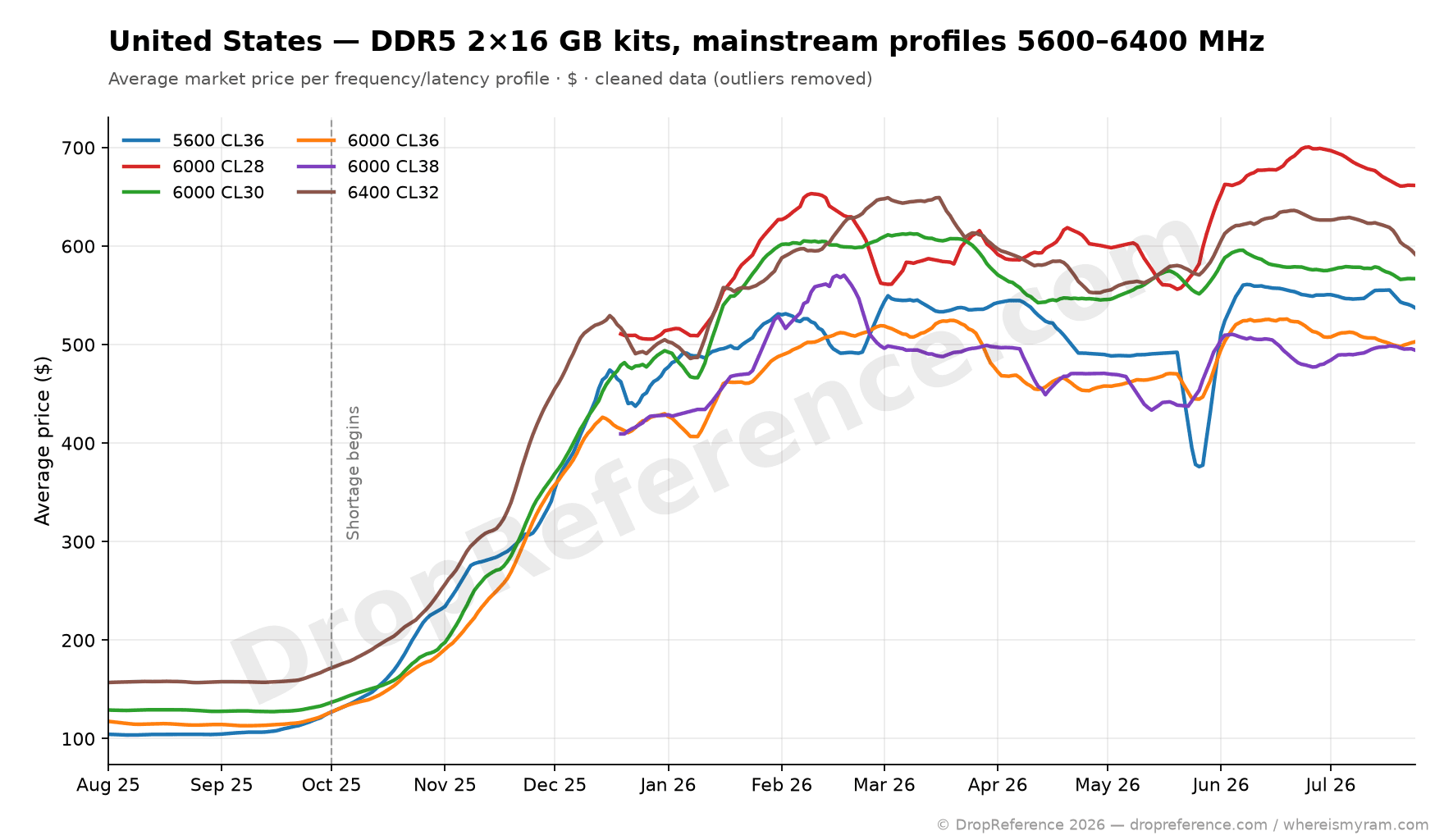
167 €. That's the cost of a basic 32 GB DDR5 kit in July 2026 at LDLC. A year ago, the same kit was around 60-70 €. You've already been the complete overview of the shortage in our dedicated article — and the situation is not brilliant. But news that came out on July 24 is shaking things up.

Yogesh Brar, a recognized analyst in the tech sector, claims that Chinese manufacturers such as CXMT and YMTC could flood the memory chip market as early as 2027 . Potential result? A significant drop in prices for everyone — smartphones, PCs, servers. "If this is confirmed, prepare for a significant drop in prices," says Brar.

Well. Before you get too excited and postpone your RAM purchase to 2027, let's take a closer look at this. Because the reality is much more nuanced than the title.

CXMT and YMTC: the two names that make Samsung tremble

The memory market is an oligopoly. Samsung, SK Hynix, and Micron together control over 95% of the global DRAM production. And they take advantage of it — they were even accused of cartel (see our article). On the NAND flash side, it's barely more open.

Beijing wants to change that. For about ten years, China has been investing billions in its semiconductor industry to become self-sufficient. The two national champions:

  • CXMT (ChangXin Memory Technologies) — based in Hefei, specialized in DRAM. They already produce DDR4 and LPDDR4X in mass. Their DDR5 is advancing, but yields remain lower than those of the Koreans. In June 2026, the Seoul Economic Daily stated that CXMT would have reached a level comparable to Samsung on HBM3 — the high-bandwidth memory used in AI GPUs. It's huge if true.
  • YMTC (Yangtze Memory Technologies) — based in Wuhan, specialized in NAND flash (SSD, storage). Already blacklisted by the United States under the Biden administration. They produce competitive 232-layer NAND chips, but American sanctions limit their access to the most advanced lithography equipment.

The recent highlight: CXMT signed a supply contract for 3 billion dollars with Tencent , and negotiates with Alibaba Cloud, ByteDance, and Xiaomi. Google would also be evaluating their chips. In short, the tech giants are starting to take them seriously.

Optimistic scenario: why it could work

Yogesh Brar's argument can be summed up in one sentence: if CXMT and YMTC manage to produce enough chips to flood the global market by 2027, Samsung and its buddies will no longer have the luxury of maintaining outrageous margins.

Concretely, here is what supports this thesis:

  • The production capacity of CXMT is increasing rapidly. The company has heavily invested in new factories. Their Hefei fab is already operational, and a second line is under construction.
  • The domestic demand in China is gigantic. Xiaomi, Oppo, Vivo, Huawei — all these smartphone manufacturers would prefer to buy local. It secures the supply chain and costs less.
  • The current prices are unsustainable. A DDR5 32GB kit multiplied by 4 in one year is not viable for the PC industry. OEMs have stocks for 9 to 12 months (according to Intel), but what about after? Even Dell and HP are looking for alternatives.
  • The previous NAND exists. When China began producing NAND flash in volume with YMTC, SSD prices temporarily dropped. Samsung responded by cutting its own production to maintain prices. This could happen again with DRAM.

In the best case scenario, we would see a price relaxation as early as the second half of 2027. Not a return to €60 per kit — but perhaps a decrease of 20 to 30% compared to current levels.

Why it's probably not for tomorrow

And now, the cold shower. Analysts from Korea Investment & Securities (KIS) have studied the issue and their conclusion is clear: the probability that Chinese chips will lower global prices in the short term is very low.

That's why.

Obstacle 1: American sanctions

CXMT is classified as a "Chinese military company" by the Pentagon. YMTC is on the list of entities subject to commercial restrictions by the US Department of Commerce. Translation: they are not allowed to purchase the most advanced lithography equipment (ASML, Applied Materials, Lam Research). This limits their ability to upgrade to the finest nodes — those that allow for the production of competitive high-frequency DDR5.

Obstacle 2: Beijing could block exports

This is the paradox. CXMT recently redirected part of its LPDDR production (mobile memory) to DDR (PC/server memory) to meet domestic demand in China. Result: DRAM shortage in the Chinese domestic market itself Chinese smartphone manufacturers are struggling to source. In this context, the Chinese government has no interest in letting these chips go abroad. On the contrary - Beijing could ban exports to protect its own industrialists.

Apple also tried to negotiate an exemption from Washington to buy RAM from CXMT. Double blockage: the US government says no (sanctions), and Beijing would probably say no too (domestic priority). The Apple case perfectly illustrates the deadlock.

Obstacle 3: production capacity is insufficient

Even without geopolitical constraints, CXMT simply cannot produce enough to impact the global market. Their current capacities barely cover domestic demand in China. To "flood the global market," they would need to multiply their production by a considerable factor. And building fabs takes a minimum of 2 to 3 years.

Obstacle 4: DDR5 yields are still lagging

According to Reuters, in Q1 2026, CXMT's DDR5 yields were still lower than those of Samsung, SK Hynix, and Micron. Producing chips is one thing. Producing chips that work with a profitable yield rate is another. And this is where the Koreans still have a massive lead.

Criterion Samsung SK Hynix Micron CXMT (China)
DRAM market share ~40 % ~28 % ~25 % ~3-5 %
DDR5 in production Yes (mass) Yes (mass) Yes (mass) In progress (low yields)
HBM3/HBM3E Leader Leader In progress R&D (comparable according to Seoul ED)
US Sanctions No No No Yes (entities list + military)
Export capacity Global Global Global Limited (domestic priority)
Main Clients Apple, Samsung Mobile Nvidia, AMD Apple, Intel Tencent, Alibaba, ByteDance
Swipe to view more

What do you actually do with your setup?

If you are waiting for a miraculous drop in RAM prices in 2027 thanks to China to build your setup, I have bad news: it's a very risky bet.

Yogesh Brar himself admits that the semiconductor crisis should persist until the first quarter 2028 minimum And even if CXMT and YMTC effectively flood the market, Samsung and SK Hynix have already shown that they know how to defend their margins — even if it means cutting their own production to maintain prices.

Some reference points to help you decide:

  • Do you need RAM now? Buy now. Prices will not drop in the next 6 months, all analysts agree on this.
  • Do you have a tight budget? Look at the DDR4. We have a dedicated article on it - it has become a relevant choice again for gaming, and prices are more stable.
  • Are you building a PC for 2027? Keep an eye on the CXMT/YMTC announcements in the second half of 2026. If their export capabilities are confirmed, you may be able to save 15-20% on your DDR5 kit. But that's a major "if."

Intel estimates that OEMs (Dell, HP, Lenovo) have built up DRAM stocks for 9 to 12 months. This means that laptop prices should not skyrocket before mid-2027 at the earliest. But for bulk RAM — the one you buy for your desktop — it's a different story. You are directly exposed to the spot market.

The real issue: AI consumes all the memory

One can turn the subject in all directions, the crux of the problem does not change. AI devours global memory production. Nvidia, AMD, Google, and Microsoft data centers are buying HBM (High Bandwidth Memory) in astronomical quantities. And HBM is stacked DRAM - manufactured on the same production lines.

Samsung, SK Hynix, and Micron logically prefer to sell HBM at $10,000 per module rather than DDR5 at $40 per stick. The margins are incomparable. Taiwanese module manufacturers (Adata, Apacer, TeamGroup) collectively raised over $880 million in debt. to survive the rise in costs. It's not a healthy market.

As long as AI continues to absorb production, Chinese chips will not be enough to fill the gap. It's a barrel of the Danaides — you fill on one side, it flows on the other.

FAQ

Are Chinese chips of lower quality?

Not necessarily. CXMT's DDR4 is already used in smartphones and servers in China without any major reliability issues. Their DDR5 is behind in yields, but the quality of the functional chips is comparable. The issue is quantity, not quality.

When will RAM prices drop?

The current consensus: not before the second half of 2027 at best, and more likely early 2028 for a real easing. The arrival of CXMT on the global market could accelerate the schedule, but the geopolitical obstacles are enormous.

Why can't Apple buy Chinese RAM?

Double lock. The United States prohibits Apple from doing business with CXMT (sanctions). And even if Washington granted an exemption, the Chinese government could block the export to protect its domestic market. CXMT is already struggling to supply its domestic customers.

Does the DRAM cartel have anything to do with this?

Indirectly, yes. Samsung, SK Hynix, and Micron have already been convicted in the past for price fixing in DRAM. The arrival of a credible Chinese competitor would be the best thing that could happen to the market — it breaks the triumph of the oligopoly. But we're not there yet.

Will Chinese DDR5 be available in France?

It's the big unknown. If US sanctions are eased and Beijing allows exports, modules integrating CXMT chips could appear at third-party manufacturers (Kingston, Corsair, etc.). But for direct sale? Unlikely in the short term.

The verdict: a hope, not a certainty

Yogesh Brar's announcement is interesting, but we must keep our feet on the ground. CXMT and YMTC are progressing quickly — their $3 billion contract with Tencent proves it. But between "serving the Chinese domestic market" and "bringing down global RAM prices," there is a gap that neither current capabilities nor geopolitics allow to be quickly filled.

The most realistic scenario: Chinese chips contribute to a slight price relaxation at the end of 2027 , mainly focusing on the LPDDR (smartphones) and DDR4 (entry-level) segments. As for the high-speed DDR5 that you're interested in for your gaming setup? You'll have to wait a bit longer.

In the meantime, current prices are here to stay. And if you need RAM, it's still best to keep an eye on promotions rather than waiting for a geopolitical miracle.