yuux
Co-founder of DropReference, I'm here to give you the best tips to build the gaming PC of your dreams!
yuux
Co-founder of DropReference, I'm here to give you the best tips to build the gaming PC of your dreams!
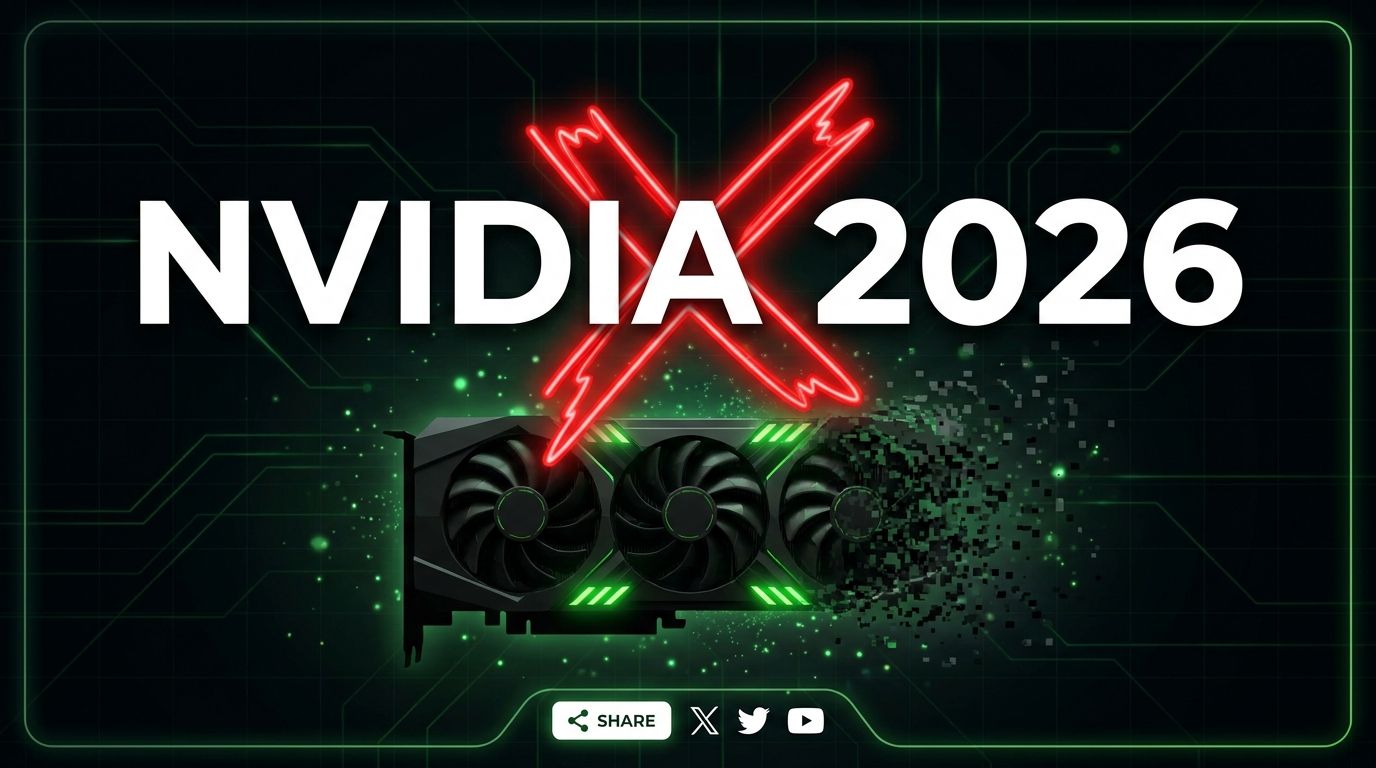
The RTX 50 SUPER are ready, physically delivered to partners. But NVIDIA refuses to launch them. The issue: 3GB GDDR7 modules at $70 each that make the cards unsellable.
This is the kind of news that would almost make you laugh if it wasn't so frustrating. The GeForce RTX 50 SUPER physically existent . They are designed, produced, and at least one NVIDIA AIB partner has actually received stock in its warehouses. Cards ready to be sold, packaged, gathering dust on shelves.
Except that NVIDIA said no.
According to the information from VideoCardz, reported by Clubic and Frandroid, the green giant has ordered its partners to do not touch the cards and to suspend all marketing until further notice. No date, no deadline announced. Just a "wait." The issue is neither technical nor logistical — the cards work. It's a matter of price. More precisely, the price of a component you know well: memory.
Three models were planned in this SUPER wave: the RTX 5080 SUPER , the RTX 5070 Ti SUPER and the RTX 5070 SUPER . The principle is the same as the previous SUPER generations: we keep the same GPU, but we boost the VRAM by switching to GDDR7 modules of 3 GB instead of 2 GB. Without changing the memory bus or the number of chips on the PCB, we gain 50% more VRAM.
On paper, it's clean. The RTX 5080 would go from 16 to 24 GB, the RTX 5070 Ti from 16 to 24 GB, and the RTX 5070 from 12 to 18 GB. Figures that would have pleased all those who complain about the lack of VRAM on the Blackwell generation — and there are many.
But between theory and launch, there is a $70 component that is blocking everything.
| Model | Current VRAM | SUPER VRAM | Memory Bus | Estimated TGP |
|---|---|---|---|---|
| RTX 5080 SUPER | 16 GB GDDR7 | 24 GB GDDR7 | 256-bit | ~415 W |
| RTX 5070 Ti SUPER | 16 GB GDDR7 | 24 GB GDDR7 | 256-bit | ~350 W |
| RTX 5070 SUPER | 12 GB GDDR7 | 18 GB GDDR7 | 192-bit | ~275 W |
| RTX 5050 9 GB | 8 GB GDDR7 | 9 GB GDDR7 | 96-bit | ~150 W |
The blockage is down to one number. A 3GB GDDR7 module currently costs between 60 and 70 dollars . A classic 2GB module? About 20 dollars Do the math: for 50% more capacity, you pay three times the price. It's a completely crazy ratio.
On a card that carries six to eight modules, the total additional cost ranges from 360 to 560 dollars just for memory. In other words, before even mentioning the GPU, the PCB, the cooling, and the manufacturer's margin, you add 350 to 550 euros to the production cost. And that, no manufacturer can absorb without skyrocketing selling prices.
To give you an idea: the current RTX 5080 is already selling for around 1,130 euros in Europe , well above the MSRP of 999 dollars. Stick 400 euros of VRAM on top and you're entering territories where even the most motivated early adopters start to think.
NVIDIA has understood this well. Rather than launching SUPER cards at grotesque prices — like an RTX 5080 SUPER at 1,600-1,800 euros — the decision was made to freeze everything. Wait for the prices of the 3GB GDDR7 to drop, or find another solution.
If the 3GB GDDR7 modules are so expensive, it's not just a factory yield issue. It's a structural problem related to artificial intelligence.
The memory foundries - Samsung, SK Hynix, Micron - all have reoriented their production massively towards HBM (High Bandwidth Memory), these stacked modules that equip data center GPUs like the H100, H200, and future Blackwell B200 from NVIDIA. HBM is where the margin is. NVIDIA buys colossal volumes for its AI accelerators, and foundries prefer to produce this rather than GDDR7 for gaming cards.
Result: standard 2GB GDDR7 is already scarce - hence the stock issues on the RTX 5090 and 5080 for months. But 3GB GDDR7 is even worse. These denser modules require a different manufacturing process, lower yields, and the few available production lines are saturated.
In short, as long as AI continues to consume all available memory on the market, the 3GB GDDR7 will remain a luxury product. And the RTX 50 SUPER will remain on the drawing board.
And it's not over. The GeForce RTX 5050 9GB — which is not technically a SUPER model but was supposed to use three 3GB GDDR7 modules — is also blocked. Same cause, same consequence.
This 9GB variant was supposed to be the affordable entry ticket in the Blackwell range. An entry-level GPU with enough VRAM to handle recent games without breaking a sweat. On paper, it was clever. In practice, putting three $70 modules on a card that should sell for around 300 euros is mathematically impossible.
Several sources, including usually reliable leakers, even mention a pure and simple cancellation of the RTX 5050 9GB. Unlike the SUPER which would be "on hold", this model may never see the light of day. At this price, NVIDIA would simply have no margin on it.
So, when can we buy them? The short answer: not before 2027.
The rumors converge towards a launch in the CES 2027 in January , provided that the prices of the 3GB GDDR7 have dropped by then. Leaker MEGAsizeGPU, who has a good track record on NVIDIA GPUs, mentions Q4 2026 at best, but most analysts are rather aiming for early 2027.
For the launch to take place, the 3GB module would need to drop below 35-40 dollars — a decrease of 40 to 50% compared to current prices. Not impossible if the foundries increase their GDDR7 production capacity in the coming months, but far from guaranteed.
And even if NVIDIA ends up launching the SUPER in 2027, don't expect miracles in terms of price. With 24 GB of GDDR7 on an RTX 5080 SUPER, we are inevitably talking about a price well above the current model. 1,500 euros does not seem unrealistic.
Waiting for the SUPER to upgrade is a risky bet. You lock your config for at least six months with no guarantee on the final price. If you need a GPU now, here's the best option:
The wisest advice: buy what is available and what you need now. Waiting for a product with no confirmed release date is the best way to stay frustrated for months.
No, not officially. NVIDIA talks about a temporary suspension, not a cancellation. The cards are physically ready with partners. But as long as the 3GB GDDR7 modules cost between 60 and 70 dollars, nothing will change. The only exception could be the RTX 5050 9GB, which is at risk of being purely abandoned.
No official date. The most optimistic rumors talk about the end of 2026, but the majority of sources point to CES 2027 (January 2027) as the most likely launch window. Everything will depend on the evolution of the price of GDDR7.
Two factors: lower manufacturing yields on these denser chips, and a massive allocation of memory capacity towards HBM for AI GPUs. Foundries (Samsung, SK Hynix, Micron) prioritize HBM production where margins are much higher, reducing the availability of GDDR7 — especially in 3GB version.
On paper, going from 16 to 24 GB of VRAM is a big leap. In 4K with heavy textures, 24 GB changes the game. But if the card is priced at over 1,500 euros, the question of value for money will seriously arise compared to an RTX 5080 at 1,130 euros which already does the job very well.
AMD does not use 3GB GDDR7 modules in its current range (RDNA 4). But the company is also experiencing the effects of memory shortages: the 2GB GDDR7 is also under pressure. On the RDNA 5 side, AMD is targeting mid-2027 for its next generation, with still vague specs. For now, the RX 9070 XT remains available and is a solid alternative.