Intel pushes back its major APU Nova Lake-S: gaming without a GPU will have to wait.

Nova Lake-S 12Xe Razor Lake-S Intel gaming APU

The Nova Lake-S with 12 Xe3P cores would switch to Razor Lake-S. What this leak really changes for gaming PCs without a graphics card.

The 12Xe of Nova Lake-S changes its name and especially its schedule

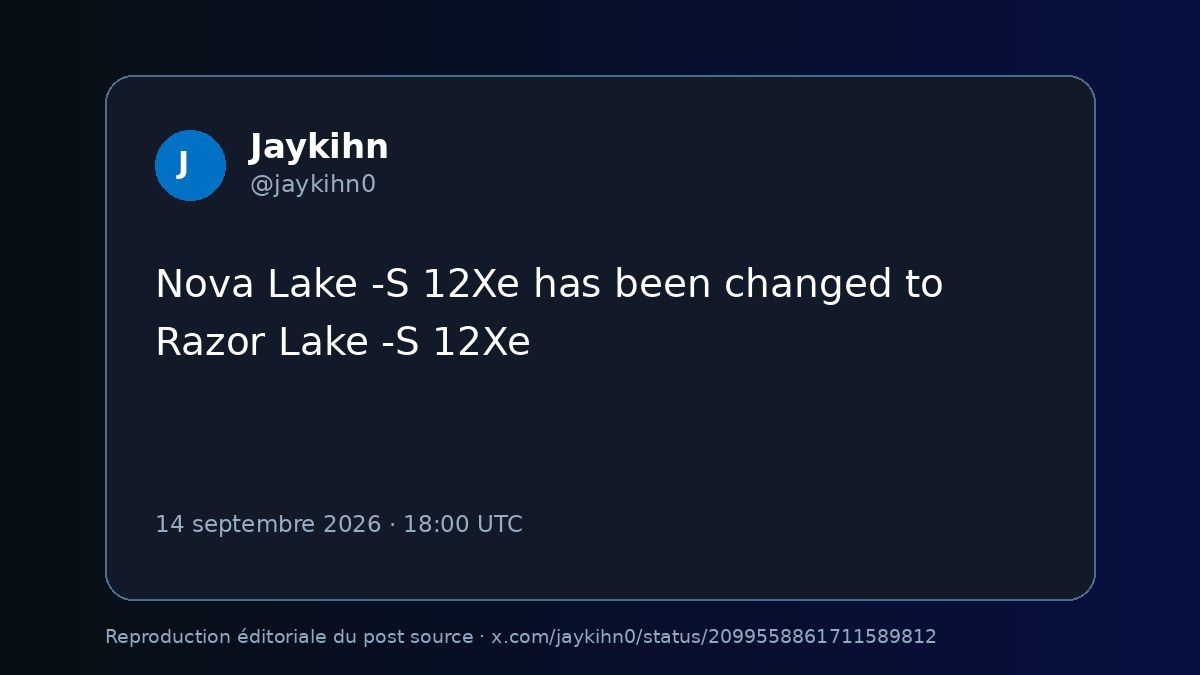
A sentence. That’s all it took to cool one of the most interesting Intel projects for the desktop PC. On September 14, 2026, the leaker Jaykihn wrote that the version Nova Lake-S 12Xe had been changed to Razor Lake-S 12Xe . No slide, no long explanation. The message fits on one line.

Post source de Jaykihn annonçant le passage de Nova Lake-S 12Xe à Razor Lake-S Click to enlarge

This post is the primary source of information. Wccftech, Tom’s Hardware, VideoCardz, TechPowerUp, and TweakTown have since picked it up, but none of these articles turn the leak into an official announcement. Intel has confirmed neither this 12Xe3P desktop model nor its transfer to Razor Lake-S . It is therefore necessary to keep the conditional from beginning to end.

It remains that Jaykihn had already published several consistent details about this chip during the summer. His history gives weight to the info, not an official stamp. The nuance seems obvious, yet it changes everything: we are talking about an internal project likely to still evolve, not a processor canceled after being presented to the public.

Why this big APU was so desirable

Desktop Intel processors generally integrate a small handy graphics circuit to display Windows, troubleshoot a config, or encode video. Playing seriously on it is another story. The 12Xe of Nova Lake-S promised to break this habit with 12 Xe3P graphic cores , making it a much more ambitious block than the service iGPU expected on the majority of the range.

According to previous leaks, the model would have combined 4 Coyote Cove P-cores, 8 Arctic Wolf E-cores, and 4 low-power cores. Total: 16 CPU cores, not counting the 12 Xe3P cores. The graphics part would have had about 20 MB of L2 cache and a PL2 of 40 W. The complete package could rise to 154 W. So it was not a small old-school Ryzen G, but a desktop chip designed around a real graphics budget.

Another figure has circulated a lot: 65 W. Beware of the trap. Jaykihn was talking about a 65 W class motherboard power supply segment necessary to unleash all graphical performance, with two VCCGT phases. It did not say that the iGPU would constantly consume 65 W. The mentioned graphical limit remained at 40 W.

On paper, this type of chip could power a compact PC without a graphics card, a powerful HTPC, or a sleek tower intended for 1080p. This is why the shift to Razor Lake-S hurts: Intel is delaying the product that would finally have given a clear gaming interest to its desktop iGPU.

Element Nova Lake-S 12Xe mentioned before the leak Situation as of September 16, 2026
Family Nova Lake-S desktop Would switch to Razor Lake-S
CPU 4 P-cores + 8 E-cores + 4 LP E-cores Configuration not confirmed
iGPU 12 Xe3P cores, about 20 MB of L2 Still expected according to the leak, but later
Power 40 W PL2 for the iGPU, 154 W for the package Values from leaks, subject to change
Plateforme LGA 1954 and DDR5 Razor Lake-S would also use LGA 1954
Calendrier After the first Nova Lake-S About a year later according to several sources
Status Project not announced by Intel Rumor from a single leaker, picked up by the press
Swipe to view more

What would remain for the Nova Lake-S office

Nova Lake-S does not disappear. The desktop range is still expected with new CPU architectures and the LGA 1954 socket. Intel had publicly mentioned Nova Lake for the end of 2026. Leaked partner schedules now place mass production in the fourth quarter of 2026 and the first sales in the first quarter of 2027. This overall delay has not yet been clarified by Intel.

For integrated graphics, the chart would be much less exciting. The classic versions of Nova Lake-S would settle for smaller blocks, with up to 4 Xe3 cores according to the information published after Jaykihn's post. That's enough for display, video, office use, and some light gaming. Not enough to properly replace a graphics card in the latest big games.

The suffix also counts. Nova Lake-S designates the desktop on socket . The mobile variants of Nova Lake would not necessarily be affected by this decision and could still receive more robust graphics configurations. Another variant called Nova Lake Edge, mentioned with 8 E-cores and 12 Xe3P, also seems to belong to a separate project. Nothing suggests it should be dismissed solely because of this tweet.

In other words, it should not be written that Intel is abandoning all the large iGPUs. The issue concerns a very specific product: the socketed model that one could imagine in a small tower or a Mini-ITX build without a dedicated GPU.

Xe3P is not just a number of cores

Comparing 12 Xe3P cores to 12 units of another architecture means nothing. Intel changes the operation of Xe cores, XMX matrix units, caches, and the graphics front-end from one generation to the next. Frequencies, memory, and power limits will at least as much determine the result as the number 12 written on a sheet.

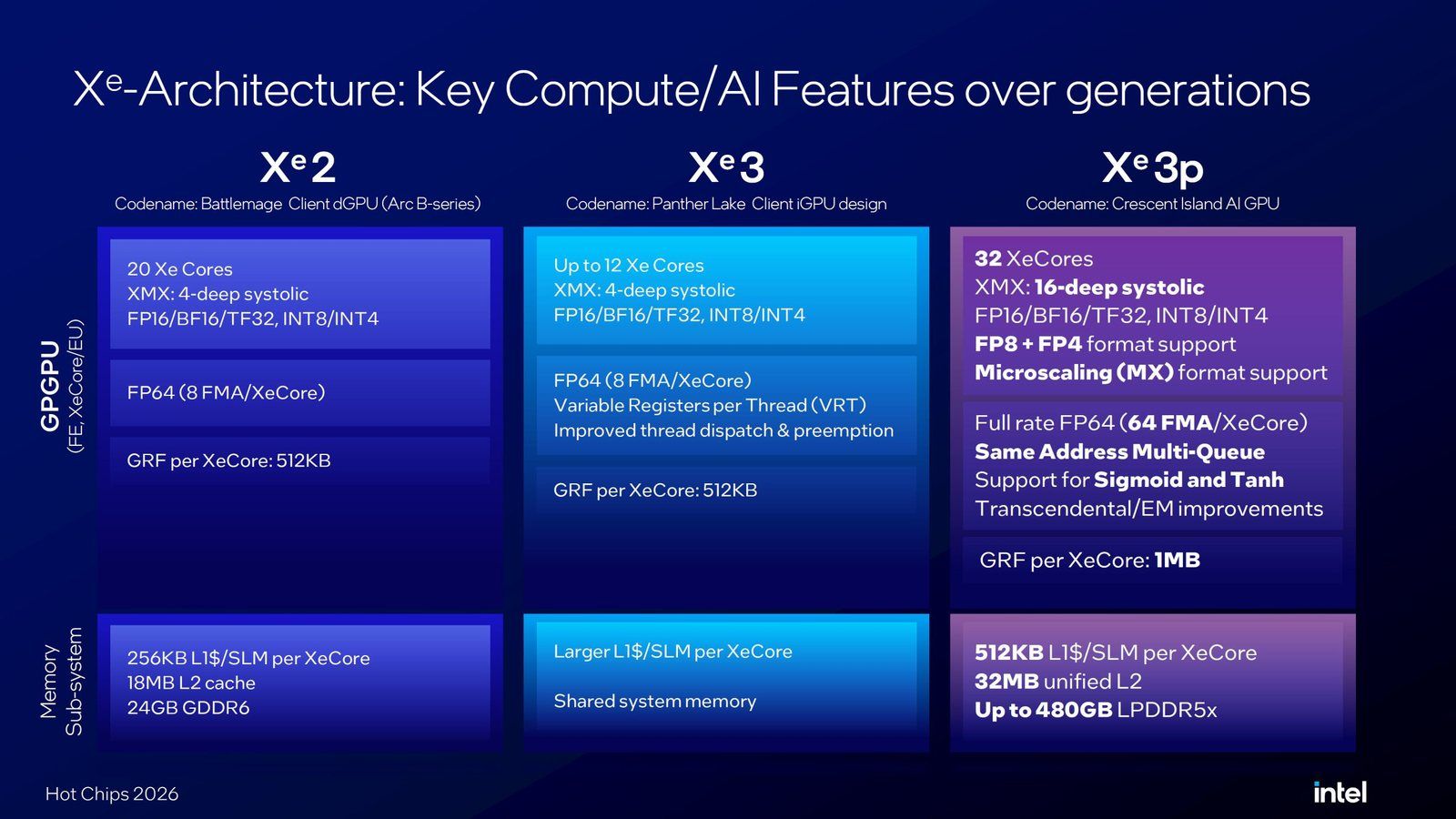
Slide Intel Hot Chips 2026 comparant Xe2, Xe3 et Xe3P Click to enlarge

The slide above deserves a cautious caption. It presents Xe3 as the client iGPU of Panther Lake and Xe3P in the context of Crescent Island, an AI GPU. It shows the technical evolution of the Xe family, not the official plan of the future APU desktop . Using it as proof of the transfer from Nova to Razor would be false.

We still have an official benchmark. For Panther Lake, Intel announced up to 12 Xe3 cores and more than 50% additional graphics performance compared to the previous generation in its own tests. This confirms that Intel knows how to build a significantly more serious iGPU. But Panther Lake mainly targets mobile, with a different memory and energy integration than a desktop LGA processor.

The real brake on integrated gaming remains the memory

A large iGPU can have good compute units and find itself starved by RAM. Without dedicated GDDR, it shares system memory with the CPU. The higher the resolution, the more textures and transfers demand bandwidth. A slow or poorly configured DDR5 setup can therefore sabotage a promising chip.

Leaks around Nova Lake and Razor Lake talk about faster DDR5, with CSO-DIMMs at 8,000 MT/s in some scenarios. Again, this is not a final specification. And 8,000 MT/s does not guarantee anything on its own: the number of channels, latency, memory controller, and graphics cache will make the difference.

This is precisely one of the advantages of AMD with Ryzen AI Max. The Ryzen AI Max+ 395 officially combines 40 Radeon graphics units with a 256-bit LPDDR5X interface and can reach 256 GB/s on the AMD reference platform. It is impossible to directly compare 40 RDNA CUs to 12 Xe3P cores, but the memory bandwidth explains why Strix Halo is so comfortable in machines without a dedicated GPU. Intel will have to respond in this area, not just in a core count table.

To play without a graphics card in 2027, what does it change?

If you were planning to build an LGA 1954 tower without a dedicated GPU, the bad news is real. The Nova Lake-S standard should boot Windows, play video, and run less demanding titles without issue. For a Cyberpunk 2077, an Unreal Engine 5 game, or even a heavily texture-loaded AAA, four Xe3 cores will probably not be the comfortable solution. We will avoid making FPS figures until the silicon is tested.

The simplest consequence is the cost. An entry-level graphics card easily adds several hundred euros, takes up space, requires a more powerful power supply, and blows more air in a small case. The 12Xe project made sense precisely because it removed this link. If the processor only arrives with Razor Lake-S, this benefit will also have to wait.

There are several exit doors. A laptop or some Panther Lake mini-PCs can already offer a much stronger Xe3 iGPU than that of a classic desktop CPU. AMD, on its side, sells Ryzen AI Max chips and other more accessible APU. Finally, a small dedicated graphics card will be easier to upgrade than an iGPU soldered to the processor.

So no, all gaming PCs without a graphics card are dead until 2028. It is mainly the Intel desktop choice on socket that loses its most attractive option . The difference is important.

Mini-PC and Mini-ITX: let's not mix everything up

The term mini-PC covers two worlds. On one side, compact cases equipped with a soldered mobile chip, like many Minisforum, Beelink or GMKtec models. On the other, the real small Mini-ITX towers with a desktop motherboard and a replaceable processor. The leak directly affects the second category.

Manufacturers of soldered mini-PCs can continue to use Panther Lake, Ryzen AI Max or future mobile variants Nova Lake if they are released as expected. For them, the post of September 14 is not a guillotine. Manufacturers of small LGA 1954 towers, on the other hand, lose the ideal candidate to offer a compact, scalable machine without a graphics card.

The 154 W PL2 mentioned for the package required staying realistic. Even without a dGPU, this chip would have needed a motherboard capable of properly powering the graphics block and serious cooling. We were far from the passive mini-PC slipped behind a screen. The gain was in the size of the GPU, not in miraculous consumption.

AMD is still gaining time without forcing

AMD does not need to respond to a product that is declining. Strix Halo, marketed under the Ryzen AI Max brand, is already at the top of the range of chips with large iGPUs. The machines are expensive, sometimes very expensive, but they exist. Intel, on the other hand, could have brought an alternative on socket and opened the door to more repairable PCs. That was the truly original part of the project.

The supposed delay gives AMD several additional months, perhaps an entire year, to lower prices, decline its technology, or prepare the next steps. The classic Ryzen G also has a simple argument: you can buy a desktop platform today that runs without a dedicated card, even if it means aiming for reasonable settings.

Razor Lake-S could turn the table later. Same LGA 1954 socket, newer CPU architecture, better matured Xe3P: on paper, the whole remains attractive. But a good product in 2028 does not fill the gap of 2027. And the longer Intel waits, the higher the expected performance rises. A decent 12Xe will no longer be enough; it will be necessary to come with a real price or versatility advantage.

Should we wait for Razor Lake-S?

Today, no. Not to buy a PC. We do not know the firm date, nor the references, nor the price, nor the performance of the 12Xe model. The only new element is a message from a leaker indicating a change of family. Delaying a purchase for a year or more on this basis would frankly be risky.

If your need is immediate, choose according to the machine. For a small expandable tower, a CPU with a backup iGPU plus a dedicated graphics card remains the simplest route. For a very compact PC without a dGPU, look at the real tests of Panther Lake and Ryzen AI Max, then the noise, the RAM, and the power limit of the specific model. The name of the processor never tells the whole story.

If you already have a good setup, then you can wait calmly. The LGA 1954 is presented by several leaks as a multi-generation platform covering Nova Lake-S then Razor Lake-S. This would be good news for scalability, but Intel still needs to confirm commercial compatibility, chipsets, and BIOS updates. Buying a motherboard on an unofficial promise remains a gamble.

FAQ on the Nova Lake-S 12Xe delay

Has Intel officially canceled the big iGPU Nova Lake-S?

No. Intel had not even publicly announced this reference. The transfer to Razor Lake-S comes from a post by Jaykihn published on September 14, 2026, then picked up by several media outlets.

Is the 12Xe3P completely canceled?

According to the leak, no. The configuration would change family and become Razor Lake-S 12Xe. The exact timeline is not known, and the product may still evolve.

Will all Nova Lake-S have a bad iGPU?

They should retain an integrated graphics circuit, but classic desktop models would be limited to significantly smaller blocks. Sufficient for display and light gaming, probably not enough to replace a modern graphics card.

Are all mini-PCs affected?

No. Mini-PCs with soldered mobile processors can use Panther Lake, Ryzen AI Max, or future mobile variants. The relocated project is a Nova Lake-S desktop processor intended for the LGA 1954 socket.

When could Razor Lake-S be released?

The leak relays suggest around a year after Nova Lake-S, so late 2027 or 2028 according to the chosen schedule. Intel has not provided any official date for Razor Lake-S.

What sources were used?

The primary source is the post by Jaykihn of September 14, 2026 . The previous technical details come from his posts on July 28 and August 9 about the power segment, the 40 W PL2 graph, and the 154 W PL2 package. The information has been cross-checked with Wccftech , Tom’s Hardware and TechPowerUp. For the official reference, the Intel announcement on Panther Lake from October 9, 2025, mentions up to 12 Xe cores and over 50% graphics gain. The specifications of the Ryzen AI Max+ 395 come from the AMD product sheet.