Intel Arc Battlemage 2026 Graphics Cards: Everything You Need to Know Before Buying

Intel graphics card Intel graphics card

2026 buyer’s guide to Intel Arc Battlemage graphics cards (B580, B570): real street prices, drivers, 1080p/1440p performance, and how they stack up vs RTX 50 and RX 9000.

Author
yuux
Co-founder of DropReference, I'm here to give you the best tips to build the gaming PC of your dreams!

Why it can be interesting to choose Intel

Wondering why buy an Intel graphics card rather than an NVIDIA/AMD one? Here are the good arguments:

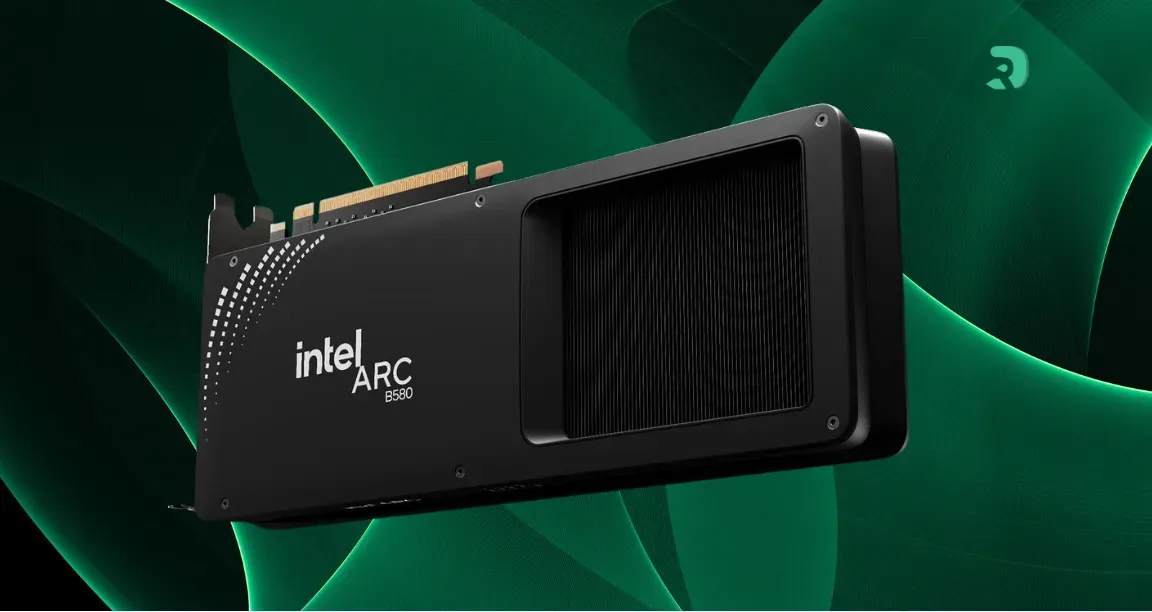
  • Intel arrived quite late in the dedicated GPU market, but it also means that they were able correct the errors , and propose a different offer For example, Arc cards offer modern features (Ray Tracing, AI upscaling via XeSS 2, AV1, and especially lots of VRAM (12GB on the B580)) at aggressive prices.
  • Report performance/price very interesting : around $260–$310, a B570/B580 is often the best $/FPS under $400 versus an 8GB RTX 5050.
  • One good compromise for gamers or creators on a medium budget who do not necessarily aim for the very high-end 4K ultra but want something solid in 1080p/1440p.
  • The " CPU brand history "Intel's can reassure (even if on GPU, it's a bit new)."
  • The Intel Iris Xe iGPUs (see section below) already offer very decent integrated graphics for lightweight/office/light gaming PCs r - so the Intel graphics universe is starting to be coherent.

👉 In summary: if you want quality, something "fairly high" for your budget without breaking the bank, and you are open to an alternative to the "big two," then Intel Arc deserves your attention.

How does Intel compare to AMD and NVIDIA

intel-gpu-b580 Click to enlarge

To put it simply: Intel is playing for third place in the dedicated GPU market. Here are the key points to know:

✅ What Intel does well

  • Intel Arc supports modern APIs (DirectX 12 Ultimate, Ray Tracing) and has its own AI-based oversampling system, XeSS, aligning the brand with features offered by NVIDIA (DLSS) or AMD (FSR).
  • Competitive prices , good performance for their segment.

⚠️ Where Intel is still behind

  • The catalog is more limited that AMD/NVIDIA (fewer models than AMD/NVIDIA; drivers improved a lot through 2026, but the ecosystem still trails CUDA/DLSS).
  • For the very high end (4K ultra, RTX 5090 / RX 9070 XT), Intel is not dominant yet .

Simplified comparison

👉 Verdict: If you want the best all-around, NVIDIA remains a step ahead. If you want a good budget/performance choice, AMD and Intel are very competitive. Intel stands out especially for good value for money and a different positioning.

What are all the available models & equivalences at NVIDIA/AMD

Here is a selection of available Intel Arc cards + approximate equivalents at NVIDIA/AMD.

Additional notes

  • Intel has announced that certain models "A-Series" are now end of life (EOL): for example, the A750 Limited Edition is officially discontinued.
  • The Battlemage lineup (B580/B570) remains Intel’s desktop gaming reference in 2026 — street ~$310 / ~$260 — with regularly updated Arc drivers .

FPS Comparison (Intel Arc vs RTX 5000 / RX 9000)

Do you want to know how Intel Arc graphics cards perform in games?

We compiled average FPS on demanding titles (Cyberpunk 2077, Horizon Forbidden West, Call of Duty MW3, Fortnite, Starfield) according to the resolution. The numbers correspond to average FPS on "High" settings, with Ray Tracing disabled and XeSS/FSR active.

Real-time Intel GPU stocks

With DropReference, you have access to all available stocks in your country at a glance:

Choose your delivery country to see prices based on your location

Filters

Aucun résultat trouvé

No results found

Try adjusting your search criteria

You can also set up notifications for the active filter and get alerted about restocks, price drops, etc.

To do this, you need to be connected via discord

What is the future of Intel GPUs

We look at what happens:

  • As of mid-2026, Battlemage remains the latest Arc desktop gaming generation; a discrete "Celestial" / Xe3P successor is not confirmed. Intel previously talked about Next Arc Family after Battlemage, but public focus has shifted toward iGPUs, Pro/AI (Arc Pro B50/B60), and datacenter.
  • If a next gaming dGPU arrives (possibly around Xe4 "Druid", still unclear), it should improve performance , energy efficiency, and aim more for the high end.
  • Intel is also expanding its Pro range (Arc Pro B50/B60) for workstations and AI : 16 GB/24 GB of memory announced.
  • What this means for you/user: either you jump now to take advantage of the good value for money, or you wait for the next generation if you are aiming for the very high end.

Intel Iris Xe Graphics Cards (iGPU)

If you do not want (or not right away) to invest in a dedicated graphics card , Intel Iris Xe is the integrated GPU that equips a large part of recent laptops and mini-PCs. Clearly, it is not made for 4K Ultra, but for boosted office work, multimedia 4K/AV1, and eSports gaming in 1080p (moderate settings), it is much more solid than the old "Intel UHD".

In a nutshell:

  • Ideal if you are looking for a responsive ultrabook , a media mini-PC, or a laptop "all-terrain" with a little play.
  • To upgrade to Intel Arc if you want 1440p , exploitable Ray Tracing, or demanding AAA games.

⚠️ Limits: shared memory (no dedicated VRAM), performance depends on TDP, number of EU (Execution Units), and RAM (ideally dual-channel), less comfortable with recent AAA titles.