DLSS 5: NVIDIA's neural rendering arrives tomorrow, and it's already dividing opinions.

DLSS 5 NVIDIA neural rendering RTX 50 Series

NVIDIA launches DLSS 5 on September 3 with NBA 2K27. Leaked benchmarks, controversy over the AI beauty filter, 50% performance drop — let's take stock before the release.

DLSS 5 comes out tomorrow: what NVIDIA is preparing with neural rendering

September 3, 2026, 9 PM Pacific Time. This is the date that NVIDIA has just confirmed for the launch of DLSS 5 , the most ambitious — and the most controversial — update of its upscaling technology since the invention of DLSS in 2018. First compatible game: NBA 2K27 , developed by Visual Concepts.

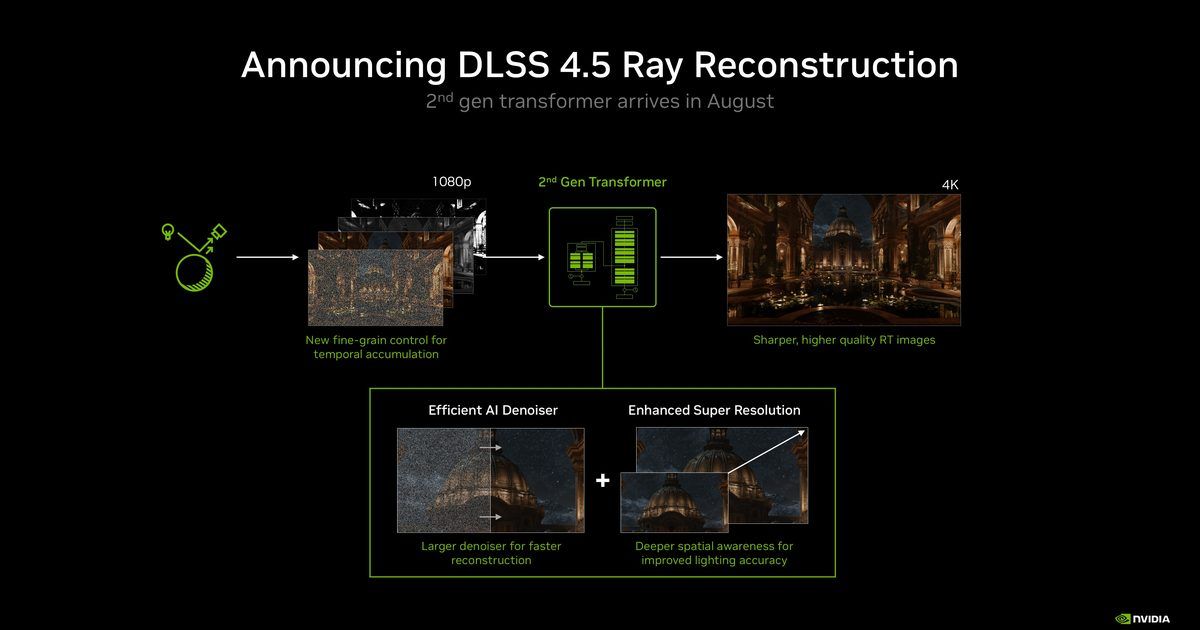
So yes, everyone knows DLSS. Super Resolution for upscaling, Frame Generation for generating intermediate frames, Ray Reconstruction for cleaning up ray tracing. That was DLSS 4.5. DLSS 5 is something fundamentally different.

NVIDIA calls it the "3D-Guided Neural Rendering" . In short, AI no longer just reconstructs the image more clearly or generates additional frames. It redraw completely the materials and the lighting of the scene to make them photorealistic. The skin of a character that diffuses light like real skin, the hair that captures reflections naturally, the deeper contact shadows... Jensen Huang did not hesitate to talk about "moment GPT for graphics" . Just that.

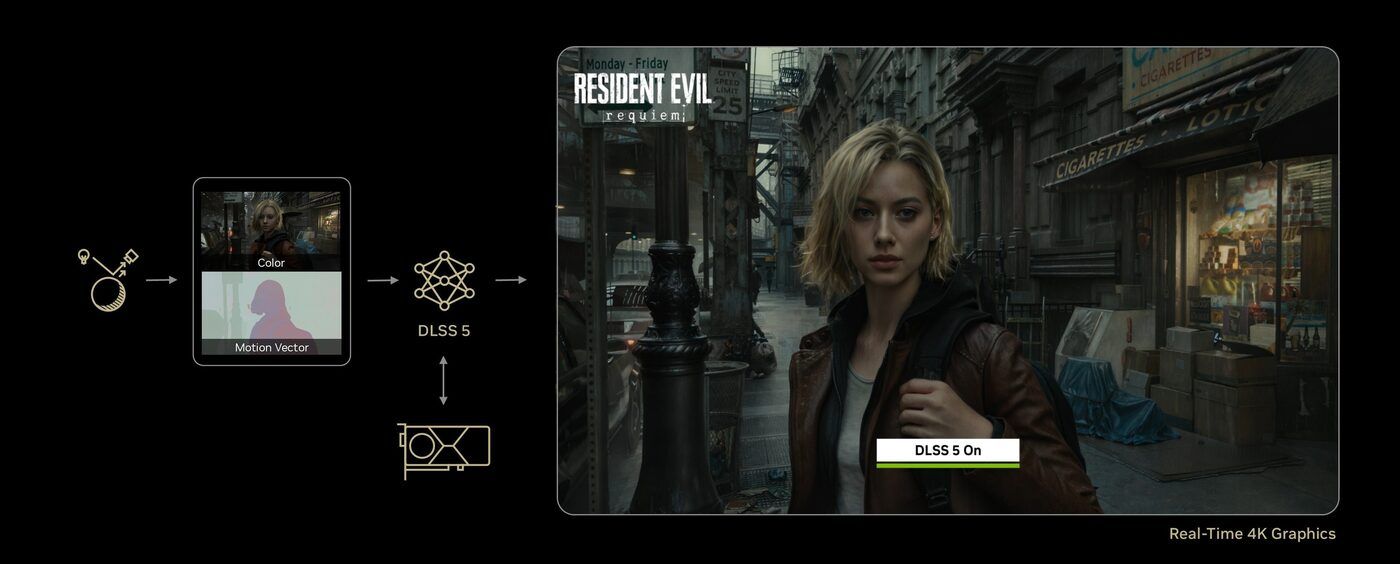
Schema fonctionnement DLSS 5 color motion vectors neural rendering Click to enlarge

In practice, DLSS 5 retrieves the frame rendered by the game engine — with all the geometry, textures, lighting buffers — and uses a specialized AI model to synthesize a more realistic rendering on top. The result is deterministic (no random variation from one frame to another) and temporally stable thanks to the motion vectors of the engine. It's not video generation like Sora, it's real-time rendering grounded in the game's 3D data.

Compatibility: RTX 50 Series only at launch — desktop, laptop and GeForce NOW. Your RTX 4090? Not invited. NVIDIA justifies this by the latest generation Tensor Cores needed to run the neural model in real time up to 4K.

Benchmarks: between NVIDIA promises and the reality of leaks

Let's start with what annoys. Last weekend, a DLL of DLSS 5 leaked via the NBA 2K27 beta. Modders immediately injected it into Control — a game that is absolutely not optimized for this tech. Result on a RTX 5070 Ti in 4K : from 71 FPS to 35 FPS. Half. Gone.

Obviously, this test should be taken with huge grains of salt. It's an unofficial mod, in an unsupported game, with unknown settings. But it gives an idea of the raw cost of neural rendering on the GPU.

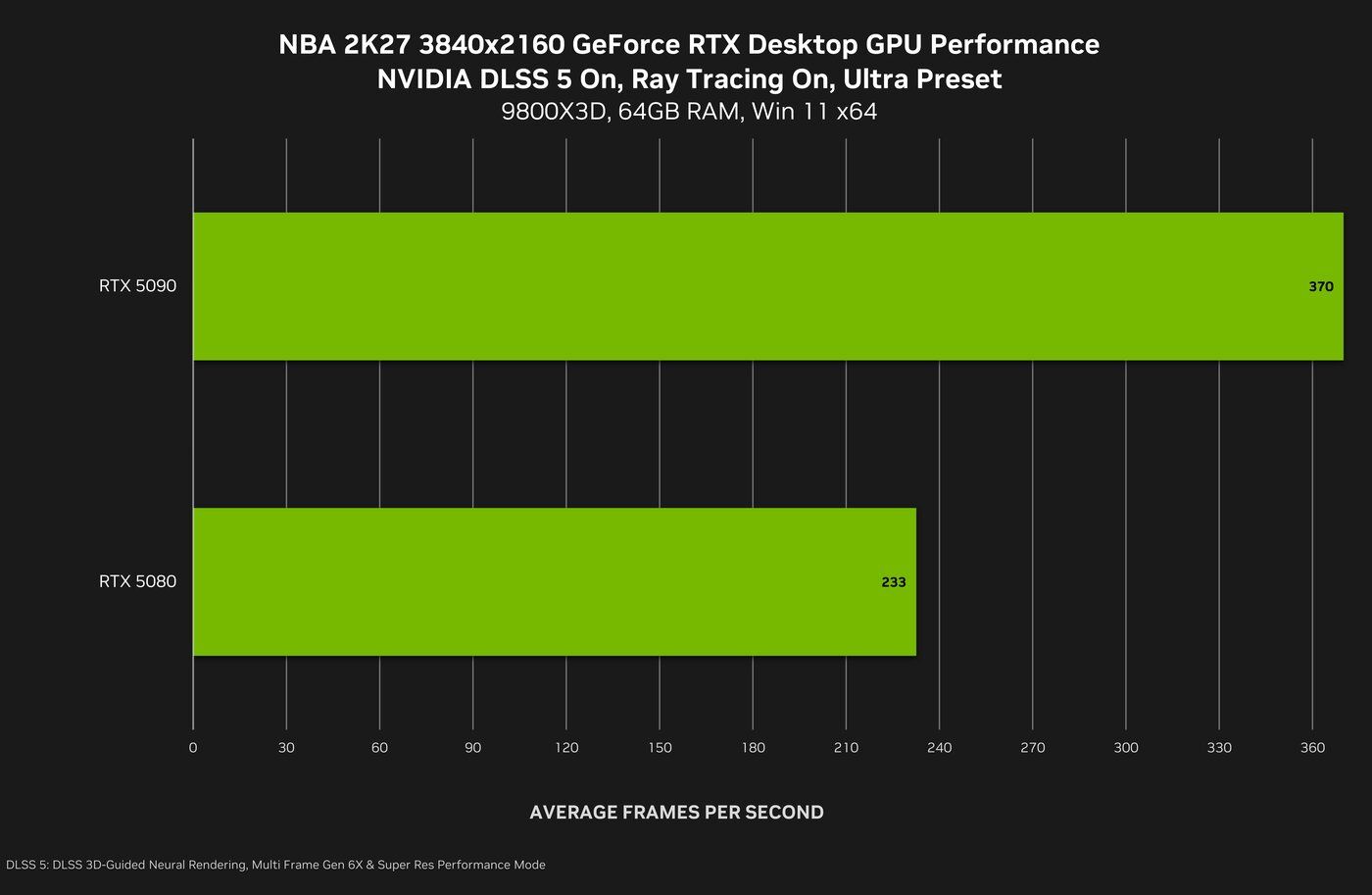
On the NVIDIA side, the official figures are more flattering — but they come with a big asterisk. According to IGN, NVIDIA itself acknowledges that DLSS 5 costs 50 to 60% of performance in NBA 2K27. The difference is that NVIDIA relies on the rest of the DLSS suite (Super Resolution + Multi Frame Generation) to compensate for this deficit. And in NBA 2K27, it results in numbers that are mind-blowing:

DLSS 5 benchmarks 4K NBA 2K27 RTX 50 Series performance Click to enlarge

370 FPS in 4K Ultra with ray tracing on an RTX 5090. It's absurd. But be careful: these numbers include Multi Frame Generation which artificially multiplies the number of frames displayed. The number of frames really rendered by the GPU is much lower. NVIDIA has not published any proper comparison DLSS 5 ON vs OFF at identical settings — which is still quite revealing.

GPU 4K Ultra + RT 1440p Ultra + RT 1080p Ultra + RT
RTX 5090 370 FPS 590 FPS ~600+ FPS
RTX 5080 410 FPS
RTX 5070 Ti 350 FPS
RTX 5070 260 FPS
RTX 5060 250+ FPS
Swipe to view more

The controversy: AI beauty filter or real graphic advancement?

And this is where it gets interesting — or toxic, depending on the point of view. Since the announcement of DLSS 5 in March, the gaming community is split in two. On one side, those who find that neural rendering indeed makes an impressive visual leap. On the other, players and developers who denounce what they call a "Snapchat filter" applied to video games .

The main problem? DLSS 5 tends to smooth out faces, to "beautify" characters and to alter the lighting in a way that strays from the original artistic direction. Screenshots have circulated showing characters with overly perfect skin, softened features, artificially flattering lighting. The term "AI slop" has come up dozens of times in discussions on Reddit and Twitter.

Kotaku reported that several interviewed developers were furious — some felt "caught off guard" by the way the tech was altering their characters in the demos. Jensen Huang responded by saying that gamers were "completely wrong" and that studios maintained total control over the implementation of DLSS 5. NVIDIA highlights the integrated artistic tools: AI model selection by scene, intensity control (structure, tone), automatic semantic masking that recognizes characters, environments, and objects to apply the effect differently.

Peter Kavic, senior producer at Visual Concepts (NBA 2K27), defends the tech: "We can define the overall tone and style to match our artistic direction, then be very precise where it matters with a pixel control mask." Not at all the same version as the anonymous developers cited by Kotaku.

My opinion? The truth is probably somewhere in between. In a game like NBA 2K27 that aims for pure photorealism, DLSS 5 makes perfect sense — making basketball players even more realistic aligns with the art direction. But in a stylized game like Zelda, Hades, or even a Resident Evil with a deliberately dark and grainy artistic direction? The risk of distorting the rendering is real. It will all depend on how studios use the controls that NVIDIA gives them.

From two RTX 5090 to a single GPU in six months

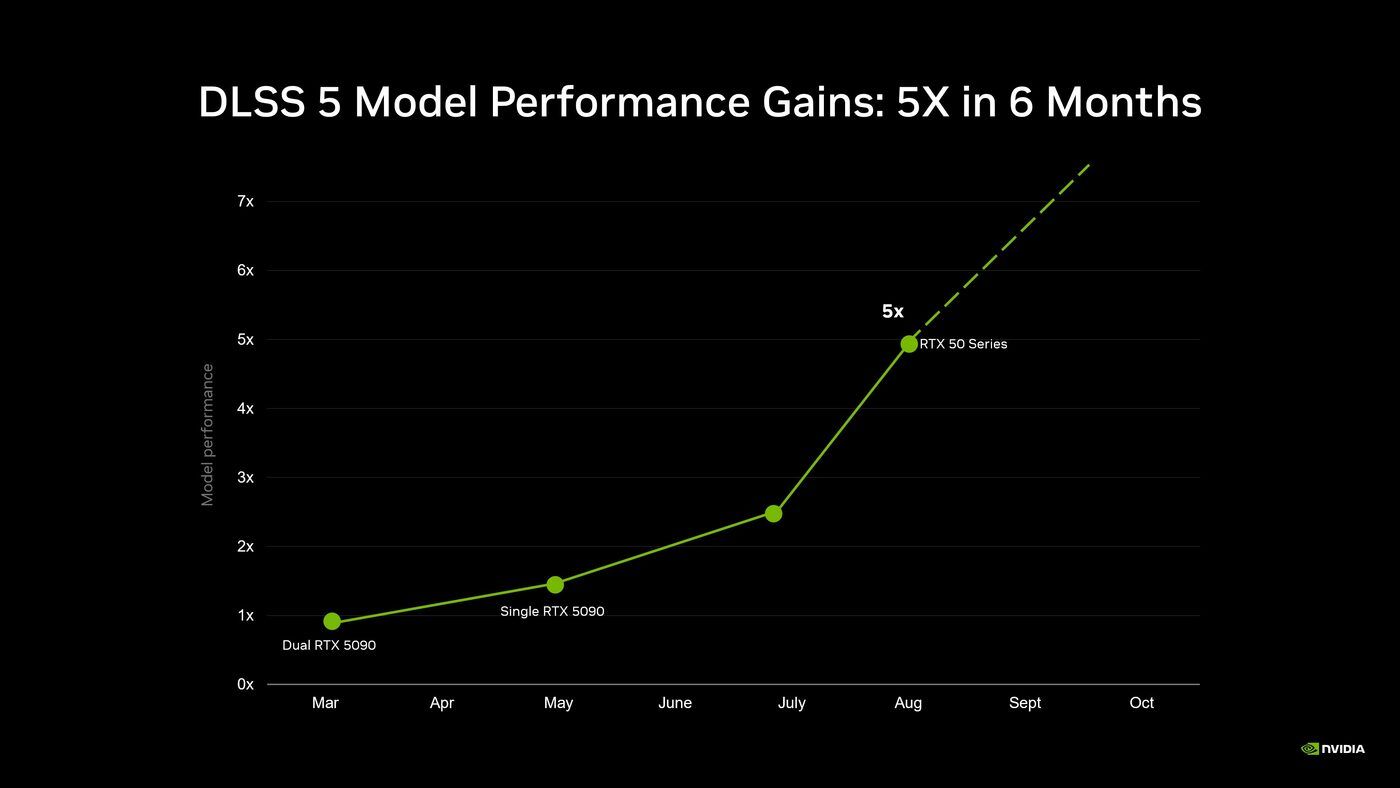
One point that should not be ignored: DLSS 5 has made astonishing technical progress in a short time. In March, during the initial announcement, the demo was running on two RTX 5090 in parallel . Six months later, it runs on a single card — including the RTX 5070. NVIDIA claims a performance gain of 5x in six months thanks to pipeline and neural model optimizations.

DLSS 5 optimization progress 5x faster in 6 months Click to enlarge

And according to NVIDIA, the optimization curve is not flattening yet. Model updates are planned for this fall to further improve performance. This is an important point: even if DLSS 5 consumes 50% of FPS today, this figure will probably decrease with future iterations. We saw it with the original DLSS — v1 was mediocre, v4.5 has become essential.

DLSS 5 vs DLSS 4.5 : two completely different philosophies

Small clarification for those who confuse the two. DLSS 4.5 and DLSS 5 are not at all the same thing.

DLSS 4.5 = intelligent reconstruction. The game outputs a low-resolution image, and the AI reconstructs it in high resolution with fewer artifacts, more details, and bonus generated frames (up to 6x with Multi Frame Generation). The goal: to run games faster and cleaner. It's performance boost.

DLSS 5 = neural rendering. The AI does not reconstruct the existing image — it generate a lighting and more realistic materials over the frame rendered by the engine. The goal: to make games appear best, at the price of performance. It's quality boost.

The two are complementary and can run together. NVIDIA's idea is: DLSS 5 improves visuals (and costs FPS), then Super Resolution and Frame Generation recover the lost FPS. On paper, you win on both fronts. In practice, it remains to be seen with independent tests — which will arrive as early as this week.

The 15 games confirmed for DLSS 5

NBA 2K27 is the first, but NVIDIA has already announced support for 14 other titles. The official list:

  • AION 2 (NCSOFT)
  • Assassin's Creed Shadows (Ubisoft)
  • Black State
  • CINDER CITY
  • Delta Force (Tencent)
  • Hogwarts Legacy (Warner Bros.)
  • Justice (NetEase)
  • NARAKA: BLADEPOINT (NetEase)
  • Neverness to Everness (Hotta Studio)
  • Phantom Blade Zero (S-GAME)
  • Resident Evil Requiem (CAPCOM)
  • Sea of Remnants
  • Starfield (Bethesda)
  • The Elder Scrolls IV: Oblivion Remastered (Bethesda)
  • Where Winds Meet

Bethesda and CAPCOM are the heaviest names on the list. Todd Howard confirmed that Starfield and future Bethesda titles will incorporate DLSS 5. Jun Takeuchi (CAPCOM) promises the tech for Resident Evil Requiem. Ubisoft brings Assassin's Creed Shadows into the mix — logical for a game that already pushes path tracing.

Special mention for EA SPORTS FC which also appears in some NVIDIA demos but is not (yet ?) in the official list. Other titles should be added in the coming weeks and months.

How to enable DLSS 5 in NBA 2K27

If you have an RTX 50 Series and you want to test it starting tomorrow evening, here is the procedure to follow:

  1. Download the Game Ready Driver of September 3 via the NVIDIA site or the NVIDIA app
  2. In NBA 2K27, go to Video Settings
  3. Active "DLSS Neural Rendering"
  4. Configure Super Resolution, Frame Generation and Reflex according to your preferences
  5. In game, you can switch the neural rendering with F9 to compare in real time

NVIDIA recommends at least a RTX 5070 for a comfortable experience. On a RTX 5060, it will technically work but the FPS may be tight in 4K — 1080p will be more realistic.

Verdict and FAQ

DLSS 5 is a gamble. NVIDIA chooses to use AI not just to boost performance, but to actively modify the visual rendering of games. It's ambitious, it's potentially revolutionary, and it's also potentially intrusive. Everything will depend on the execution: if studios use artistic controls correctly and NVIDIA continues to optimize the model, we could look back in two years and see this as a turning point. If it's poorly calibrated, it will just be an Instagram filter for a $1000 GPU.

This week's independent tests will be decisive. In the meantime, we remain cautiously optimistic.

Is DLSS 5 compatible with my RTX 4090?

No. At launch, DLSS 5 is exclusive to the RTX 50 series (desktop, laptop, and GeForce NOW). The RTX 40, 30, and 20 are not supported. NVIDIA has not announced any future backward compatibility, but it is not excluded if the AI model is sufficiently optimized.

Does DLSS 5 replace DLSS 4.5?

No, they are complementary. DLSS 5 (neural rendering) adds on top of Super Resolution, Frame Generation, and Ray Reconstruction. You can enable both at the same time — this is actually what NVIDIA recommends to offset the performance cost of neural rendering.

How many FPS does DLSS 5 cost?

NVIDIA acknowledges a cost of 50 to 60% in NBA 2K27. A leak in Control shows a drop from 71 to 35 FPS on RTX 5070 Ti at 4K. But these numbers are evolving: NVIDIA promises ongoing optimizations and the model has already improved by 5x in six months.

Does DLSS 5 really change the faces of characters?

It is the subject that divides. The screenshots show visible differences on the faces — smoother skin, modified lighting, features sometimes softened. NVIDIA claims that studios have full control through semantic masking and intensity adjustments. The final result will depend on each implementation.

When will the other games have DLSS 5?

NVIDIA says "this fall" for the upcoming titles. 15 games are officially confirmed but without a specific date beyond NBA 2K27. Integration is done via the Streamline framework or the Unreal Engine 5 plugin, which should accelerate adoption for studios already using these tools.