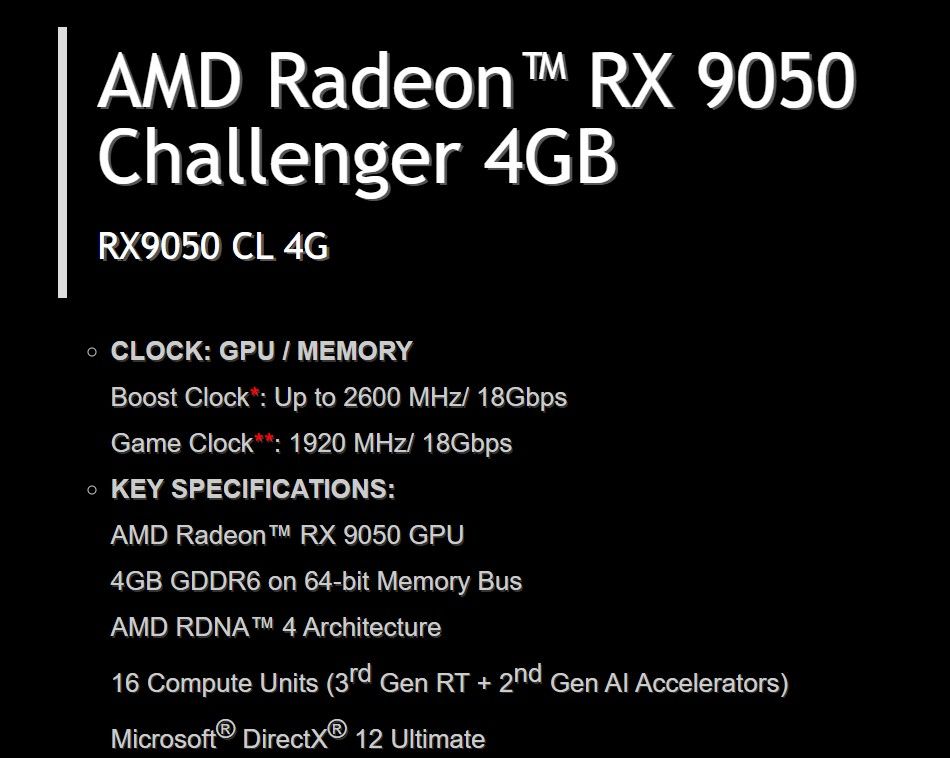
The RX 9050 is based on the die Navi 44 — the same silicon as the RX 9060 XT, but cut in half. We're talking about 16 Compute Units out of the 32 available , soit 1 024 Stream Processors. C'est ce qu'on appelle du CU harvesting : AMD récupère les puces qui ne passent pas le contrôle qualité en config complète et les revend en version réduite. Classique, mais efficace.
199 mm² of die in TSMC N4P, 29.7 billion transistors. The boost clock goes up to 2,600 MHz as a reference - Sapphire pushes to 2,760 MHz on its PULSE with Honeywell PTM7950 in thermal paste. And all this consumes 92W of TBP . Only one 8-pin connector, 450W recommended power supply. That's 40W less than the non-XT RX 9060. Basically, a card that doesn't heat up, consumes nothing, and fits in any case.
On the memory side, the retail model includes 8 GB of GDDR6 at 18 Gbps on a 128-bit bus , soit 288 GB/s of gross bandwidth. Plus 32 MB of Infinity Cache to buffer frequent accesses. For 1080p, it's fine — most medium/high textures fit in the cache without hitting the GDDR6.
- GPU — Navi 44, 16 CU, 1 024 SP, TSMC 4nm
- Boost Clock — 2 600 MHz (ref.) / 2 760 MHz (Sapphire PULSE)
- VRAM — 8 GB GDDR6, 18 Gbps, 128 bits, 288 GB/s
- Infinity Cache — 32 MB
- TBP — 92W, 1x 8-pin PCIe
- Outputs — 1x DisplayPort 2.1a, 2x HDMI 2.1b
- PCIe — 5.0 x8
- Price — $279 (MSRP)
The launch partners: ASRock, Sapphire, PowerColor. All in dual-slot dual-fan, maximum 249 mm long. Initial availability in Asia-Pacific and Latin America only. For Europe and North America, no date announced.