AMD Neural Lighting versus DLSS 5: Can RDNA 5 finally catch up with NVIDIA?

AMD Neural Lighting RDNA 5 DLSS 5

AMD is reportedly preparing a Neural Lighting for RDNA 5. What the leak claims, what the GPUOpen research proves, and why NVIDIA maintains the advantage.

A phrase from a leaker, and a lot of conditional

AMD would be preparing its own response to NVIDIA's neural rendering. The name that is circulating is Neural Lighting , a technology associated with future RDNA 5 cards and capable of reconstructing part of the lighting with neural networks. Said like that, it almost sounds like a product announcement. It is not one.

The primary source is a message from Kepler_L2 published on the AnandTech forum on September 15 and 16, 2026. Its formula is short: AMD would have its version of "Neural Lighting" from DLSS 5 on the next generation. It adds that the calculation would be "pretty heavy," so probably too heavy for RDNA 4. TweakTown, Club386, VideoCardz, and TechPowerUp then picked up this discussion. AMD has confirmed neither this name, nor an RDNA 5 exclusivity, nor even the product.

There is still some solid evidence behind the rumor. AMD published two papers in 2026 dedicated to indirect neural lighting. This is the right way to read this leak: a credible hint placed on a real research track, but not a technical sheet hidden in a drawer.

Neural Lighting: what the leak really says

In the vocabulary used by Kepler_L2, neural rendering encompasses shader operations replaced or assisted by a neural network. Neural Lighting would more precisely target indirect light, shadows, and complex interactions between materials. We are therefore talking about something other than a simple FSR that enlarges a rendered image in low definition.

  • The name Neural Lighting comes from the leaker, not from a trademark or an AMD presentation.
  • The association with RDNA 5 is based on the assumed computing cost and on rumors of more powerful AI hardware.
  • The idea of a deep integration into the engine comes partly from Kepler_L2's personal analysis. He does not present it as a confirmed AMD specification.
  • The 2027 or 2028 calendar remains unofficial. AMD has not announced a Radeon "RX 10000" nor a launch date.

This last nuance matters a lot. Several articles have transformed the technical preference of the leaker, with access to geometry, BVH, materials, and depth buffers, into an already decided AMD architecture. We know nothing about it. The concept is relevant. Its integration into a driver, FSR, or a future developer kit remains unknown.

AMD is already working on neural lighting

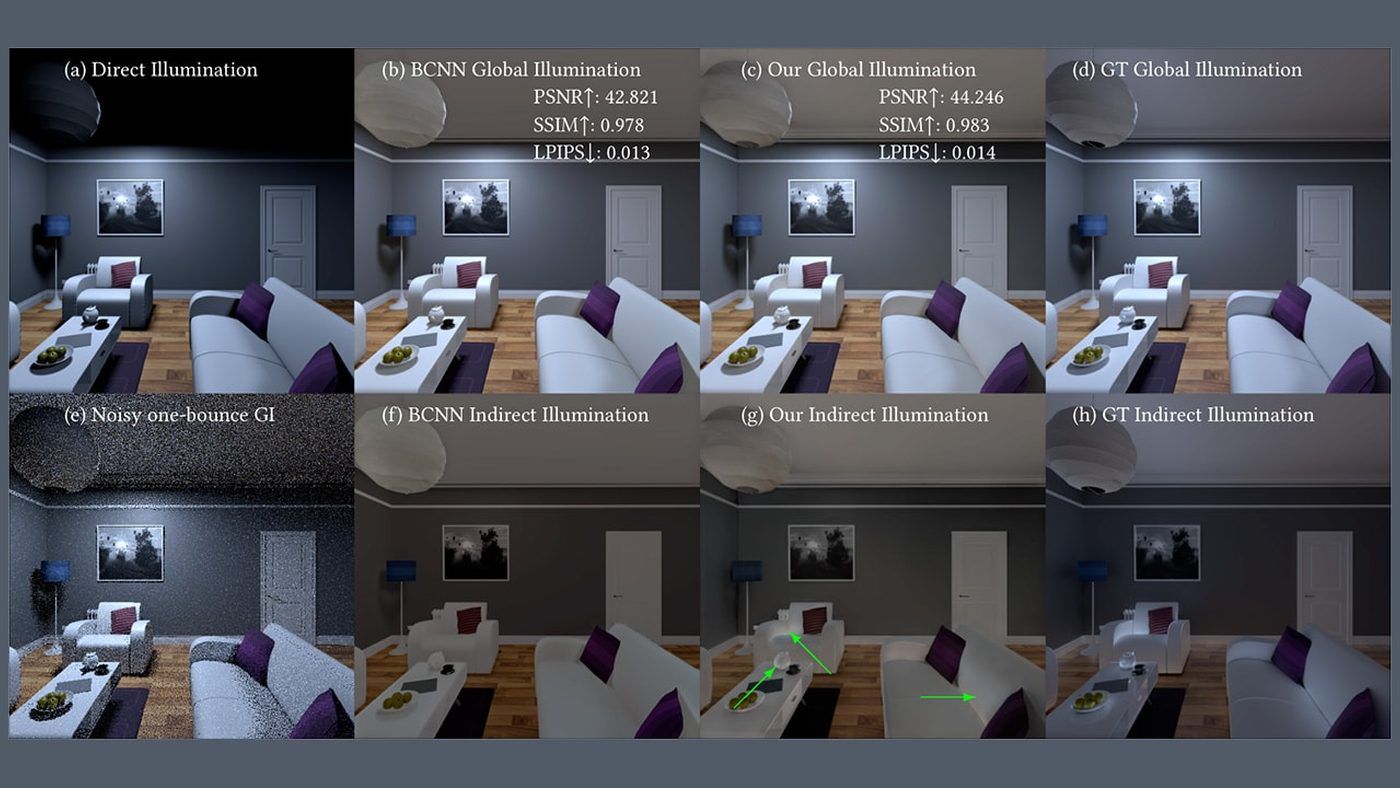
The best argument in favor of the rumor does not come from another leaker. It comes from GPUOpen. At SIGGRAPH 2026, AMD researchers presented a lightweight model for indirect lighting reconstruction. It combines camera-visible buffers with reflective shadow maps rendered from light sources. The result: the network also receives information about off-screen surfaces, those that a purely screen-space method often misses.

Recherche AMD sur la reconstruction neuronale de l’éclairage indirect présentée à la SIGGRAPH 2026 Click to enlarge

The prototype has 2.19 million parameters and requires 432 GFLOPs. In the published test, it runs in 45.56 ms at 512 × 512 on an Instinct MI250 accelerator, in FP32 and without inference optimization. In other words: it is a proof of research, not yet a real-time gaming feature ready to check in Adrenalin . At 60 frames per second, the entire frame must fit within 16.7 ms. The model alone far exceeds this budget in this configuration.

The fact remains that the method exactly addresses the problem mentioned in the leak: to reconstruct a plausible indirect light without launching enough rays to melt the framerate. The intellectual bridge is obvious. The product bridge, however, remains to be built.

A second paper goes even further

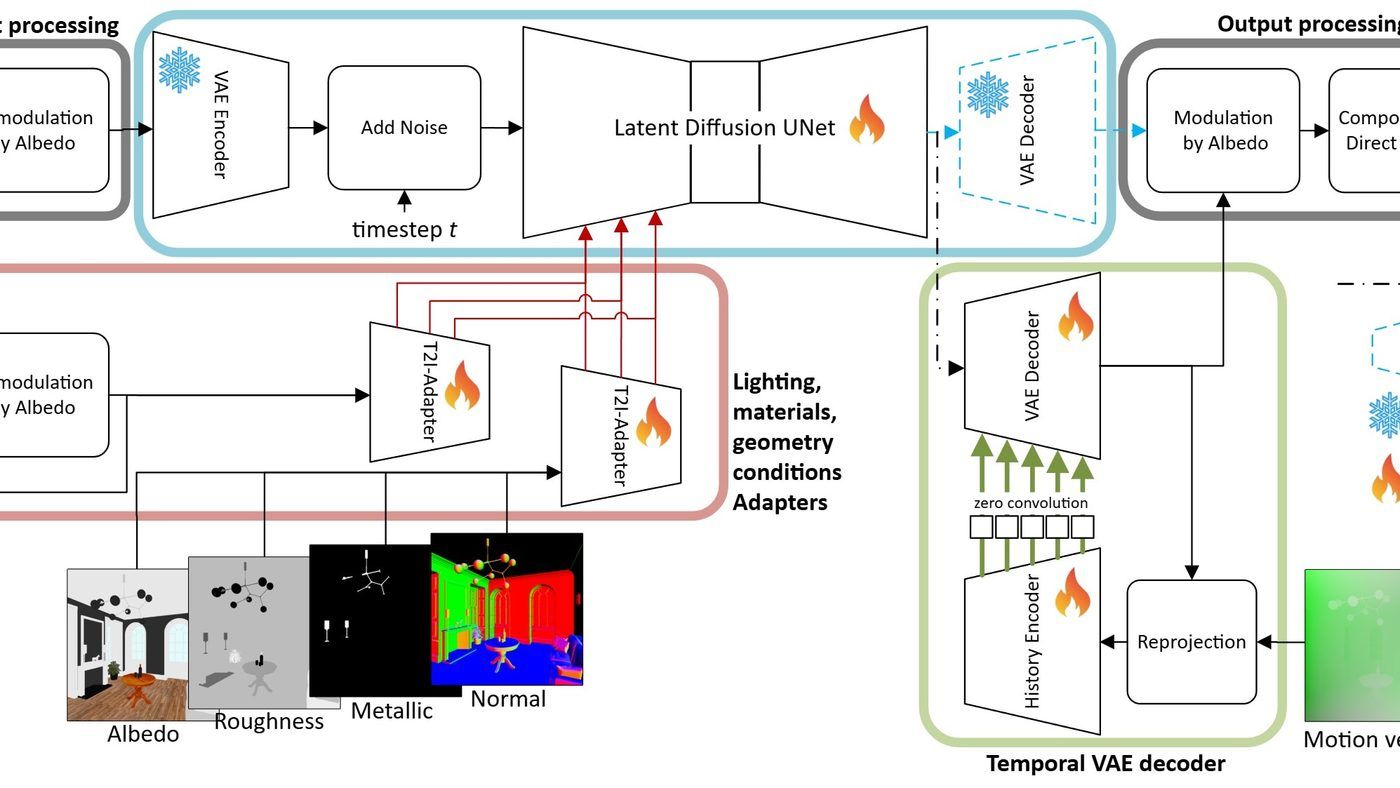
AMD has also released for ECCV 2026 a "generative illumination" model with latent diffusion in a single step. It starts from direct lighting, normals, albedo, roughness, materials, and some light cues. A temporal decoder reuses the previous image with the motion vectors to limit flickering.

Schéma AMD du modèle de generative illumination stable dans le temps Click to enlarge

It is clearly more structured than an image generator running free. The geometry and properties of materials serve as safeguards. AMD also acknowledges that classic diffusion models can hallucinate or overexpose the scene, then shows how its control inputs reduce these flaws.

But again, no shortcut. This paper does not mention RDNA 5 and does not name anything Neural Lighting. It shows that AMD has been working on the subject for several years. It does not prove that a consumer Radeon will execute this model as is.

DLSS 5 no longer just creates pixels

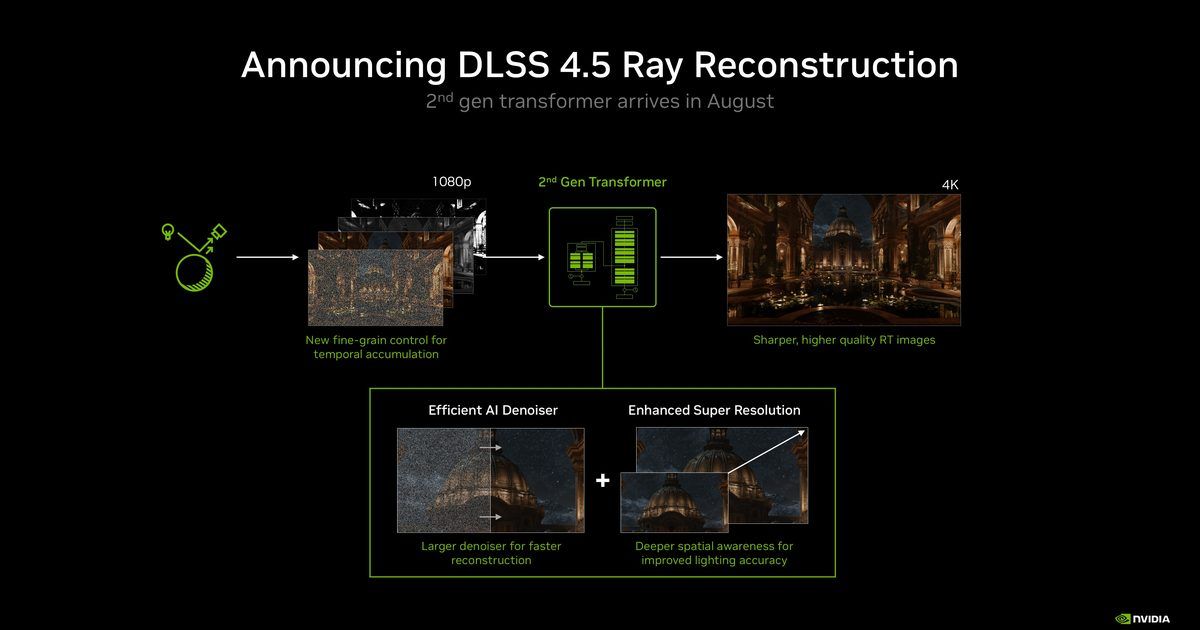
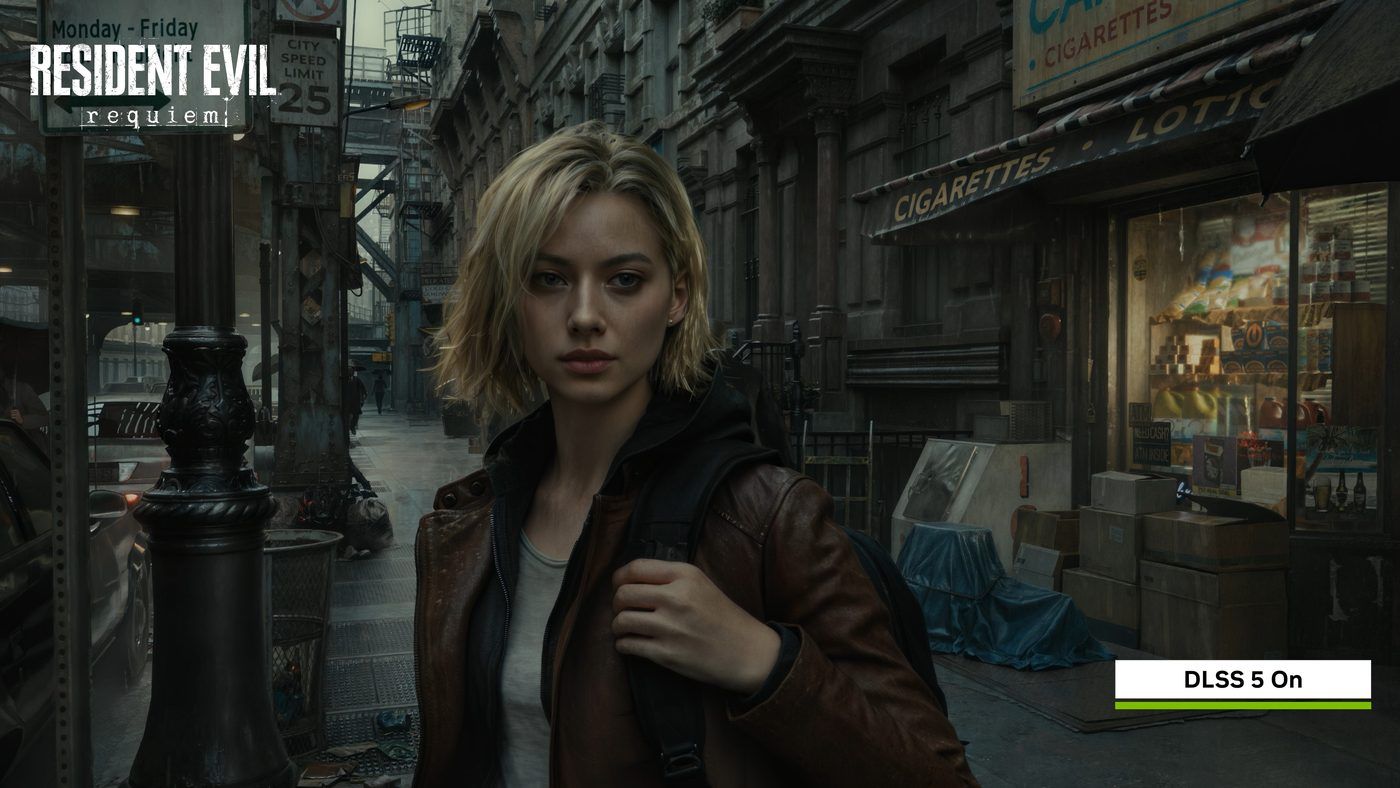
NVIDIA has already crossed the stage of commercial demonstration. DLSS 5 takes the color and motion vectors of each frame, then applies a model trained to understand faces, hair, fabrics, translucent skin, and lighting conditions. Developers have intensity, colorimetry, and mask settings. NVIDIA refers to "3D-Guided Neural Rendering" because the result must remain tied to the 3D content and stable from one image to the next.

NVIDIA DLSS 5 Neural Rendering activé dans Resident Evil Requiem Click to enlarge

The change is significant: DLSS is no longer just a performance tool. It retouches lighting and material rendering. This is precisely what divides. When the result respects the studio's intention, the image can achieve stunning realism. When the model imposes its idea of "natural," a face changes, the skin becomes waxy, or a deliberately stylized atmosphere gets smoothed out. That's where it gets stuck.

Kepler_L2 proposes to separate the lighting model from the model responsible for complex surfaces and to eliminate the color grading step. This is an interesting technical critique, not proof that AMD has already chosen this division.

Compared point NVIDIA DLSS 5 AMD Neural Lighting
Status Official technology, already shown and integrated into games Rumor from Kepler_L2; no AMD announcement
Objective Improve lighting, materials, characters, and final rendering Indirect lighting / global illumination according to the leak
Known inputs Color, motion vectors, and developer controls Unknowns; AMD research uses geometry, materials, and light indices
Integration NVIDIA Streamline, settings by artists No SDK or integration path announced
Hardware RTX 50 at launch; RTX 40 extension announced RDNA 5 likely according to the leaker, without confirmation
Main risk GPU cost and alteration of visual style Delay, hardware exclusivity, and limited game support
Possible advantage Mature ecosystem and software lead Richer engine data if AMD follows this path
Swipe to view more

Can RDNA 5 really catch up with NVIDIA?

In terms of ideas, yes. AMD is not starting from scratch and its GPUOpen work is serious. Providing the model with scene information rather than asking it to guess each surface from the final image can reduce hallucinations. The separation between light and materials can also give artists more control. On paper, this is even the approach that many players would prefer.

AMD's problem has never been solely the algorithm. It requires hardware capable of running the network without slaughtering the FPS, an easy-to-integrate SDK, tested profiles on dozens of games, and strong relationships with studios. NVIDIA has been pushing Streamline and DLSS since 2018. Eight years of tools, documentation, and field feedback do not disappear just because a research paper is clever.

And the calendar stings. DLSS 5 is already here in 2026. If RDNA 5 arrives at the end of 2027 or in 2028, AMD will have to aim for the version of NVIDIA available at that time, not the one from today. Catching up to a moving target remains the real challenge.

Why an RDNA 5 exclusivity would be credible

Running DLSS 5 on a current Radeon with mods gives an idea of the computing wall, even if this hack obviously does not measure an optimized AMD implementation. On an RX 9070 XT, reported tests fall below 20 FPS in certain scenarios. This is not proof that RDNA 4 is incapable of neural lighting. It is proof that you cannot carry a heavy NVIDIA model on another architecture without paying a hefty price.

RDNA 5 is precisely expected with more matrix capabilities and dedicated hardware for more ambitious ray tracing. These elements also remain in the rumor column. AMD could offer a full version on the new generation and a reduced mode on RDNA 4, just as NVIDIA extends certain functions to the RTX 40. Or cut it off completely. We do not have the answer.

For the buyer, the conclusion is simple: do not buy a 2026 card imagining that it will receive Neural Lighting later . No commitment guarantees it. A RX 9070 XT must be chosen for its performance, its VRAM, and the features it has today.

Choose your delivery country to see prices based on your location

Filters

RTX 5080

RTX 5080

56 Listed Products

Starting at

$1,370

RTX 5060 Ti

RTX 5060 Ti

49 Listed Products

Starting at

$449

RTX 5070 Ti

RTX 5070 Ti

38 Listed Products

Starting at

$1,000

RTX 5060

RTX 5060

36 Listed Products

Starting at

$359

9070 XT

9070 XT

35 Listed Products

Starting at

$690

9070

9070

28 Listed Products

Starting at

$278

9060 XT

9060 XT

28 Listed Products

Starting at

$450

RTX 3080

RTX 3080

23 Listed Products

Starting at

$680

RTX 3070

RTX 3070

23 Listed Products

Starting at

$444

RTX 3060

RTX 3060

21 Listed Products

Starting at

$245

RTX 5070

RTX 5070

21 Listed Products

Starting at

$670

RTX 3090

RTX 3090

18 Listed Products

Starting at

$1,830

RTX 3050

RTX 3050

16 Listed Products

Starting at

$241

RTX 3060 Ti

RTX 3060 Ti

14 Listed Products

Starting at

$400

6600 XT

6600 XT

13 Listed Products

Starting at

$350

RTX 3070 Ti

RTX 3070 Ti

13 Listed Products

Starting at

$410

RTX 4060

RTX 4060

12 Listed Products

Starting at

$530

6900 XT

6900 XT

12 Listed Products

Starting at

$719

RTX 2060

RTX 2060

11 Listed Products

Starting at

$259

RTX 4070 Ti

RTX 4070 Ti

11 Listed Products

Starting at

$1,000

RTX 4080 Super

RTX 4080 Super

11 Listed Products

Starting at

$1,099

7600

7600

10 Listed Products

Starting at

$320

RTX 4080

RTX 4080

10 Listed Products

Starting at

$1,500

RTX 4060 Ti

RTX 4060 Ti

10 Listed Products

Starting at

$460

6700 XT

6700 XT

9 Listed Products

Starting at

$649

RTX 4070

RTX 4070

9 Listed Products

Starting at

$765

RTX 2080

RTX 2080

9 Listed Products

Starting at

$406

RTX 3080 Ti

RTX 3080 Ti

9 Listed Products

Starting at

$965

RTX 3090 Ti

RTX 3090 Ti

8 Listed Products

Starting at

$2,149

GTX 1650

GTX 1650

7 Listed Products

Starting at

$264

GTX 1660 Super

GTX 1660 Super

7 Listed Products

Starting at

$218

6500 XT

6500 XT

7 Listed Products

Starting at

$208

RTX 5050

RTX 5050

7 Listed Products

Starting at

$310

7800 XT

7800 XT

7 Listed Products

Starting at

$720

RTX 5090

RTX 5090

7 Listed Products

Starting at

$6,118

6800 XT

6800 XT

6 Listed Products

Starting at

$795

RTX 4090

RTX 4090

6 Listed Products

Starting at

$4,100

RTX 2080 Ti

RTX 2080 Ti

6 Listed Products

Starting at

$669

RTX 4070 Super

RTX 4070 Super

5 Listed Products

Starting at

$799

GTX 1660 Ti

GTX 1660 Ti

5 Listed Products

Starting at

$241

7900 XT

7900 XT

5 Listed Products

Starting at

$850

GTX 1050 Ti

GTX 1050 Ti

4 Listed Products

Starting at

$264

RTX 4070 Ti Super

RTX 4070 Ti Super

4 Listed Products

Starting at

$1,364

RTX 2080 Super

RTX 2080 Super

4 Listed Products

Starting at

$670

B570

B570

4 Listed Products

Starting at

$260

6600

6600

4 Listed Products

Starting at

$93

GTX 1660

GTX 1660

3 Listed Products

Starting at

$224

A750

A750

3 Listed Products

Starting at

$210

6750 XT

6750 XT

3 Listed Products

Starting at

$559

RTX 2070

RTX 2070

2 Listed Products

Starting at

$665

RTX 2060 Super

RTX 2060 Super

2 Listed Products

Starting at

$575

6950 XT

6950 XT

2 Listed Products

Starting at

$1,190

B580

B580

2 Listed Products

Starting at

$611

7900 GRE

7900 GRE

2 Listed Products

Starting at

$990

6800

6800

2 Listed Products

Starting at

$630

7600 XT

7600 XT

1 Listed Products

Starting at

$695

6400

6400

1 Listed Products

Starting at

$303

RTX 2070 Super

RTX 2070 Super

1 Listed Products

Starting at

$795

7900 XTX

7900 XTX

1 Listed Products

Starting at

$1,690

7700 XT

7700 XT

1 Listed Products

Starting at

$749

A770

A770

1 Listed Products

Starting at

$595

The consoles could accelerate the movement

The rumors surrounding a unified UDNA architecture place the next generation AMD at the heart of future Radeon but also consoles. Sony is already working with AMD on Project Amethyst, with a clear focus on machine learning and ray tracing. Microsoft is also communicating about neural rendering for its next hardware.

If a common base equips PC, PlayStation and Xbox, studios will have a good reason to integrate compatible buffers and rendering paths. This is probably AMD's best card. Not because consoles guarantee technical success, but because they can turn a minority Radeon option into a cross-platform feature planned from the engine's design.

Be careful though: neither Sony nor Microsoft has confirmed Neural Lighting. Mixing their official work with the name that came from a forum would make a nice story, but bad information.

Our verdict on September 17, 2026

AMD owns the research bricks. NVIDIA already owns the product, the games, and the ecosystem. This is the balance of power, without smoke and mirrors. Neural Lighting could become a more data-respectful response to 3D and artistic direction. For now, it is mainly an unofficial name attached to two excellent scientific papers.

RDNA 5 can catch up with NVIDIA on a specific feature. Catching up the entire DLSS stack in 2027 or 2028 will be much harder. AMD will need to deliver good performance from the first driver, several solid games, and simple integration. A lab demo at 512 × 512 will not be enough.

The leak deserves to be followed. Not to be taken at face value.

FAQ on AMD Neural Lighting and RDNA 5
Has AMD announced Neural Lighting?

No. The name and its association with RDNA 5 come from Kepler_L2 on the AnandTech forum. AMD has not released any product statement regarding this.
Is Neural Lighting the future FSR 5?

We do not know. The technology could join a future version of FSR, another SDK, or remain a research project. The name FSR 5 is not confirmed in this context.

What is the difference with DLSS 5?

DLSS 5 is an official NVIDIA product that enhances lighting, materials, and characters based on the rendered frame and temporal data. Neural Lighting would aim more at global illumination and could leverage deeper 3D data, but this architecture remains hypothetical.

Will the Radeon RX 9000 be compatible?

Nothing indicates it. Kepler_L2 thinks that the load will be heavy enough to reserve the function for RDNA 5. AMD has not provided any compatibility list.

When will the RDNA 5 cards be released?
Leaks talk about 2027, with a risk of slipping to 2028. AMD has announced neither date, nor commercial name, nor corresponding Radeon range.

What sources allow to verify this information?

The primary discussion is on the forum AnandTech . The two AMD works are available on GPUOpen : Lightweight attention-based indirect illumination and Temporally stable generative illumination . The official description of DLSS 5 has just been NVIDIA . The leak has been cross-referenced with TweakTown and Club386.