TCG Card Shop Simulator 1.0: 10 tips to succeed in your shop

TCG Card Shop Simulator 1.0 TCG shop tips Tetramon guide

Price, layout, employees, boosters, and tournaments: 10 concrete tips to launch your shop in TCG Card Shop Simulator 1.0.

What version 1.0 really changes

TCG Card Shop Simulator has finally exited its early access. The big highlight of this version 1.0 is Tetramon Duel Master : the cards you used to collect for their price now serve to build a real deck and face other players. Tournaments therefore take on a different dimension. Your shop remains the heart of the game, but selling all your good cards without thinking can now handicap you.

The official launch is set for September 15, 2026. The French Steam page shows September 14, a simple shift related to the online launch time. The update also brings new maps and decorations. The official guide published by Xbox details decks of 50 cards, a limit of four copies per name, four elemental zones, and 500 Tamer points at the start.

Click to enlarge

No need to turn your shop into a factory from day one. The ten tips below aim for something much more useful: keeping a clean cash flow, automating chores at the right time, and enjoying the 1.0 novelties without sacrificing your business.

1. Do not enlarge the shop as soon as the button appears

An empty extension brings in nothing. It mainly ties up the money that was supposed to pay for the next boxes. At first, keep a compact shop with a few well-stocked shelves, a cash register, and only the game tables that you really use. It's less pretty than a large store, but significantly more profitable.

Wait to have several days of stock in advance and a cash register capable of absorbing a large order before buying square meters. A safety reserve equivalent to two or three complete restocks avoids the classic scenario: you expand, you set up new furniture, then you have no cash to put products on it.

In short: stock before walls.

The extension becomes relevant when the aisles are truly saturated, when customers are waiting due to lack of space or when your assortment no longer fits on the displays. Not before. The store level rises anyway thanks to sales; no need to force growth on credit.

2. Aims for the market price increased by about 10 %

The market price is your starting point, not a decoration. For boosters, boxes, and accessories that sell well, a markup close to 10 % generally offers a good compromise between margin and volume. Then round to a readable amount. An item priced at 18.40 can for example go for 20 rather than 20.24.

Avoid pushing the entire catalog up by +20% just because a few customers agree. Refusals cost you revenue and slow down stock rotation. Conversely, selling below market only makes sense to clear a slow reference or quickly recover cash flow.

Values are changing. Take the labels again after a day change or when you notice a wave of refusals. Version 1.0 also displays price tracking tools for the cards: use it to spot a rise before selling a rare item at a bargain.

3. Never let your loss leaders drop to zero

A shop full of rare displays but without affordable boosters drives away revenue. Cheap products attract small budgets, fill baskets, and often come back in customer requests. So keep at least one spot for each popular item that you can restock without pain.

In the evening, look at the empty spaces rather than the gross sales. A shelf that empties before closing deserves more facings or an extra box in reserve. A product still full after three days can lose space. It's silly, but this visual reading is more reliable than a selection decided once and for all. When money is tight, buy first what sells quickly; the large boxes and expensive accessories will come later. A profitable box on paper is useless if it sits in the reserve for a week.

4. Shorten the journey between storage, shelf, and checkout

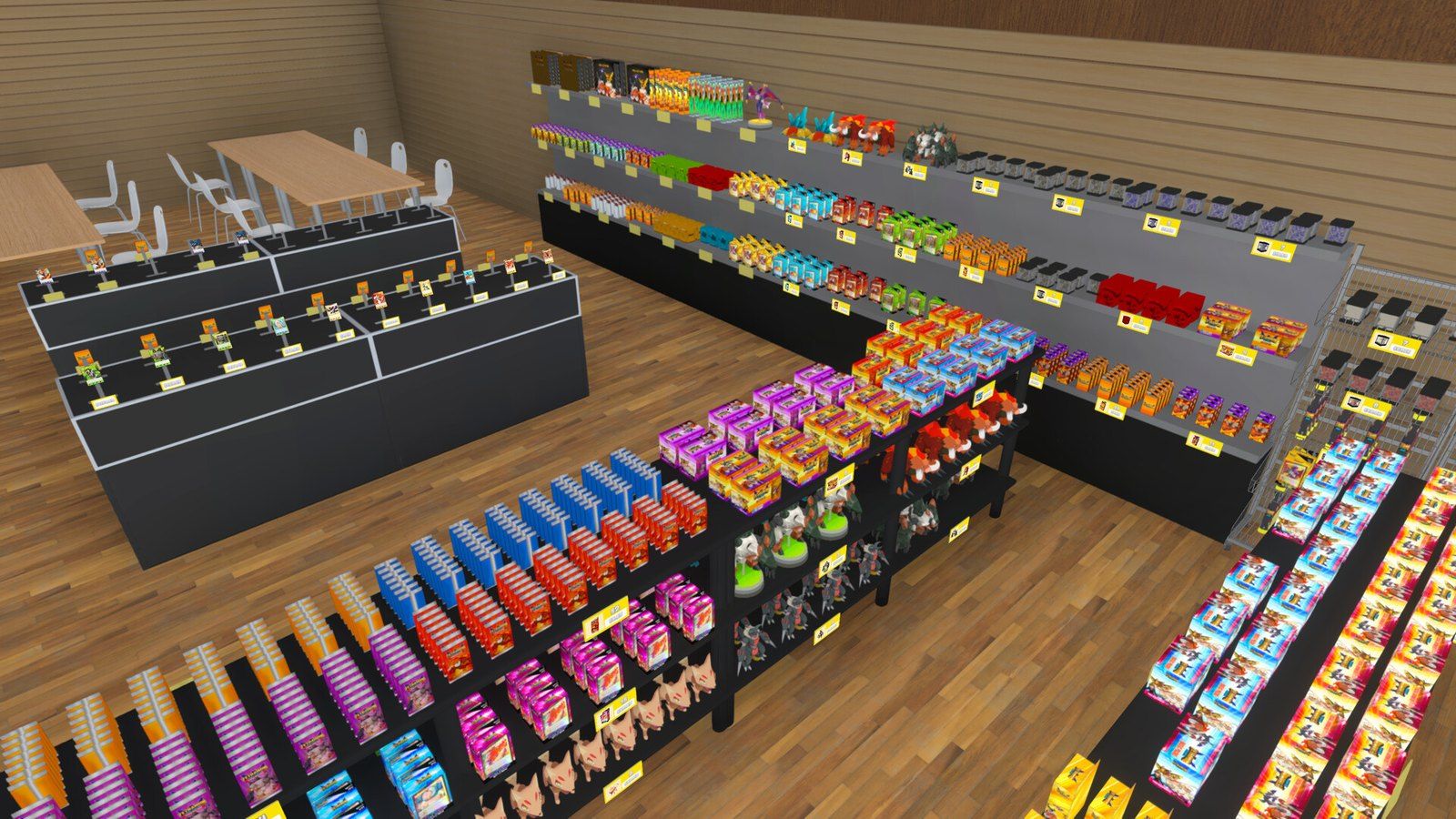
The best layout is not the one that looks the most realistic. It is the one that avoids twenty trips back and forth to put away a box. Place the reserve shelves behind or near the corresponding aisles, group the products by family, and leave wide enough passages for customers and employees to pass each other without blocking.

Click to enlarge

The cash register must remain close to the exit, but without blocking the entrance. The gaming tables can occupy the back or one side of the store: players sit for a long time, they have no reason to monopolize the area where all the buyers pass. The individual card displays, on the other hand, benefit from being visible and easy to restock.

Test the layout for a full day before repurchasing furniture. If your restocker crosses the entire store for each box, move the stockroom. If he waits because a customer is blocking an aisle, widen it. Two well-used meters are better than a new extension.

5. Your first good employee must handle the cash register

Hiring too early can sink a small shop. A slow employee costs money without eliminating your main bottleneck. Wait for the lines to become regular and for the business to generate enough to pay the salary without touching the restocking budget.

Then, prioritize choosing a fast employee at the checkout. Each customer processed frees up a spot for the next one, while you can place orders, organize the cards individually, and respond to exchanges. Don't assign him a secondary task that sends him to the other end of the store at the worst moment. The second useful position is restocking. Here, there's no need to aim for the most expensive employee right from the start: an average employee does the job if the stockroom is close and well sorted. When you unlock the card storage, also give him the task of filling the singles tables as a secondary task.

6. Get the team to work before opening

At 8 o'clock, your employees can start tidying up while the shop's sign is still closed. Take advantage of this downtime. Let them empty the boxes from the day before, restock the displays with cards, and recharge the devices before starting the day.

This routine becomes frankly profitable as soon as you have several aisles. Opening with ten empty spots forces the team to run while customers are already taking the last items. Opening five minutes later, but with a full store, gives a much cleaner pace.

Also prepare the orders in the evening. The boxes arrive, you store them in reserve and the employee finishes in the morning. The player thus keeps their active time for the decisions that matter: prices, purchases, exchanges, and tournament management.

7. Treat hygiene as a flow issue

Smelly customers are not just a joke in the game. They can annoy other visitors and disrupt traffic around the tables. Place two automatic dispensers near the entrance to cover the passage when one of the devices is recharging. In a large store, add a second area near the tables.

Keep spare refills in reserve and assign their management to an employee as soon as the task is available. An empty diffuser is obviously useless, and it can easily be forgotten among the boosters. Check its stock with the other consumables before opening. The same logic applies to the aisles: the less cluttered they are, the less a troublesome customer blocks the entire store. You are looking for throughput, not a perfect photo for Instagram.

8. Open boosters with a separate budget

Cracking packs is fun and earns experience, but it's not your working capital. Set a dedicated envelope after restocking, salaries, and bills. If you have to choose between ten boxes to sell and ten boxes to open, the store's stock comes first.

Once the cash flow is solid, opening up in volume becomes more interesting. Sell the mid-value cards that are performing well, keep the big pulls until you understand their utility, and turn the commons that are accumulating into lots thanks to the workbench. These bundles may not be dream-worthy, but they recover part of the money tied up in hundreds of duplicates.

Manual opening provides more experience than automation, at the cost of a lot of time. Machines are mainly useful when the business is already running without you. Buying a machine too early and ending up dry is the perfect trap.

9. Keep a core of playable cards for Tetramon

Before 1.0, selling an expensive card was almost always tempting. Now, start by checking if it fits in your deck. Tetramon Duel Master imposes 50 cards and a maximum of four copies of the same name. So set aside a coherent core before exposing the duplicates.

The board has four basic zones: Fire, Earth, Water, and Wind. The attack power combines the strength of the Tetramon and that of the zone where you place it. An average card in the right place can perform better than a rare card played carelessly. Evolutions also require their base form; selling all your commons can break an entire chain.

Each player starts with 500 Tamer points and places four cards face down in their Guardian zone. When the points drop below 400, 300, 200, and then 100, a Guardian card joins the hand. So do not empty all your resources to deal the first damage: the opponent gradually regains return options.

10. Only launch tournaments when the shop can handle them

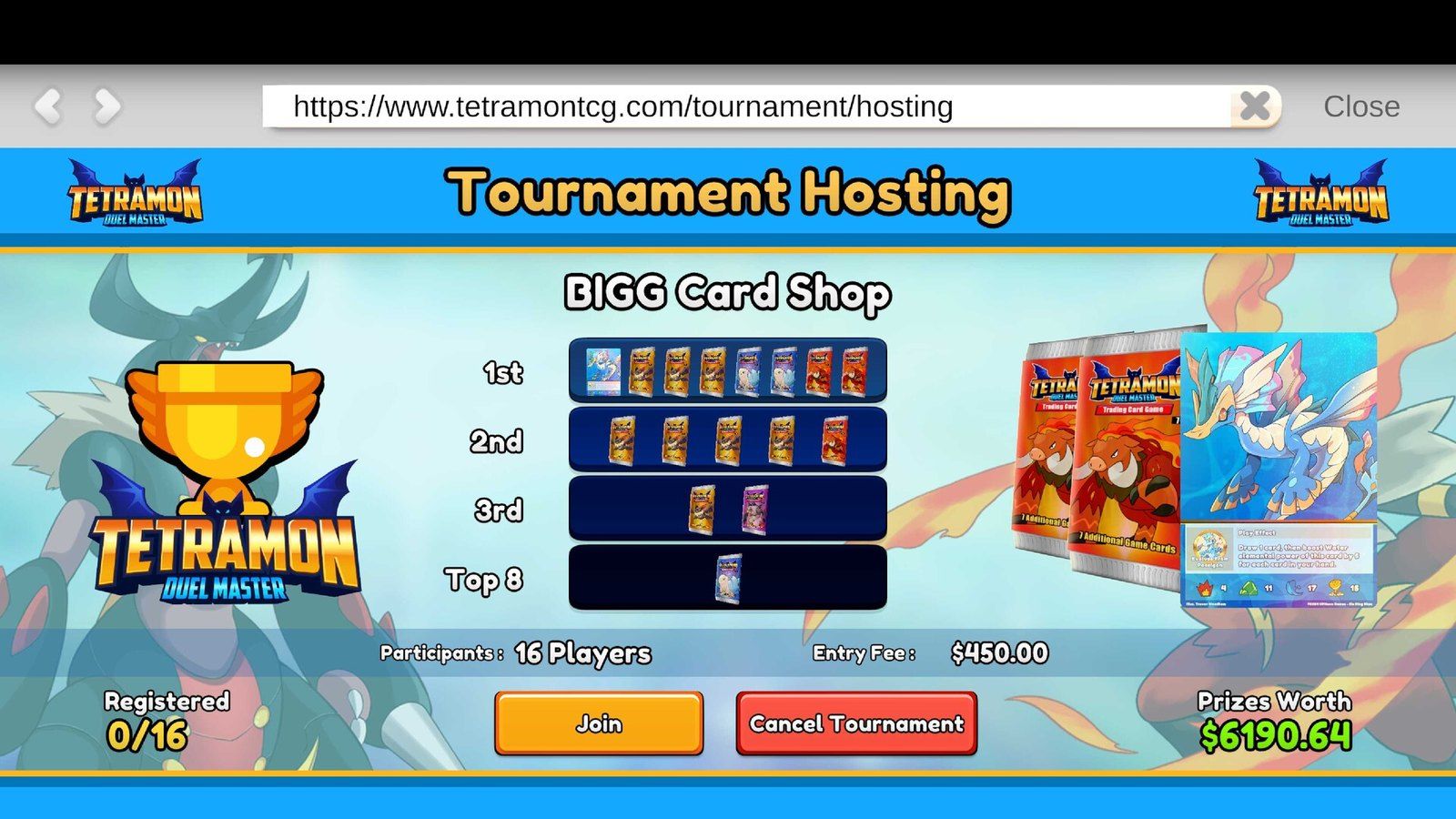
A tournament can pay off big, but it takes up space, tables, and sometimes valuable cards as rewards. Start small. The tournament update requires preparing the dedicated application, numbering the tables, and placing the rewards on the Prize Shelf. Also check that the sales activity continues during the event and that players do not block the checkout or the most profitable aisles.

Always calculate the break-even point before validating: registration fees multiplied by the number of participants, minus the actual value of the prizes and the lost earnings related to the space occupied. A beautiful deficit tournament remains a deficit. Keep the impressive rewards for formats capable of attracting enough players.

Otherwise, postpone. There is no shame in preferring a big sales day to a poorly prepared event.

The novelty of 1.0 makes these events more interesting because you can also prepare your own deck and play. But don't mix everything up. Plan a commercial stock, a personal collection, and a reserve of lots. Three separate boxes, three clear uses, many fewer cards sold by mistake.

Moment To be checked Quick decision
Before opening Aisles, stock, displays, prices Let employees finish restocking
Midday Checkout line and empty spots Move a task or order a box
Before a tournament Free tables, lots, registrations Postpone if the store is already saturated
After closing Out of stock products and slow sales Increase facings or free up space
Before opening packs Cash after expenses and stock Use only the booster budget
Swipe to view more

The most profitable routine takes just a few minutes

In the morning, let the team fill the shelves before opening. During the day, especially monitor the cash register and stockouts. In the evening, order what has really sold and adjust the prices of the items whose market has changed. Nothing spectacular. Just a store that doesn't trip itself up.

For Tetramon, first build a legal deck of 50 cards with its bases and evolutions. The four allowed copies improve consistency, but there's no need to force four copies everywhere. A starting hand contains five cards and you have a complete mulligan. If it doesn't launch any game plan, return it rather than hoping for a miracle on the next draw.

Tournaments come next, when the shop can absorb the cost of the prizes and the additional traffic. This is the real lesson of this 1.0: the game gives you more ways to use your cards, thus more ways to waste your money. Keep separate accounts and you will enjoy the new features without ruining the shop.

FAQ on TCG Card Shop Simulator 1.0

Should all rare cards be sold?

No. Keep at least the useful cards for your Tetramon deck, the bases necessary for evolutions, and the copies you want to reserve for tournaments. Sell the duplicates beyond the limit of four copies or the cards that do not serve your strategy.

What percentage to add to the market price?

About 10 % is a simple adjustment to start. Increase or decrease according to the rejections and the rotation speed. Very expensive cards require more caution: a few percent already represent a large amount.

When to hire the first employee?

When the checkout line or restocking regularly prevents you from managing orders and cards. If the salary forces you to reduce stock, it's too early. The first good hire is usually a fast cashier.

How many cards are needed in a Tetramon deck?

A deck contains 50 cards, with a maximum of four copies for each name. The starting hand consists of five cards and each player is entitled to a complete mulligan before the start of the duel.

Are tournaments more profitable than sales?

They can be, especially with a lot of participants and well-calculated registration fees. But they take up space and consume lots. If your shop is already lacking tables or stock, the classic sale remains safer.

What are the sources used?

The rules of Tetramon come from the official Xbox guide published on August 17, 2026. The date and commercial functions are cross-referenced with the Steam page of TCG Card Shop Simulator. The management tips are based on the mechanics observed in recent versions and on the community guide of Amiibo Doctor updated to v0.70.3.