yuux
Co-founder of DropReference, I'm here to give you the best tips to build the gaming PC of your dreams!
yuux
Co-founder of DropReference, I'm here to give you the best tips to build the gaming PC of your dreams!
AMD unveiled its complete roadmap at Advancing AI 2026. Zen 7 in 2028-2029, then the curtain falls for AM5. But don't panic: your platform still has many good years ahead of it.
July 22, 2026, San Francisco. AMD unveils its CPU roadmap at the Advancing AI 2026 , and we discover the complete sequence: Zen 6 in 2027, Zen 7 in 2028-2029, Zen 8 in 2030. Three generations. The thing we didn't see right away in the slides is the line at the bottom of the table. The one that says "AM5" next to Zen 7. And nothing next to Zen 8.
Translation: Zen 7 will be the latest generation Ryzen compatible AM5 . After, it's a new socket. New chipset. New motherboard. Everything.
Before panicking and selling your B650 on Leboncoin, take a deep breath. Because the situation is much more reassuring than it seems — and AM5 still has many beautiful years ahead of it.
 Click to enlarge
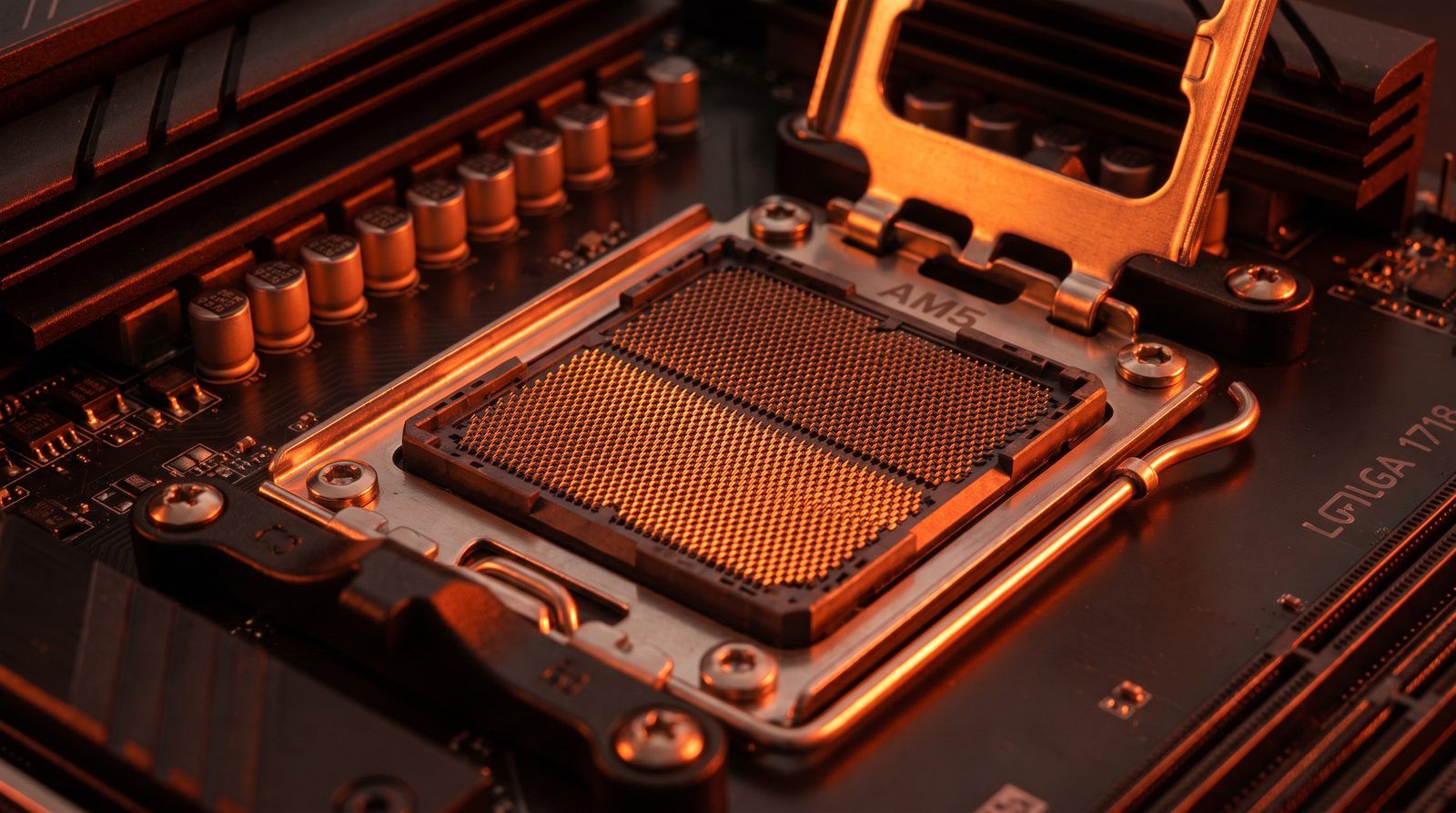
September 2022. AMD launches the Ryzen 7000 (Zen 4) on a brand new LGA 1718-pin socket, named AM5. DDR5 mandatory, PCIe 5.0, end of the pin grid array — switching to LGA like Intel. At the time, the promise: "we support AM5 until at least 2025."
2025 is short, we had said. Except that AMD extended the sauce. Twice.
Seven years of support for a desktop socket. This is unprecedented at AMD - and downright unthinkable at Intel, which changes sockets every two years on average. As a reminder, AM4 lasted from 2017 to 2022 with four generations (Zen, Zen+, Zen 2, Zen 3). AM5 does the same, or even better.
| Generation | Architecture | Year | Process | Socket |
|---|---|---|---|---|
| Ryzen 7000 | Zen 4 | 2022 | TSMC 5nm | AM5 |
| Ryzen 9000 | Zen 5 | 2024-2025 | TSMC 4nm / 3nm | AM5 |
| Ryzen 10000 (Olympic Ridge) | Zen 6 | 2027 (expected) | TSMC 2nm | AM5 |
| Ryzen 11000 (?) | Zen 7 | 2028-2029 (expected) | TSMC 2nm advanced (?) | AM5 (latest gen) |
| Ryzen 12000+ (?) | Zen 8 | 2030+ | Unknown | AM6 or new socket |
We are in July 2026. Zen 6 hasn't even been released yet — the Ryzen 10000 "Olympic Ridge" are expected to arrive in early 2027. So, Zen 7 is still quite unclear. But we can piece together quite a few things.
Concretely, if you buy an AM5 motherboard today - let's say an X870E or even a B650 -, you will be able to theoretically upgrade your CPU until 2028-2029 without changing platform. That's something.
OK but why not Zen 8 also on AM5? Good question. The answer lies in three letters and a number: DDR6 .
DDR6 is expected for 2028-2029 in final specification (JEDEC), with the first consumer modules around 2030. And here, it's the same scenario as AM4 → AM5: when memory changes, the socket must follow. The memory controller integrated into the CPU must be redesigned, the number of pins changes, the routing on the motherboard as well.
In short, it's not just AMD wants abandon AM5. That's what physics dictates. And frankly, 4 generations of CPUs on the same socket (Zen 4, 5, 6, 7) with 7 years of support is a record in the industry.
People who knew AM4 know: it was the good times. You bought a B450 in 2018, you could upgrade up to the 5800X3D in 2022 without changing the motherboard (with a BIOS update, of course). Four generations, five years. The absolute record at AMD at the time.
AM5 does even better. Judge for yourself:
| Criterion | AM4 | AM5 |
|---|---|---|
| Lifespan | 2017-2022 (5 years) | 2022-2029 (7 years) |
| CPU Generations | 4 (Zen → Zen 3) | 4 (Zen 4 → Zen 7) |
| Memory Type | DDR4 | DDR5 |
| PCIe max | 4.0 | 5.0 |
| Latest CPU | Ryzen 7 5800X3D (2022) | Zen 7 (2028-2029) |
| Number of chipsets | 8 (A320→X570) | 9+ (A620→X870E) |
Spoiler: not much for now. But it's worth clarifying things.
You still have three possible upgrades in front of you: Zen 5 (available now), Zen 6 (2027) and Zen 7 (2028-2029). Your B650 or X670 motherboard has bright days ahead. The best advice? Wait for the Zen 6 Olympic Ridge in early 2027 — the switch to 2nm should bring a real performance leap.
Two upgrades remaining. You're in a good position. No need to move before 2028 at the earliest, unless you're the type who wants the latest CPU. The 9800X3D remains a monster in gaming, and will be for another two years easily.
This is the best time to take the plunge. AM5 motherboards are mature (good BIOS, stabilized prices), Ryzen 9000 are excellent, and you know that your platform will hold until at least 2029. Where an AM4 buyer today finds themselves in a complete deadlock.
Will need to be patient. We're talking about 2030 at the earliest. And the first generations of the new socket are always a bit of a hassle (unstable BIOS, early-adopter DDR6 compatibility, high launch prices). Remember the chaotic launch of AM5 at the end of 2022 - DDR5 cost an arm and the performance wasn't up to par compared to AM4 in the first few months.
AMD did not exactly say these words, but the roadmap presented at Advancing AI 2026 shows Zen 7 as the last architecture listed under AM5. Zen 8 appears without mention of a socket, clearly implying a platform change. And the extended AM5 support until 2029 fits perfectly with a Zen 7 in 2028-2029.
Now. The platform is mature, prices are reasonable, and you will have at least 2-3 CPU upgrades ahead of you. Waiting for AM6 means waiting for 2030 - that's in 4 years.
If AMD follows the same pattern as AM4, yes — with a BIOS update. The B650/X670/B850/X870E boards should all be compatible. AMD has historically managed socket backward compatibility well (although some entry-level boards like the A620 may not support the high TDPs of Zen 7).
The JEDEC DDR6 specifications are expected for 2028-2029. The first consumer modules should arrive around 2030-2031, at the same time as the AM6 platforms (AMD) and a new Intel socket. This means that your DDR5 modules still have at least 3-4 years of relevance.
Different philosophy. Intel has long used socket change as a commercial lever (you want the new CPU? Buy a new motherboard). AMD, since AM4, plays the loyalty card: you invest in the platform, you upgrade the CPU without changing everything. It works — it's one of the arguments that has convinced many gamers to switch to AMD. And with AM5, they push the concept even further.
AM5 is going to die. But not before 2029, and not before having welcomed four generations of processors. If you buy or are already on AM5 in 2026, you made the right choice. Enjoy the platform, upgrade when you feel like it, and when Zen 8 and DDR6 arrive in 2030, you will have gotten your money's worth.
And by then, we will probably have seen Ryzen with 24 cores and 256 MB of 3D cache. But that's another story.